The New York Times has published what it clearly believes is a definitive investigation into the identity of Satoshi Nakamoto, the pseudonymous creator of Bitcoin. The conclusion: Adam Back, the British cryptographer and CEO of Blockstream, is the man behind the mask. The evidence? A cocktail of linguistic analysis, timeline coincidences, and the kind of circumstantial reasoning that would make a conspiracy theorist blush.
Let's start with the stylometry, because that's where the Times hangs most of its argument. Stylometry is the statistical analysis of linguistic style. It can be useful in certain contexts, particularly when you have large corpora of text and controlled comparisons. What it cannot do, reliably, is identify a single anonymous author from a pool of technically sophisticated cypherpunks who all read the same papers, used the same terminology, and communicated on the same mailing lists in the late 1990s and early 2000s.
The Methodological House of Cards
The Times hired a firm to analyze Satoshi's known writings, the Bitcoin whitepaper, forum posts, and emails, against samples from various suspects. Adam Back, we're told, scored highest on certain metrics. What metrics? The article is vague. How were confounding variables controlled? Unclear. What was the confidence interval? Not mentioned.
Stylometry has a troubled history in high-profile cases. As a technique it is especially ineffective to heavily polluted topics, such as the search for Satoshi. Researchers have repeatedly shown that the technique struggles when applied to technical writing, where vocabulary is constrained by subject matter. When everyone in a field uses phrases like "proof of work" and "hash function," the stylistic fingerprints blur. The cypherpunk mailing list was a small, intellectually incestuous community. Its members shared ideas, syntax, and even grammatical quirks. Finding overlap between any two of them would be trivial.
And yet the Times presents its findings with the confidence of a DNA match.
The Coincidence Engine
Beyond the stylometry, the article leans heavily on temporal coincidences. Adam Back was cited in the Bitcoin whitepaper. Adam Back was active in cryptographic research during the relevant period. Adam Back went quiet on public forums during the months Satoshi was most active.
This is the investigative equivalent of noting that a suspect was in the same city when a crime occurred. It proves nothing except proximity. The cypherpunk community was small. Many people fit these criteria. Hal Finney was cited in the whitepaper and received the first Bitcoin transaction. Nick Szabo developed bit gold, a conceptual precursor. Wei Dai created b-money. All of them have been accused before.
The Times frames these coincidences as revelatory. In reality, they are great examples of selection bias in action. If you start with a suspect and work backward, you will find coincidences - this is inevitable. That's how brains work. It's also how bad investigations work.
Why This Keeps Happening
The identity of Satoshi Nakamoto is catnip for legacy media. It offers the promise of a scoop, a name, a face to attach to an abstract phenomenon. But the obsession reveals more about the media than about Bitcoin. The technology works regardless of who invented it. The protocol is open. The code is auditable. The mystery is, in many ways, the point.
Publications like the Times have tried this before. Newsweek famously identified Dorian Nakamoto in 2014, a retired engineer in California who had no connection to the project. The story fell apart within days. Gizmodo and Wired pointed fingers at Craig Wright, who has since spent years in court trying to prove a claim that most of the Bitcoin community considers fraudulent. Each time, the methodology is the same: find someone who fits the profile, assemble circumstantial evidence, publish with fanfare.
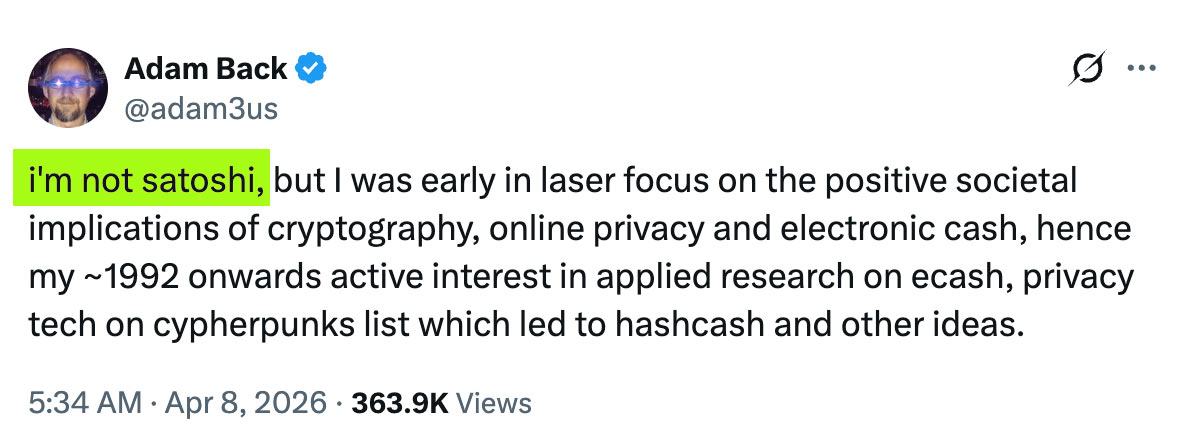
Adam Back has denied being Satoshi. He has done so repeatedly, clearly, and without equivocation. The Times acknowledges this in a single paragraph before steamrolling past it. Denials, apparently, are just what Satoshi would say.
The Limits of Knowing
There is something almost religious about the Satoshi question. It invites speculation precisely because it resists resolution. The Times article will not settle the matter. It will generate traffic, spark arguments on social media, and fade into the archive of discredited claims.
What it will not do is prove anything. Crypto continues to evolve without needing a founder's blessing. The search for Satoshi is not journalism. It is mythology maintenance, and the tools being used are not up to the task.
If Adam Back is Satoshi, the evidence presented here does not establish it. If he isn't, the Times has just added his name to a long list of people accused by institutions that should know better.