The pattern was always there if you knew where to look. In 2017, the crypto industry raised billions of dollars through initial coin offerings, promising revolutionary technology and decentralized futures. In 2026, those same projects are shutting down, consolidating, or watching their token prices collapse to levels not seen since their launches.
More than 20 crypto projects have shut down in Q1 2026 alone, according to BeInCrypto reporting. The closures span wallets, exchanges, NFT platforms, and DeFi tools. These are not scam collapses or rug pulls. These are orderly exits from teams that ran the math and realized they had no path forward.
Cardano's Unraveling
No project better illustrates the 2026 crypto reckoning than Cardano. ADA has dropped below $0.20 for the first time in five years, down roughly 70% over the past year and more than 93% from its 2021 all-time high. Charles Hoskinson, the project's founder, warned in early June that a wave of ecosystem failures is coming. Within days, he announced he was stepping away from social media.
The ecosystem's collapse has been swift. TapTools, Cardano's primary analytics platform, announced it would shut down within two weeks. JPG.store, the ecosystem's largest NFT marketplace, closed permanently in late May. The Cardano Summit 2026 in Singapore was canceled after the community voted against funding the event. Engineering proposals for 2026 were cut to $46.8 million from $97.5 million the previous year.
Cardano's total value locked stands at roughly $118-125 million, ranking it 27th among all blockchains. For context, Ethereum's DeFi ecosystem holds tens of billions. Solana runs well ahead of Cardano's figure. Newer chains like Aptos and Mantle have already surpassed it.
The DeFi industry as a whole has contracted sharply. Total value locked across all platforms has dropped to $69 billion from a high of $150 billion last year.
The Momentum Machine Breaks Down
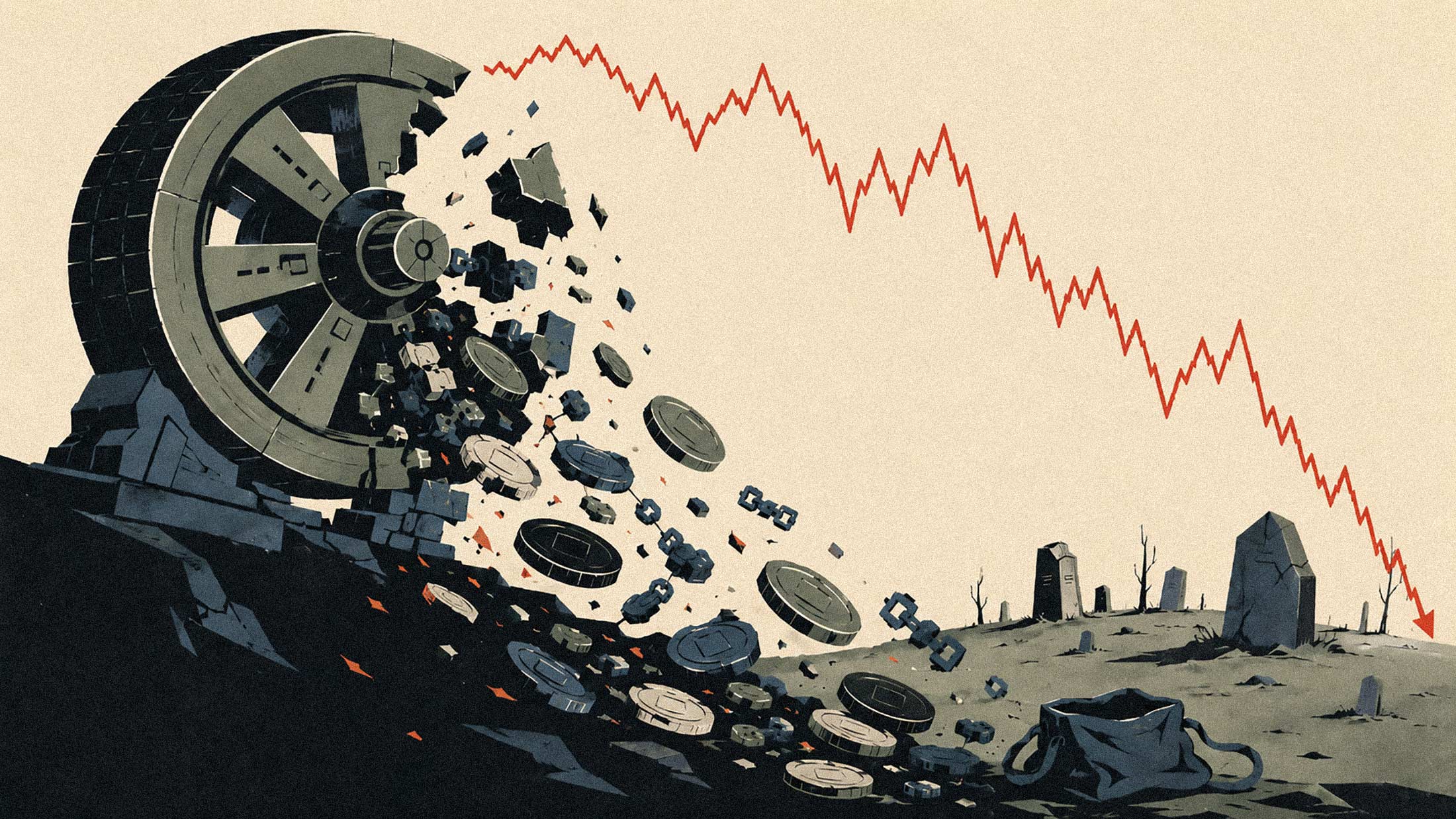
Blockchains are momentum machines. When prices rise, treasuries swell, developer grants flow, projects launch, users arrive, and the flywheel spins faster. When prices fall, the flywheel reverses. Treasury values drop. Funding rounds shrink. Projects shutter. Developers leave for chains with more runway. Users follow the developers.
The structural problem for ICO-era chains is that their founding teams are legally and architecturally distanced from the token's price action. Hoskinson has been explicit about this. He explained that decentralized governance means he no longer controls the network's direction and that boosting ADA's price was never his responsibility. This is likely true from a legal compliance perspective. It is also cold comfort to holders who watched their investments lose 93% of their value.
The governance architecture that was supposed to be Cardano's strength has become a coordination problem. The community voted against funding its own flagship conference. There doesn't seem to be desire to spend the treasury to save struggling projects, Hoskinson noted. He personally acquired wallet provider Nami and infrastructure company Blockfrost to prevent their collapse, but he cannot rescue everything.
The 2017 Class
EOS raised $4.2 billion in its year-long ICO, making it the largest crowdfunding event in crypto history. The token peaked at $22.89 in April 2018. In February 2026, EOS hit an all-time low of $0.07, trading at $0.08 by mid-April. The project has since rebranded to Vaulta, a quiet admission that the original vision failed. Tether announced it would discontinue USDT support on EOS, calling it a legacy blockchain.
The ICON Network announced it will permanently shut down on December 31, 2026, with all ICX emissions and staking rewards halted and the chain kept alive only to support migration to a new token. Once the network is turned off, it will exist only as a static ledger.
Major venture firms like Andreessen Horowitz, which previously backed multiple crypto projects, have shifted to AI and robotics. VC funding for crypto fell to $653 million in April 2026 across 61 rounds, the smallest total in 12 months. In April 2025, the same investors deployed over $2 billion across 89 rounds.
The Death Spiral
The dynamic is self-reinforcing. Weak market conditions hurt project revenues. Projects that cannot sustain operations shut down. Shutdowns damage sentiment. Damaged sentiment pushes token prices lower. Lower prices further stress remaining projects. The founding teams, insulated by legal structures and decentralized governance, are simultaneously unaccountable for price action and unable to directly impact it.
Some observers compare Cardano to XRP and Solana, both of which faced existential crises before recovering. But those recoveries depended on specific catalysts. XRP received legal clarity when Ripple won key rulings against the SEC. Solana proved it could survive the collapse of FTX, its most prominent backer. Cardano's catalyst remains unclear.
The industry has a word for what happens next. Analysts call the current period a brutal reshuffle. Others see parallels to the 2018 ICO bust, which ultimately cleared the field for DeFi to emerge. That may be true. But for the projects and token holders caught in the consolidation wave, historical perspective offers limited comfort.
The 2017 ICO boom was premised on a simple bet: that billions of dollars in capital, distributed across hundreds of projects, would produce a few winners and many losers, but that the winners would justify the losses. Nine years later, the winners list is short. Ethereum survived. Bitcoin was never part of the ICO wave to begin with. The rest of the field is consolidating toward zero.
The ICOs promised decentralized futures. They delivered decentralized losses. The founding teams walk away with reputations intact and legal exposure minimized. The token holders hold the bags.