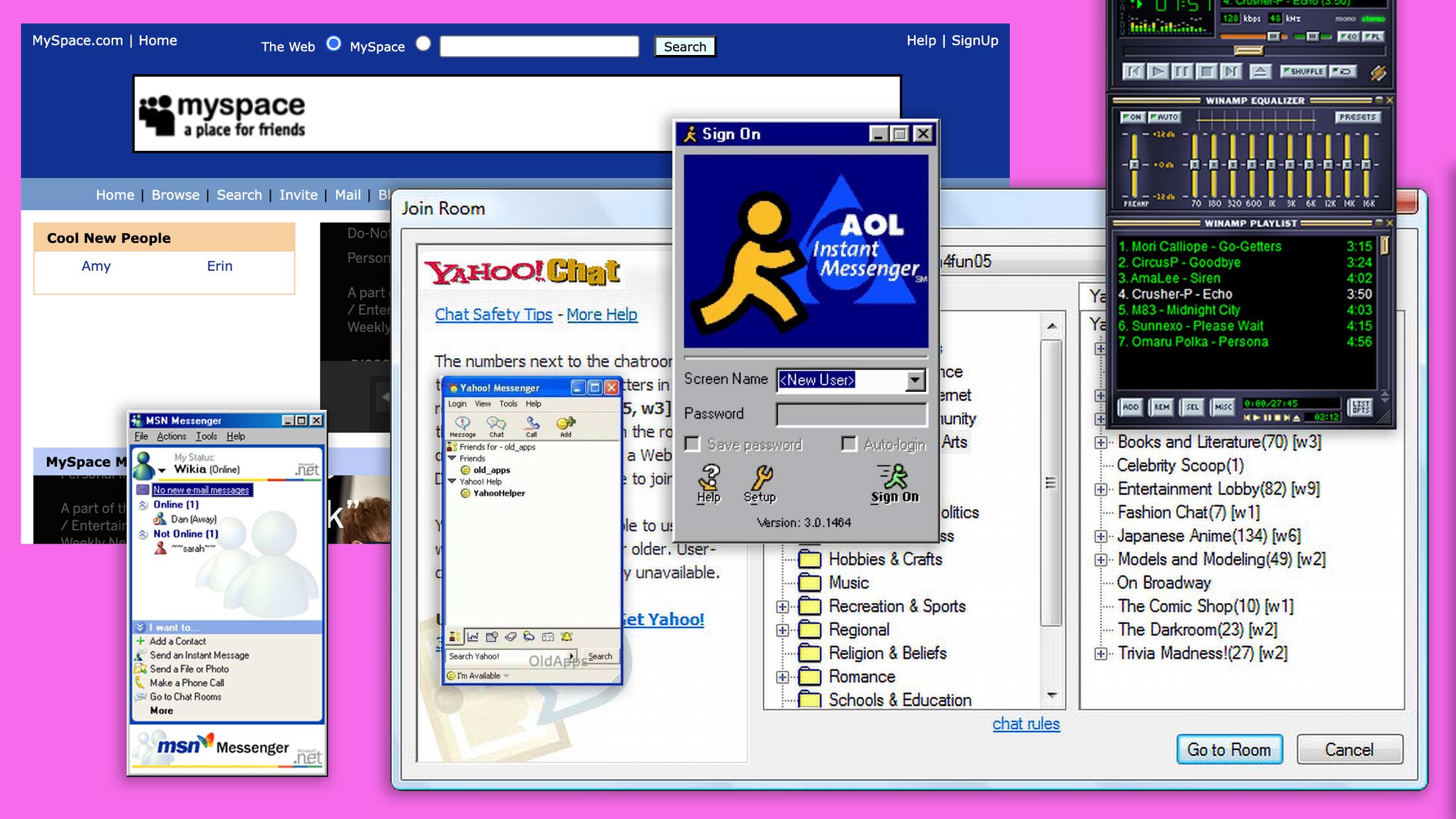
Myspace's owners have confirmed they're planning to bring the platform back. Chris and Tim Vanderhook, the brothers who purchased Myspace in 2011, say they're committed to reviving the site with a new vision that rejects algorithms and doom-scrolling. They haven't set a date, and they haven't outlined a product. What they have is a thesis: that users are exhausted by the current landscape.
They're probably right. But the nostalgia the Myspace announcement triggered tells a more complicated story than simply wanting customizable profiles and Top 8 friend lists. It points backward to something deeper, something platforms like Yahoo Chat and AOL Instant Messenger represented before the real-name era crushed them.
The Internet Before Your Name Was Required
When the public internet emerged in the early 1990s, pseudonymity was the default. You picked a username and that was your identity. ICQ launched in 1996, AOL Instant Messenger in 1997, Yahoo Messenger in 1998. These platforms required nothing of you except an email address, which itself could be anonymous. There was no credit card on file, no government ID, no payment processor conducting identity verification in the background.
Yahoo Chat launched in 1997 and became one of the largest social gathering places on the early web. The chat rooms and games sections fostered communities that existed entirely separate from users' legal identities. Nobody cared if the user named "WolfPack97" was 14 or 34, a plumber or an executive. Evaluation of contributions happened on the merits of what was said, not who was saying it.
This wasn't a design flaw. It was the architecture. Early internet communities tended to be interest-based rather than social-tie-based, which meant there were few costs for using pseudonyms. Digital cameras were rare. Webcams were rare. Constructing an online persona required little effort because the entire environment was text-first.
Yahoo shut down its public chat rooms on December 14, 2012. AOL Instant Messenger followed, shutting down in December 2017 after two decades. By then, both had been rendered irrelevant by Facebook, which demanded real names from the start.
The Real-Name Pivot
Facebook's real-name policy fundamentally reshaped what social media is. When the company receives a complaint about a possible fake name, users must verify their identity by providing copies of identification like a driver's license. The company's stated rationale is safety: confirming identities helps stop scams, phishing, abuse, and foreign political influence.
But as platforms have consolidated, this verification architecture has become the norm. When Randi Zuckerberg declared in 2011 that "anonymity on the internet has to go away," she articulated an ideology that now governs most of the web. Real names, the thinking goes, create accountability. Pseudonymity creates trolls.
Research complicates this narrative. A study analyzing 45 million comments on the Huffington Post found that stable pseudonyms created more civil discourse than either full anonymity or real names. The problem was never pseudonymity itself. It was disposable identities without consequences, a feature easily solved by requiring verified accounts that don't have to be tied to legal names.
What We Actually Lost
The early web's anonymity architecture made possible a kind of participation that's now vanishing. Users could explore ideas, communities, even aspects of their own identities without those explorations being permanently attached to their professional reputation or family relationships. A closeted teenager in a conservative town could find community. A worker could complain about their industry without fear of retaliation. A curious person could simply ask a stupid question.
This wasn't without costs. Yahoo Chat became notorious enough for abuses that the platform eventually stripped away user-created rooms in 2005. Moderation at scale proved difficult. But the solution the industry settled on, attaching every utterance to your real name and indexing it across search engines forever, created different problems.
Today, most users accept that anything posted online exists in perpetuity, searchable by future employers, romantic partners, and anyone else with interest. The chilling effect is hard to measure but real. Even as encrypted messaging platforms proliferate, the public square grows more sanitized.
What a Myspace Relaunch Actually Means
The Vanderhooks say their relaunch will avoid algorithms. They describe their vision as "different from current social media platforms." What they haven't addressed is identity.
If a new Myspace requires Facebook login, or implements KYC-style verification, or ties profiles to credit cards and phone numbers, it will be a nostalgia play at best. The aesthetic of early 2000s social media without the substance.
The Myspace users remember wasn't just visually customizable. It was architecturally different. You could be whoever you wanted to be. Your past didn't follow you unless you chose to carry it. The same dynamics driving interest in decentralized communication tools are at play here: users want spaces where participation doesn't require handing over their entire identity.
Yahoo Chat, AIM, and the old Myspace are gone. Whether anything like them can exist in today's regulatory and commercial environment is unclear. What's clear is that millions of people miss what they represented, even if they struggle to articulate exactly what that was.
Some compromises become permanent standards. Real-name social media might be one of them. Or the pendulum could swing, pushed by users who remember when the internet let you be someone else.