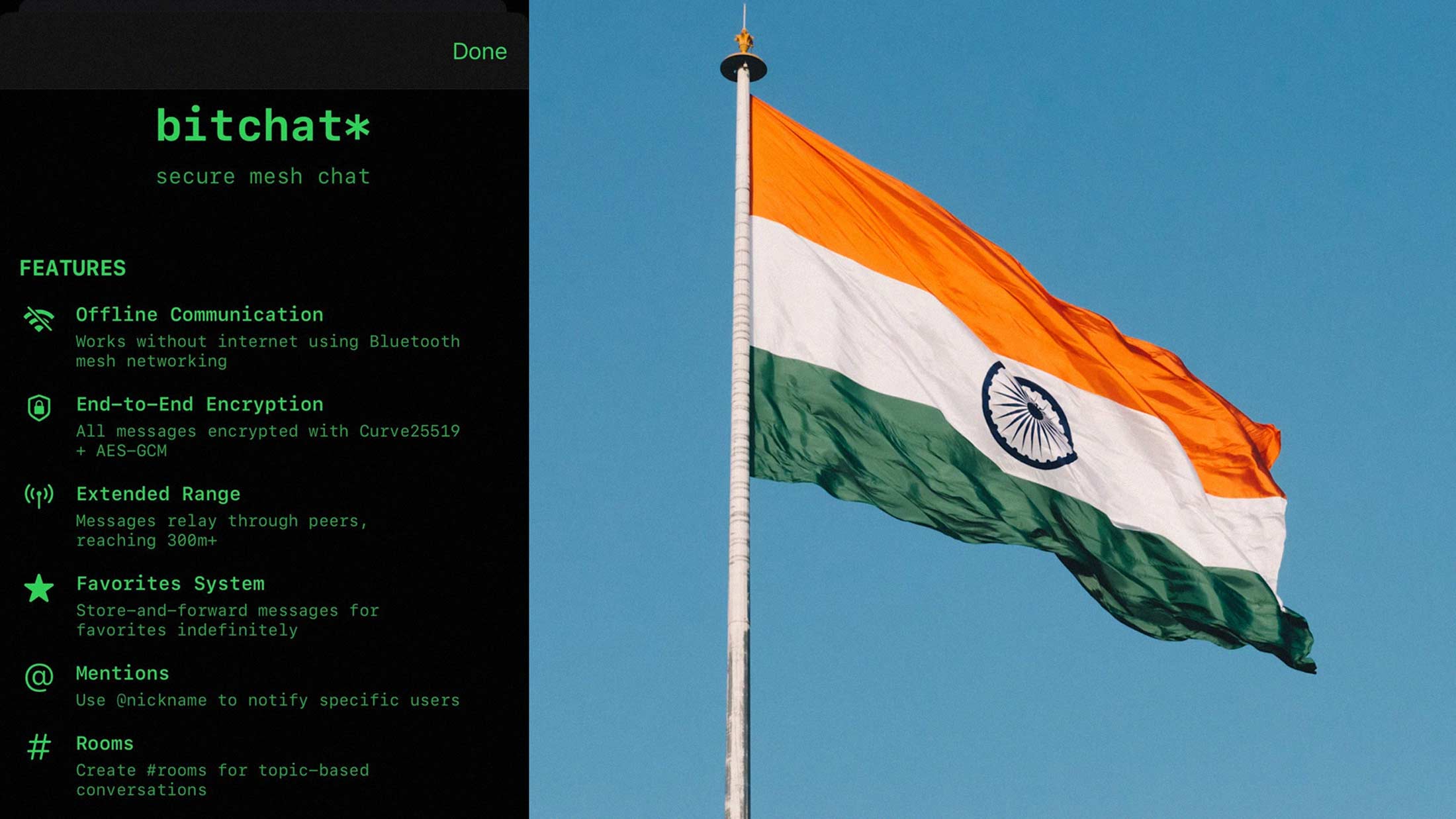
The Indian government has ordered Microsoft-owned GitHub to remove the source code for Bitchat, the Bluetooth mesh messaging app created by Jack Dorsey. The order, issued by the Indian Cyber Crime Coordination Centre on July 23, gave GitHub three hours to comply. The stated rationale: Bitchat enables communication during network restrictions and could be exploited by those seeking to evade lawful surveillance.
The timing is not coincidental. Protesters have gathered at Jantar Mantar in New Delhi for weeks, demanding the resignation of Union Education Minister Dharmendra Pradhan over irregularities in the NEET-UG 2026 medical entrance exam. Mobile internet services were suspended in a 1.5 kilometer radius around the protest site. Students turned to Bitchat.
What the Government Is Actually Trying to Shut Down
Bitchat operates without servers, accounts, or phone numbers. Messages travel through Bluetooth Low Energy mesh networks, hopping between nearby devices until they reach their destination. The architecture is designed for scenarios where centralized infrastructure has failed or been deliberately disabled.
The enforcement action cited Section 79(3)(b) of India's Information Technology Act. The Internet Freedom Foundation condemned the order as "unconstitutional and authoritarian," arguing that it targets the app because it enables communication during internet restrictions, not because of any unlawful content. The foundation also noted that the order circumvented legal procedures for blocking online content.
India is the second major nation to move against Bitchat this year. China compelled Apple to remove the app from its China App Store in April 2026. But targeting GitHub repositories represents a different escalation. Removing an app from a store limits distribution. Trying to remove source code from GitHub attempts to kill the project at its root.
Why Open Source Doesn't Die This Way
Bitchat's code is released under the MIT license. This means anyone on earth can copy, modify, and redistribute it without permission. Before I4C sent its notice to GitHub, the code had already been cloned, forked, and mirrored across platforms. Iranian protesters used a localized fork called Noghteha during internet blackouts earlier this year. That fork recorded over 70,000 downloads in three days via Google Play, with additional distribution happening through sideloading and Bluetooth.
The decentralized nature of open-source development makes it structurally resilient to government takedowns. Deleting a GitHub repository does not delete knowledge. It does not erase the thousands of developers who have already studied the protocol. It does not unmake the Android port, the iOS build, or the third-party clients written for macOS and Linux.
The Community Infrastructure
The ecosystem that has grown around Bitchat illustrates why software censorship rarely works. Bitle, an open-source project using ESP32 microcontrollers, creates standalone relay nodes that extend Bitchat's mesh range autonomously. A solar panel and weatherproof enclosure let these devices operate indefinitely on remote trails without human intervention. The firmware implements the full Bitchat binary protocol over Bluetooth LE and handles Noise Protocol handshakes for secure communication.
More recently, a community whitepaper proposed bridging Bitchat to LoRa radio via Meshtastic, which would push message relay distances from hundreds of meters to potentially 10 kilometers in rural conditions. These extensions exist because the protocol is documented, the source code is available, and developers anywhere can experiment without asking permission.
The Fundamental Miscalculation
Governments attempting to suppress decentralized communication tools face an asymmetry they do not seem to understand. Centralized platforms have offices to raid, servers to seize, and executives to pressure. Bitchat has none of these. When Dorsey posted on X that "the government of india does not like technologies like bitchat and wants it taken down," he was describing a preference, not an outcome anyone can guarantee.
Microsoft has not publicly confirmed whether it complied with the three-hour deadline. As of publication, Bitchat remains available on the Apple App Store. The Android APK can be sideloaded from mirrors. The protocol specification is published. The knowledge exists.
Open-source software resists censorship the same way it resists everything: through redundancy. The code has no single point of failure. Neither does the community.