Pioneer Labs, a nonprofit research organization based in Emeryville, California, has announced what it calls the first microbe specifically engineered for Mars. The organism, designated sPL.001, is designed to produce bioplastic construction materials from Martian soil, water, and processed atmosphere.
The announcement, made Tuesday by CEO Erika Alden DeBenedictis, marks a concrete milestone in the otherwise speculative field of off-world biomanufacturing. According to Pioneer Labs, the bacterium can source all its nutrients directly from Martian regolith without requiring fertilizers shipped from Earth or pre-processing to remove toxic compounds like perchlorates.
Today, Pioneer Labs is announcing our first step towards terraforming Mars. 🚀🌼
— Erika Alden DeBenedictis (@erika_alden_d) September 22, 2026
With equipment that fits in just a single rocket launch, we can convert Martian dirt, water, and air into enough building materials to construct a small city on Mars.
To do it, we made the first… pic.twitter.com/IOacNinJkg
The Science Behind sPL.001
The organism is an evolved strain of Cupriavidus necator H16, a bacterium well-studied for its ability to produce polyhydroxyalkanoates, or PHAs. These are biodegradable bioplastics with mechanical properties comparable to conventional petroleum-based polymers. Pioneer Labs used adaptive laboratory evolution across more than a trillion cumulative cell divisions to improve the organism's tolerance to high concentrations of acetate and leached regolith.
According to a preprint published on bioRxiv, the evolved sPL.001 strain produced more than three times the PHA yield of its parent strain under simulated Martian conditions. The organism consumes acetate derived from atmospheric carbon dioxide and converts it into bioplastic.
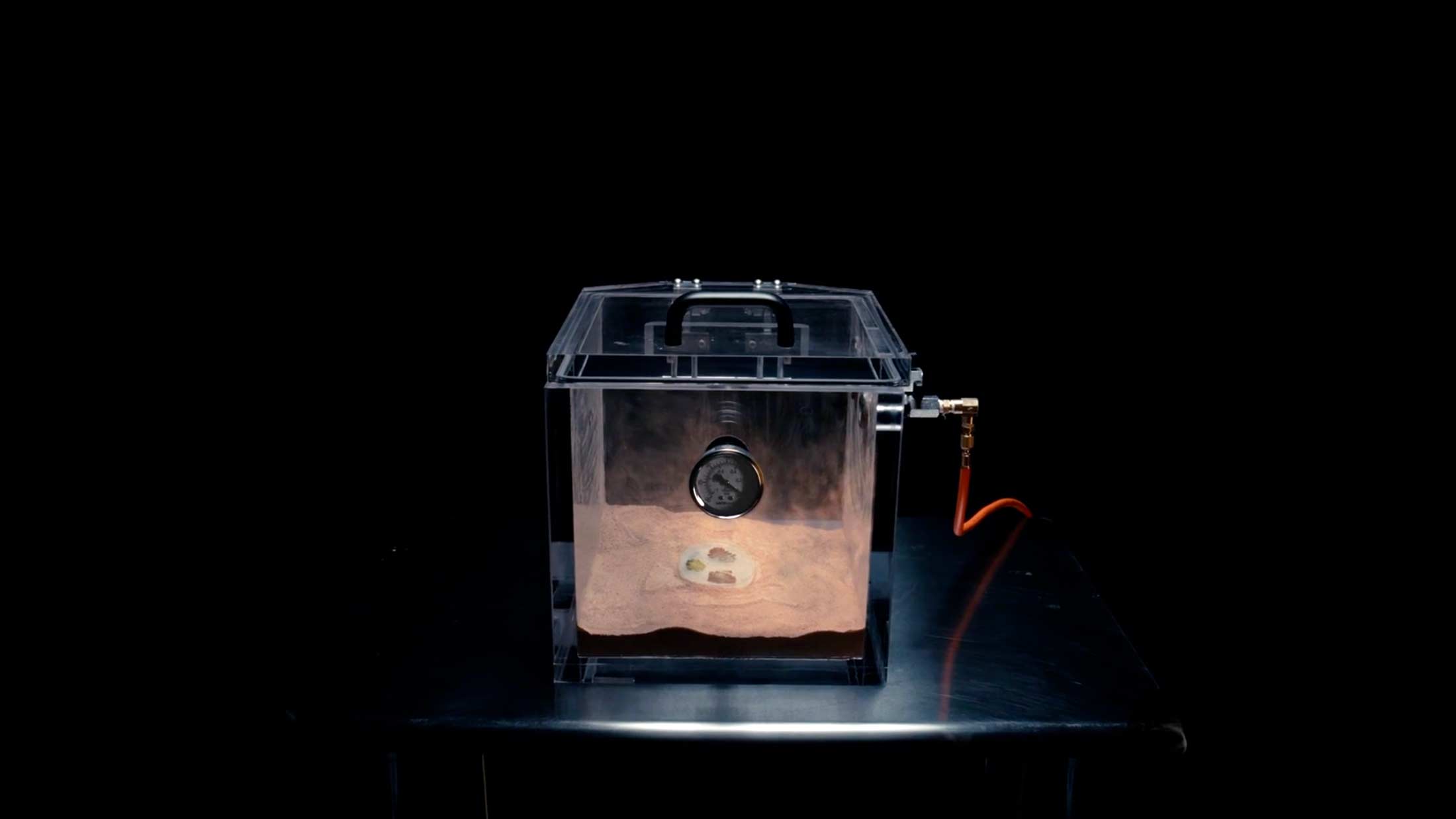
Pioneer Labs claims that equipment fitting on a single rocket launch could, over roughly four years, generate enough bioplastic to construct radiation-shielded, pressurized habitats for a small settlement. The microbes would grow inside heated bioreactors, shielded from the planet's extreme radiation, low pressure, and freezing temperatures.
Designed to Fail Outside the Lab
The organization has emphasized biosafety as a core design principle. sPL.001 cannot survive without a continuous supply of acetate. If it escapes its bioreactor or feeding stops, growth halts immediately, and Martian surface conditions rapidly kill the cells.
Pioneer Labs states that even a catastrophic leak of an industrial-scale bioreactor would clear planetary protection thresholds by several hundred times over. The company is explicit: this microbe has no chance of terraforming Mars on its own. It describes sPL.001 as the first of five organisms that would be needed to begin making the planet hospitable to life.
Context and Competition
The announcement arrives as interest in Mars in-situ resource utilization continues to grow. NASA's MOXIE experiment, which flew aboard the Perseverance rover, demonstrated that oxygen can be extracted from the Martian atmosphere using solid oxide electrolysis. MOXIE completed its mission last year after successfully producing oxygen from carbon dioxide in 16 separate runs.
But MOXIE was a chemistry demonstration. Pioneer Labs is pursuing a biological approach, arguing that engineered microbes can produce a wider range of materials, including structural polymers that electrolysis alone cannot generate.
Elon Musk responded to the announcement on X, writing that terraforming Mars could come "maybe sooner" than the 2030s. SpaceX continues to position its Starship rocket as the vehicle that would transport cargo and eventually humans to the red planet.
What Remains Unproven
Pioneer Labs has demonstrated these results in simulated Martian conditions on Earth, not on Mars itself. Translating laboratory performance to an actual planetary environment involves variables that cannot be fully replicated in a terrestrial lab. The organization acknowledges this, framing sPL.001 as a proof of concept rather than a flight-ready system.
The nonprofit has published three papers alongside the announcement, detailing the directed evolution process, biosafety testing, and a reference architecture for deployment. Whether any space agency or private company will actually fly the organism remains to be seen.
For now, sPL.001 represents a tangible step in a field that has mostly consisted of roadmaps and speculation. Whether biology can really help humanity settle another world is a question that can only be answered with hardware on Martian soil.