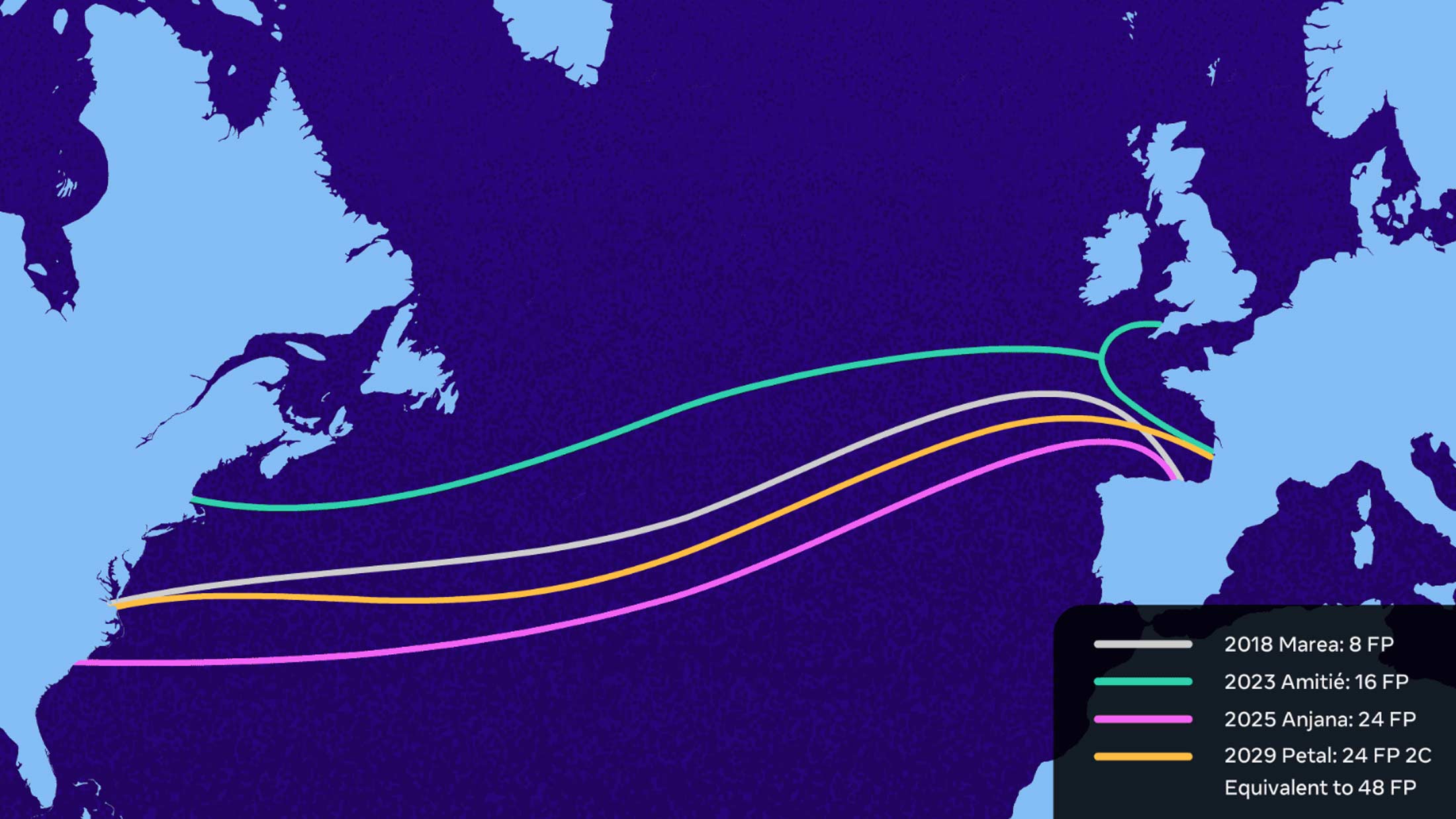
Meta announced Petal today, a transatlantic subsea cable connecting France and the United States that will deliver 1 petabit per second of capacity when it enters service in 2029. If those numbers hold, Petal will be the first transoceanic cable to cross the petabit threshold and the largest single-generation capacity increase in the history of subsea infrastructure.
One petabit per second is 1,000 terabits per second. Meta frames this as roughly the network capacity required for 75 percent of the world's population to stream music simultaneously. That comparison is marketing shorthand, but it gestures at the scale involved. The cable will span approximately 7,000 kilometers, running between landing points on the Atlantic coasts of both countries.
The Multi-Core Breakthrough
What makes Petal technically significant is the deployment of multi-core fiber at transoceanic distances. Traditional subsea cables use single-core fiber strands. Petal will use two-core fiber, effectively doubling the data-carrying capacity per strand without proportionally increasing power requirements or physical infrastructure.
This matters because subsea cables face hard constraints. Power comes from shore-end equipment rated at 18 kilovolts, and exceeding that threshold requires requalifying the entire subsea ecosystem. Meta says Petal's design stays within existing power limits, avoiding that costly and time-consuming process. The approach relies on Fan-In/Fan-Out (FIFO) devices that couple light between the two cores and highly efficient amplification systems. According to Meta's engineering blog, it took years of collaborative development with partners NEC and Sumitomo Electric Industries to qualify the first petabit-class transoceanic system.
NEC will serve as the turnkey supplier, responsible for manufacturing and installation. Sumitomo Electric is producing the multi-core fiber itself. Orange will support the French landing site.
Why Meta Builds Pipes
The obvious question is why a company that sells advertising is building ocean-floor infrastructure. The answer has two parts.
First, AI infrastructure requires enormous bandwidth. Training and inference workloads have fundamentally changed the capacity calculus for hyperscalers. What once could be leased from telecom consortiums now needs to be owned outright. According to TeleGeography data cited by industry analysts, hyperscalers including Meta, Google, Microsoft, and Amazon now account for approximately 75 percent of total international bandwidth, up from negligible levels in 2010.
Second, Meta's business is global. The company makes more money outside North America than in its home market. Having priority access to dedicated subsea capacity ensures quality of service for the billions of users on Facebook, Instagram, WhatsApp, and Threads. When your platforms handle roughly 22 percent of all mobile traffic and 10 percent of all fixed internet traffic, owning the physical layer stops being optional.
Meta has invested in more than 20 subsea cable projects over the past decade, deploying what the company describes as hundreds of thousands of kilometers of cables globally. This includes Project Waterworth, a $10 billion-plus project spanning 50,000 kilometers that will touch five continents. It includes the 2Africa system, the longest subsea cable ever deployed at 45,000 kilometers, connecting 33 countries across Africa, Europe, and Asia. Petal adds to this portfolio with a specific focus on transatlantic capacity.
What Petabit-Class Cables Enable
The practical implications extend beyond Meta's internal needs. Subsea cables carry approximately 99 percent of intercontinental internet traffic. Nearly every message, phone call, and video conference between continents travels through glass strands on the ocean floor. When a hyperscaler doubles the capacity of a major transatlantic route, that capacity eventually shapes what applications become feasible.
Distributed AI inference is one example. As companies deploy large language models globally, they need low-latency connections between data centers and edge locations. Real-time collaboration tools, cloud gaming, and high-definition video streaming all benefit from fatter pipes. The shift from terabit to petabit capacity changes what can be built on top of these networks.
There are also resource efficiency gains. Meta notes that carrying a petabit through one cable significantly reduces materials, resources, and carbon footprint compared to building two 0.5 petabit systems. Traditional thinking held that doubling capacity meant doubling cables. Multi-core fiber breaks that assumption.
The Competitive Landscape
Meta is not alone in this infrastructure race. Google has been developing multi-core fiber technology with industry partners and has anchored eight new subsea systems in the Asia-Pacific region. Microsoft has partnered on multiple cable projects. Amazon, through AWS, has expanded its subsea footprint. The subsea cable market is projected to grow by approximately $4 billion over the next four years, driven by cloud adoption, data center expansion, and AI workloads.
Investment in new submarine cables planned to enter service between 2026 and 2029 exceeds $16 billion. That level of spending has not been seen since 2000-2001.
Petal represents Meta's bet on what comes next after the current generation of cables. The company says it will be 5.5 times the capacity of Marea, its first transatlantic investment. Whether the two-core fiber approach scales to four cores or beyond remains an open engineering question. But for now, the cable industry has a new benchmark to chase.