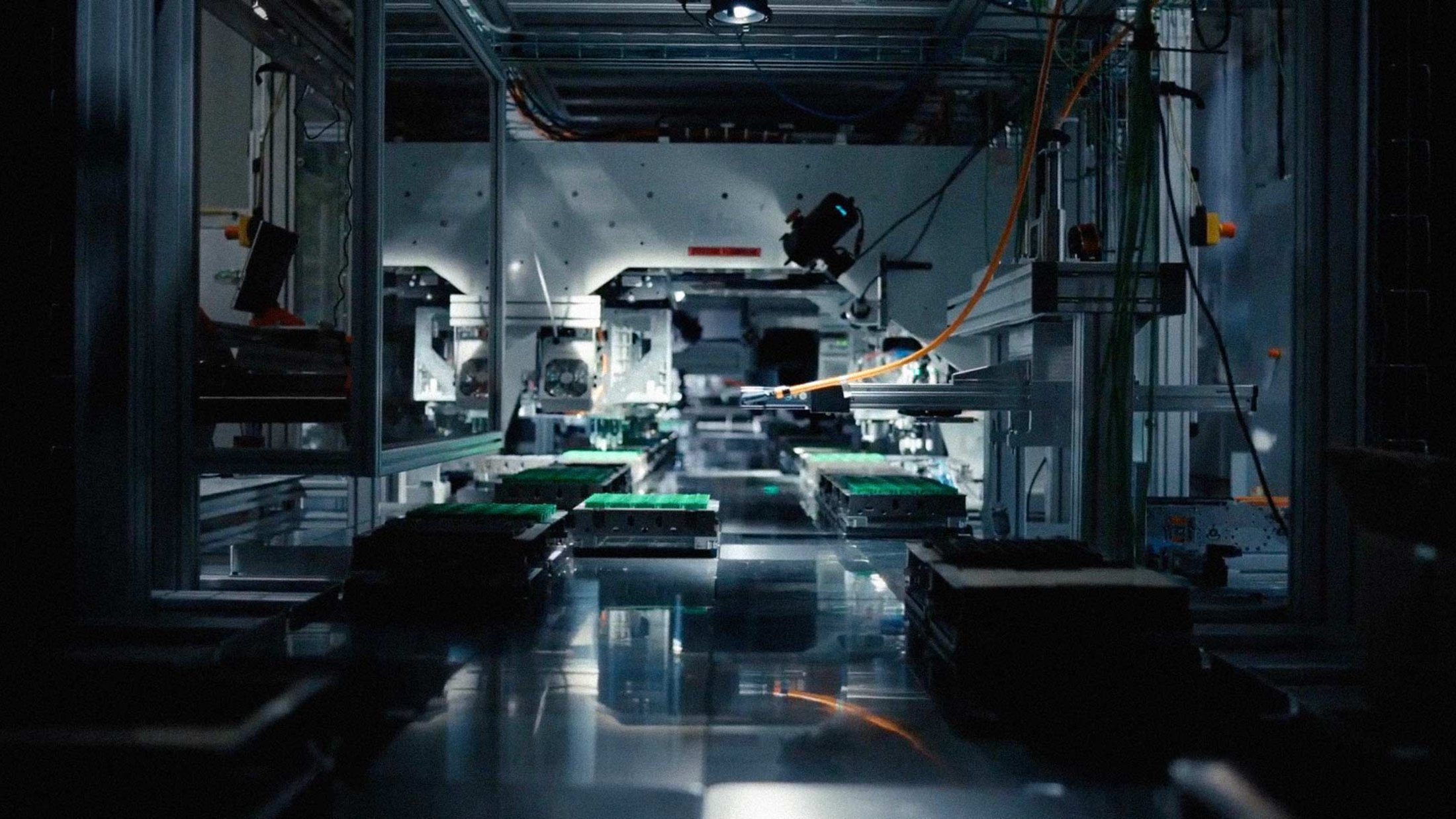
CircuitHub has been running an automated circuit board factory in South Deerfield, Massachusetts since 2021. On Sunday, the company finally told the world about it.
The Grid, as CircuitHub calls it, occupies 5,000 square feet and uses levitating movers to shuttle individual boards between robots that print solder paste, place components, reflow, and inspect. AI agents, learned models, and traditional optimizers orchestrate the whole system. Each board takes its own route through the factory, which means the line never stops to reconfigure between designs.
"For thirty years the West accepted a trade-off: design here, build in China, and wait," said Andrew Seddon, CircuitHub's founder and CEO. "The Grid ends that trade-off."
The company says it now ships boards in an average of four days, compared with nine days for a typical quick-turn shop in Shenzhen. Pricing, according to CircuitHub, has reached rough parity with Chinese competitors. A sample motor controller board the company priced out came to $630 for five assembled four-layer units delivered to a US address; the Shenzhen alternative cost about $465 including shipping and US tariffs, but took more than twice as long.
PCBs made in America. Twice as fast as Shenzhen. Today @CircuitHub is unveiling The Grid, our factory-scale robot in Massachusetts that builds circuit boards on demand. No changeovers, no per-design setup. Prototypes and production batches, fully automated. https://t.co/M2UTpeXuMX
Advertisement— Andrew Seddon (@seddonandrew) October 26, 2026
Numbers From a Factory That Has Already Shipped
The Grid is not a prototype. CircuitHub says the facility has already delivered more than 2.2 million boards, placed over 150 million components, and served more than 26,000 engineers. Production volume runs into tens of millions of dollars annually. Customers include an unnamed major EV maker, one of the world's largest AI labs, and what the company describes as household-name tech companies.
Demand has outpaced what the factory can build. CircuitHub is expanding Massachusetts capacity fivefold this year and plans a second facility in the UK for 2027.
The Economics of High-Mix Manufacturing
Traditional contract manufacturers optimize for batch runs. Changing a line over for a one-off prototype costs almost as much in setup time as running a thousand units. CircuitHub's pitch is that software-defined changeovers let the same factory profitably run a single prototype next to a commercial batch, processing dozens of different designs simultaneously.
"One unit of 100 designs runs as easily as 100 units of one," the company's announcement states.
Plural, a European-rooted venture fund founded by Taavet Hinrikus, Sten Tamkivi, Ian Hogarth, and Khaled Helioui, led CircuitHub's $28 million Series A in May 2026. The round brought total funding to roughly $48 million since the company's 2011 founding. Sten Tamkivi, a partner at Plural, said CircuitHub is "changing the unit economics of the entire industry."
The Reshoring Problem CircuitHub Doesn't Solve Alone
The US share of global PCB production has collapsed from 30 percent to 4 percent over three decades, according to the Printed Circuit Board Association of America. Domestic fabricators number around 145 today, down from more than 2,000. Roughly 90 percent of boards used by American engineers are made in Asia, with more than half coming from China.
Congress noticed. On the same day CircuitHub announced The Grid, Senators Ruben Gallego and Jim Justice introduced S.4569, the Protecting Circuit Boards and Substrates Act, which proposes a 25 percent tax credit for purchases of American-made PCBs and a $3 billion grant program for domestic manufacturers.
CircuitHub operates in a particular slice of the market: high-mix, low-volume production. The company notes that 95 percent of electronics projects involve fewer than 10,000 units. Mass-production reshoring is a different animal, with different economics and different infrastructure requirements. The company's model works for robotics teams, satellite builders, and R&D; departments iterating quickly. Whether automation can make domestic PCB manufacturing viable at commodity scale remains unproven.
The Grid's architecture invites a comparison Seddon himself makes: "Just as software companies share cloud compute, hardware companies can now share our Grid." It's a framing that resonates with a generation of founders who assume on-demand access to infrastructure. What the company is testing is whether the same logic can hold for atoms, not just bits.
A European Grid is planned but not yet scheduled. Post-money valuation and run-rate revenue have not been disclosed.