Elon Musk posted on X this week about the limitations of human cognition and how Neuralink could fix them. His thesis is familiar: our output bandwidth is pathetically low, our input bandwidth could be higher, and brain-computer interfaces are the path to human-AI symbiosis. He framed the technology as improving "the probability of a great outcome for humanity in the future."
The argument is coherent. It is also running headfirst into some inconvenient neuroscience.
The 10 Bits Per Second Problem
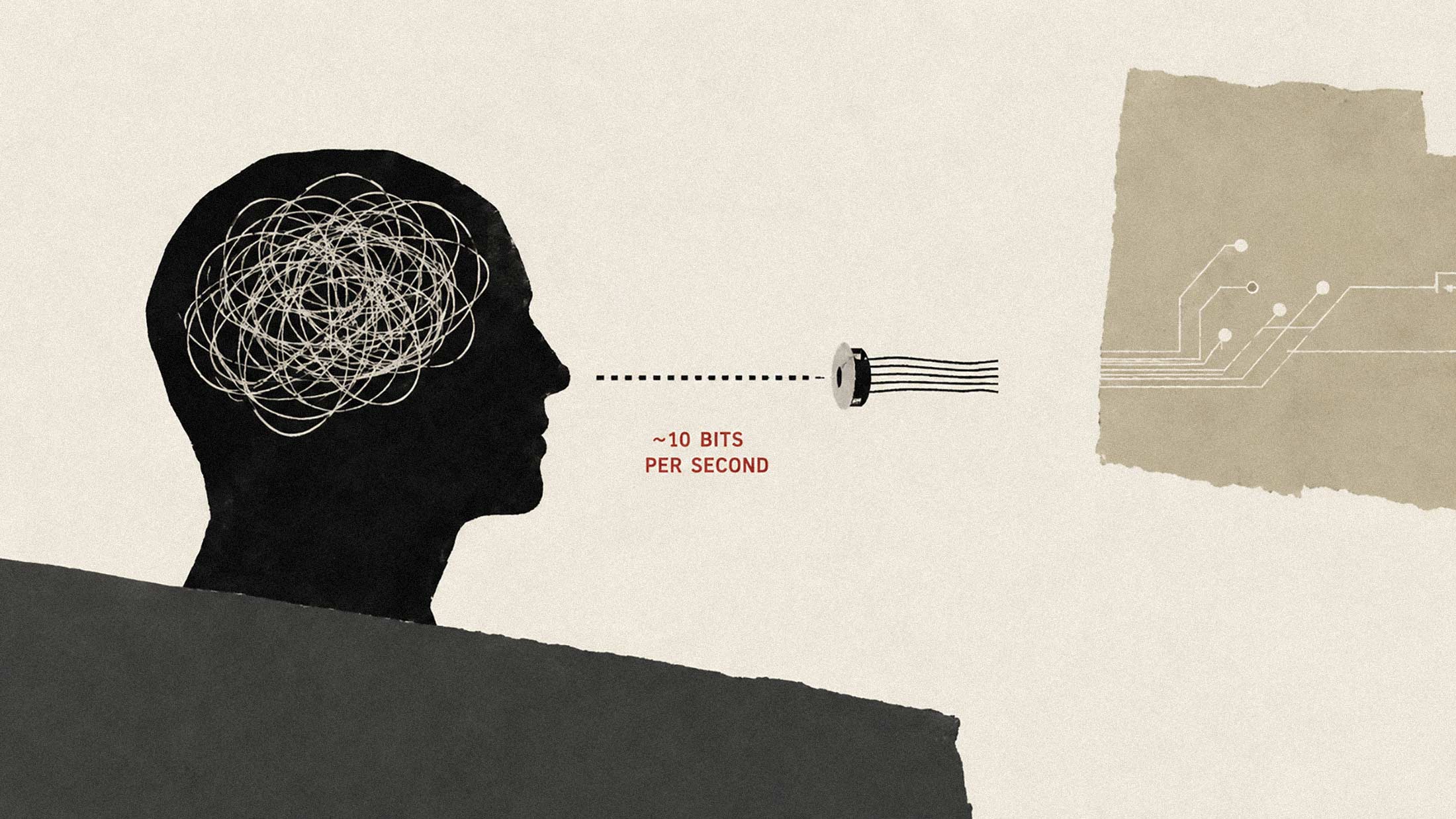
Research published in Neuron in early 2025 quantified something that had been suspected for decades: human conscious thought operates at roughly 10 bits per second. Caltech neuroscientist Markus Meister and graduate student Jieyu Zheng arrived at this figure by measuring information throughput across a range of tasks, from touch typing to solving Rubik's Cubes to memorizing card decks. Even record-holding memory experts peaked at about 10 bits per second.
That number sounds absurd. Meister himself has called it "ridiculously small." For context, a 1959 Bell Telephone modem operated at 100 bits per second. Your home WiFi runs at 100 megabits per second. The human brain takes in sensory data at over one billion bits per second. But when it comes to actual decision-making, actual output, the rate collapses by a factor of 100 million.
This is the bottleneck Musk wants Neuralink to address. The problem is that the bottleneck may not be at the interface between brain and world. It may be intrinsic to how brains work.
Neuralink's Current Reality
As of early 2026, Neuralink has implanted its device in 21 patients globally. The first patient, Noland Arbaugh, received his implant in January 2024 and has since used it to play video games, browse the internet, and control a computer cursor with his thoughts. The company reports that participants are achieving 8 to 10 bits per second of information transfer, comparable to able-bodied mouse use. Typing speeds have reached up to 40 words per minute through imagined finger movements.
The company raised $650 million in Series E funding in June 2025, valuing it at approximately $9 billion. It has received FDA Breakthrough Device Designation for both speech restoration and its Blindsight project, which aims to restore vision by stimulating the visual cortex directly. Human Blindsight trials are expected later this year.
Neuralink's roadmap for 2026 includes high-volume production of its N1 implant and nearly complete automation of the surgical procedure. Musk has floated the possibility of over 1,000 human implants this year, though the company had reached only 21 by late January.
The Deeper Question
Here is where Musk's thesis gets complicated. Neuralink's current devices achieve roughly the same information transfer rate that Meister's research identified as the brain's fundamental processing limit. That's not a coincidence. If the constraint is architectural, not interfacial, then adding more bandwidth to the pipe connecting brain to machine does not solve the problem. You are still limited by what the brain can actually do with the information.
Meister and Zheng speculate that the brain's 10 bits per second limit may stem from evolutionary pressures that favored sequential, single-threaded cognition. As they note, "Human thinking can be seen as a form of navigation through a space of abstract concepts." Just as a traveler selects one route through a forest, the mind follows one path of thought at a time.
If that architecture is fundamental, the path to human-AI symbiosis may require something more radical than improving the connection. It may require changing what the brain actually is.
What Musk Is Really Proposing
Musk's long-term vision, articulated repeatedly since Neuralink's founding in 2016, draws from Iain M. Banks' Culture novels and the concept of "neural lace." The idea is that a high-bandwidth interface could allow direct communication between humans and AI, distributing intelligence across millions of augmented individuals rather than concentrating it in a small number of powerful systems. If everyone has access to AI through their brains, the argument goes, no single actor can monopolize it.
It is a compelling framing, and Musk has been consistent about it for nearly a decade. He believes AI represents an existential risk and that the safest outcome is one where humans and machines merge rather than compete.
But the 10 bits per second finding suggests the merge may be harder than anticipated. The brain-computer interfaces that exist today, including Neuralink's, are already operating near the ceiling that neuroscience says conscious cognition can sustain. The limiting factor is not the technology. It is us.
Neuralink's medical applications for paralysis, vision loss, and speech impairment remain valuable and are advancing. The company's clinical work is generating real outcomes for real patients. But the transhumanist thesis Musk articulated this week requires something beyond faster surgery and more electrodes. It requires a brain that can think in parallel, at scale, with bandwidth that evolution never gave us.
Whether that is achievable, and whether it would still count as human, remains an open question.