Around 100 species of birds can both fly and swim. Puffins, petrels, loons, and kingfishers plunge into the water to chase prey, then burst back into the air and keep flying. Engineers at MIT and EPFL in Switzerland have now built a robot that does something similar.
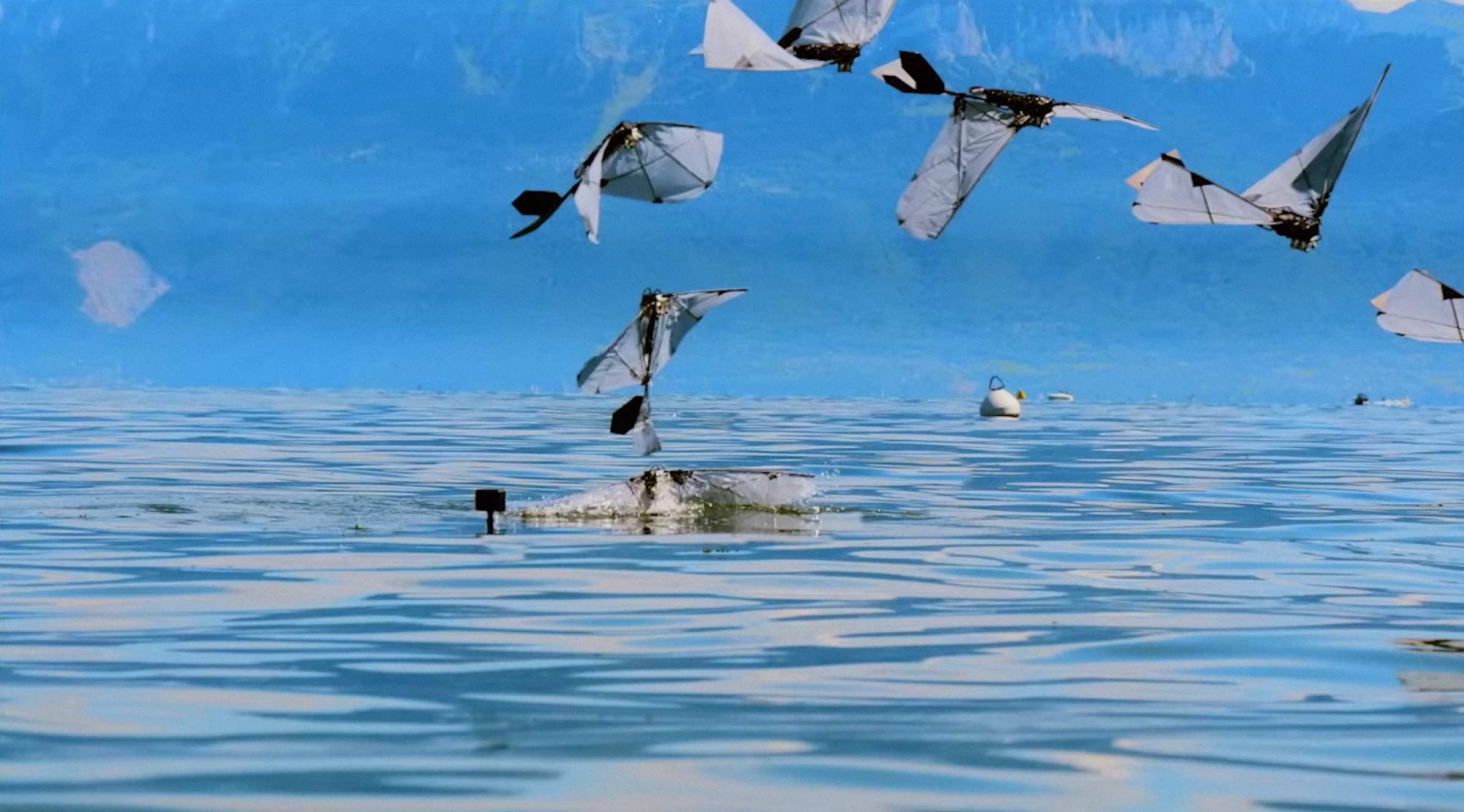
The machine is called FAAV, short for flapping-wing aerial-aquatic vehicle. Published this week in the journal Science, the research describes a 250-gram robot with a carbon-fiber body, flexible membrane wings, and a small motorized tail. It can cruise through the air at roughly 6 meters per second, swim underwater at about 1 meter per second, and leap out of the water into flight using only its wings. No propellers, no folding mechanisms, no paddling feet.
Raphael Zufferey, an assistant professor of mechanical engineering at MIT who leads the AURA Lab, is the paper's lead author. The team includes collaborators from EPFL and Northwest Indian College in Bellingham, Washington.
The Problem With Two Mediums
Water is roughly 1,000 times denser than air. Moving through one versus the other demands entirely different physics. Any vehicle attempting to operate in both typically needs heavy transforming components to switch between locomotion modes.
The MIT-EPFL team found a simpler solution. They studied biological data on puffins, petrels, kingfishers, and other diving birds. Smaller species flap their wings around 10 times per second in the air, dropping to about four times per second when swimming underwater. They do not fundamentally redesign their bodies for each medium. They adapt their rhythm.
FAAV works the same way. A battery and waterproof electric motor inside the body drive a crankshaft that pumps the wings at roughly five beats per second. The wings themselves are thin membranes coated with hydrophobic nanoparticles that shed water quickly. The flexibility is intentional. In dense water, the wings passively deform by up to 90 percent, shrinking the effective stroke and reducing motor load. In the air, they stiffen and generate lift.
Breaking the Surface
The water-to-air transition is the hardest part. Earlier aerial-aquatic robots relied on chemical combustion, tethered power, or dedicated propellers to achieve it. FAAV does it with wings alone.
The window is tight. The exit takes less than a second and roughly eight to ten wing strokes. The team discovered the robot must approach the surface at a steep 70-degree pitch to keep the wingtips from dragging through the water. Any shallower and surface tension traps the wings. Any steeper and the robot flips backward.
What's surprising is that FAAV doesn't need feet. Most diving birds, including puffins and ducks, paddle at the water's surface while flapping their wings to generate enough thrust for liftoff. The MIT-EPFL team found that, in robotics at least, the paddling step is not mandatory. With the right combination of wing size, flapping frequency, and tail angle, a bird-scale robot can breach the surface on flapping power alone.
Testing in Lake Geneva
The team tested the robot first in an indoor water tank, then in Lake Geneva. They fabricated three sets of wings: small (60 centimeters wide), medium (80 centimeters), and large (100 centimeters). After multiple flights with various wing sizes, flapping frequencies, and tail angles, they found that the medium-sized wings produced the most reliable performance across all three phases: swimming, surface transition, and flight.
On a single battery charge, the team estimates the robot can fly approximately 6 kilometers or swim about 2 kilometers. Beyond roughly 15 meters of underwater travel, it becomes more energy-efficient to leap out and fly than to keep swimming.
What It Means
The practical applications are still speculative. Zufferey has described a vision where oceanographers or marine biologists launch the robot from a boat, send it to monitor a whale pod or sample water near a coral reef, then have it fly back with the data. The cost would be a fraction of traditional methods.
For now, FAAV is not autonomous. All operations are pre-programmed timing sequences. The team has demonstrated diving and surface takeoff separately, but has not yet strung together a full dive-and-return mission.
The research also has value for biologists studying how diving birds actually work. Glenna Clifton, an animal movement biologist at the University of Portland who was not involved in the project, told NPR the robot offers insights into what makes the flight biology of diving birds unique. A robot that can be instrumented and controlled offers experimental access that's impossible with live animals.
Zufferey's group joins a growing field of bio-inspired robotics that borrows design principles from creatures evolution has already optimized. The challenge, as always, is making the borrowed designs work in engineering terms. FAAV suggests that birds may have already solved the aerial-aquatic problem more elegantly than roboticists assumed, and that the key insight may be what the robot doesn't need: transformation, propellers, or paddling feet. Just wings that flex.