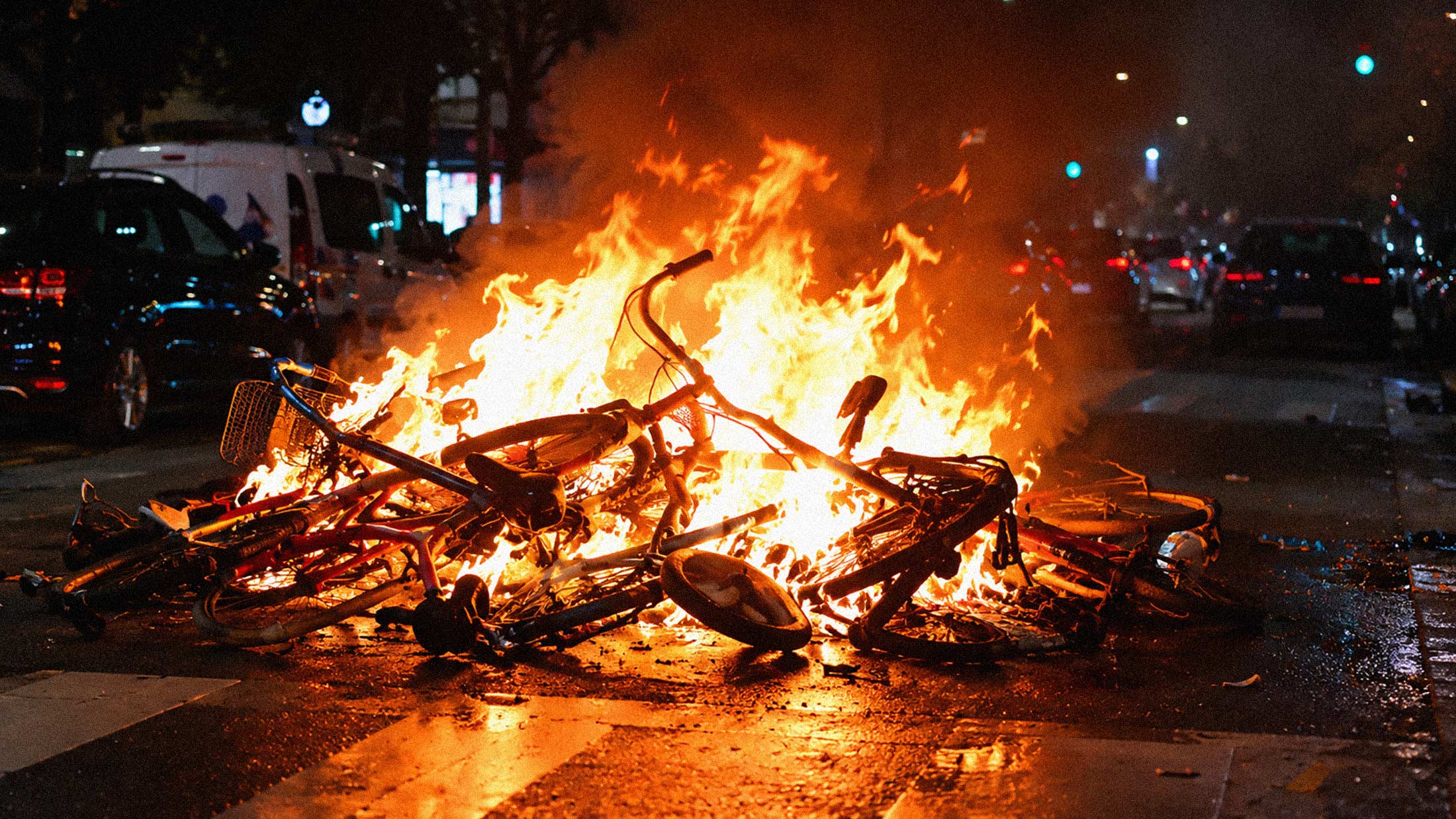
Paris tore itself apart Saturday night. More than 320 people were detained across France, with 235 of those in Paris, after Paris Saint-Germain beat Arsenal on penalties in the Champions League final in Budapest. Seven police officers were wounded. Six vehicles and two businesses were damaged. A group stormed the Paris ring road, shutting down traffic and lighting flares. About 150 people attempted to breach one of the gates at Parc des Princes.
Problems in Paris pic.twitter.com/KOU8r5UF4S
— Elon Musk (@elonmusk) May 31, 2026
This is the second consecutive year PSG has won Europe's top club prize. It is also the second consecutive year that victory has triggered riots in the French capital. Last year, when PSG beat Inter Milan 5-0 in Munich, the violence was worse: two people died, more than 200 cars were torched, and 559 people were arrested.
The Deployment
Interior Minister Laurent Nunez deployed 22,000 police officers across France for the match, including 8,000 in Paris alone. Tram lines were halted. Several metro stations shut down. Bus traffic stopped in key areas. The security apparatus was built to prevent a repeat of 2025.
It partially succeeded. Fewer arrests. Fewer injuries. But the pattern held: the worst of the chaos centered on the Champs-Elysées and the Chatelet district, between the Louvre and Notre-Dame. Footage circulating on social media showed fireworks going off in packed streets, fans scrambling, riot police using tear gas and baton charges.
Marine Le Pen, the far-right three-time presidential candidate, posted on X that "only in France does a football club's victory spark riots." Interior Minister Nunez called the unrest "absolutely unacceptable." A victory parade is still planned for Sunday on the Champs-de-Mars, with 100,000 people expected, followed by a reception at the Élysée Palace.
The Role of Technology
France is now one of the most surveilled democracies in Europe. The country's Olympic surveillance law, passed in 2023, authorized algorithmic video surveillance at sporting events. It was supposed to expire in March 2025. It did not.
The system uses AI software from companies like Videtics, Orange Business, ChapsVision, and Wintics to scan public video feeds in real time, looking for abandoned packages, crowd surges, weapons, and anomalous movement patterns. A PSG match against Lyon was among the early test sites. The 2024 Paris Olympics became the full deployment.
Civil liberties advocates warned at the time that temporary measures would become permanent. They were right. France now has roughly 90,000 CCTV cameras monitored by police and gendarmerie, according to a 2020 estimate. The AI layer adds the capacity to process all of it simultaneously.
The question is whether any of this actually prevents violence. Saturday's numbers suggest the surveillance helped limit the damage compared to 2025. But surveillance did not stop the riots from happening. The crowd surges still occurred. The ring road was still blocked. The flares still went off.
The Coordination Problem
On the other side of the technology equation sits Telegram, where messages coordinating protest movements now hurtle back and forth in real time. During France's 2023 riots following the police shooting of Nahel Merzouk, Telegram channels tracked police movements and directed demonstrators. In 2025, the same pattern emerged during the "Block Everything" protests against austerity measures.
French authorities are well aware of the problem. The arrest of Telegram CEO Pavel Durov at Le Bourget Airport last August underscored Paris's willingness to hold platforms accountable for content moderation failures. But encrypted messaging remains largely beyond the reach of real-time enforcement.
The result is a surveillance asymmetry. The state can see everything in public spaces. It cannot see what is being planned. And no amount of AI crowd analysis can predict when a firework will be thrown at a police officer.
What Actually Works
France has been here before. Riots followed PSG's 2020 Champions League final loss to Bayern Munich, with 148 arrests. Riots followed their 2013 Ligue 1 title, with 30 injuries. Two weeks ago, hooded ultras stormed the pitch during a Nantes-Toulouse match, forcing the game to be abandoned.
The technology deployed to contain these events keeps getting more sophisticated. So does the coordination among those who evade it. After the 2024 Olympics, critics argued that France was using the Games as a surveillance power grab. The government countered that the systems had "demonstrated effectiveness."
Both things can be true. AI surveillance may reduce the severity of predictable incidents. It does not eliminate the social conditions that produce them. France's football violence is not a technology problem. It is a cultural and political one, rooted in inequality, alienation, and a long tradition of street protest.
The surveillance state can make riots more containable. It cannot make them disappear. That is a harder problem, and it does not have a software solution.