Hair loss affects roughly 80 million Americans. The two FDA-approved treatments for androgenetic alopecia, finasteride and minoxidil, have been around for decades and produce cosmetically acceptable results in only a modest percentage of patients. The field has been stuck.
That may be changing. Researchers at multiple institutions have begun using machine learning to design new therapeutic compounds from scratch, and one breakthrough study published in Nano Letters demonstrates what happens when AI gets pointed at the oxidative stress problem underlying pattern baldness.
The Oxidative Stress Theory of Hair Loss
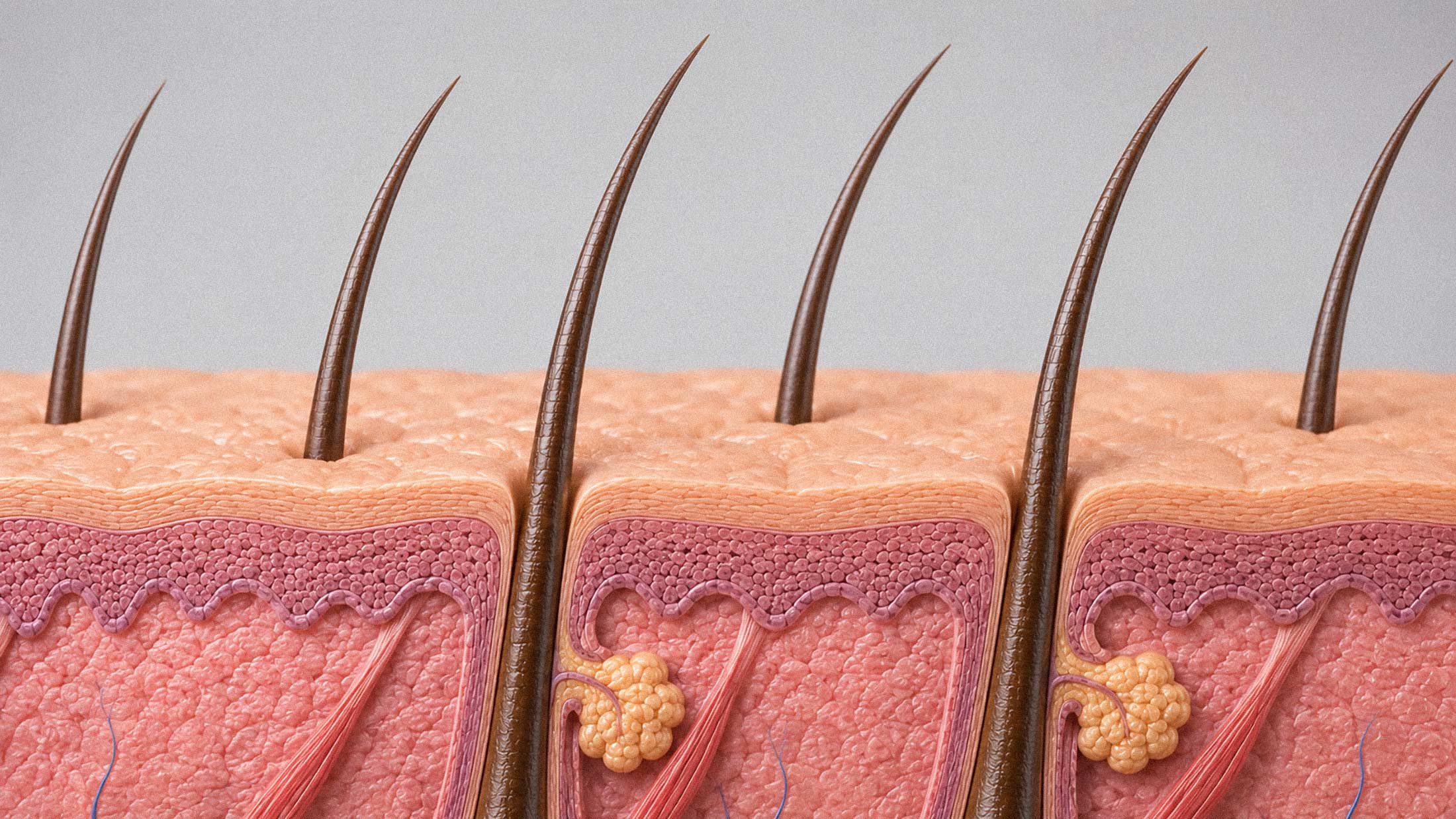
Androgenetic alopecia, the medical term for male- and female-pattern baldness, is primarily caused by oxidative stress-induced dysregulation of hair follicles. When reactive oxygen species accumulate at excessive levels in the scalp, they overwhelm the body's natural antioxidant enzymes, particularly superoxide dismutase (SOD). The follicles become damaged. Hair miniaturizes and eventually stops growing.
Researchers have previously attempted to create synthetic SOD mimics called "nanozymes" to neutralize these reactive oxygen species. The problem: early nanozymes weren't particularly effective at the job. They existed, they worked in theory, but they didn't work well enough to matter clinically.
Machine Learning Screens 91 Compound Combinations
A team led by Lina Wang, Zhiling Zhu, and colleagues at Shandong University decided to let machine learning solve the design problem. Rather than manually testing compounds one by one, they used ML models to screen 91 different transition-metal, phosphate, and sulfate combinations to predict which would have the strongest SOD-like activity.
The algorithms identified manganese thiophosphite (MnPS3) as the most promising candidate. Subsequent testing confirmed the prediction was correct. The IC50 of MnPS3 measured just 3.61 micrograms per milliliter, making it up to 12-fold more potent than most previously reported SOD-like nanozymes.
The team synthesized MnPS3 nanosheets through chemical vapor transport of manganese, red phosphorus, and sulfur powders, then embedded them in a microneedle patch designed to penetrate deep into the skin where hair follicles actually reside.
Results in Mouse Models
In initial tests with human skin fibroblast cells, the nanosheets significantly reduced reactive oxygen species levels without causing harm. The researchers then moved to animal trials.
Nine male mice with induced androgenetic alopecia were randomly assigned to three groups: a negative control receiving only testosterone, an experimental group receiving testosterone plus the MnPS3 microneedle patch (MnMNP), and a positive control receiving testosterone plus minoxidil.
Within 13 days, the mice treated with the nanozyme patch regenerated thicker hair strands that more densely covered their previously bald backsides compared to those treated with either testosterone alone or minoxidil. The MnMNP also outperformed minoxidil even with a reduced frequency of application.
The visual difference in the published images is striking. The nanozyme-treated mice show substantially more hair coverage than their minoxidil-treated counterparts.
Why This Matters Beyond Hair
The hair regeneration results are interesting on their own terms. But the researchers emphasize that the study's broader significance lies in demonstrating how machine learning can accelerate the discovery of nanozyme therapeutics generally. The same computational approach could be applied to wound treatment, tumor therapy, and other conditions where targeted enzyme mimics might prove useful.
This research sits within a larger wave of AI-driven scientific discovery that has begun producing results across multiple fields. The approach of using ML to screen vast combinatorial spaces, rather than testing compounds manually, compresses timelines that previously stretched across years into weeks or months.
What Comes Next
Mouse results don't automatically translate to humans. The hair loss research community has a graveyard full of treatments that looked promising in rodents but failed in clinical trials. The MnPS3 microneedle patch will need to demonstrate safety and efficacy in human subjects before it becomes a real treatment option.
The broader trend, however, is clear. AI-assisted drug discovery is no longer theoretical. The ARTAS robotic system, which has been FDA-cleared since 2011, already uses AI-guided imaging to identify and extract ideal donor hair follicles for transplantation, harvesting 500 to 1,000 grafts per hour with transection rates comparable to experienced surgeons. That's the procedural side. The molecular side is now catching up.
Other research groups have developed nanozyme microneedle systems using ceria and nickel-copper bimetallic compounds, all targeting the same oxidative stress pathway. A 2025 study using curcumin-loaded nanoparticles delivered via microneedles also showed superior efficacy compared to minoxidil in mouse models. The computational infrastructure to run these kinds of molecular screening experiments has become accessible enough that multiple teams are now pursuing similar approaches simultaneously.
Androgenetic alopecia affects approximately 50 million men and 30 million women in the United States alone. The condition impacts roughly 30% of men in their 30s, with prevalence increasing with age. For a condition this common, the current treatment options remain remarkably limited. Minoxidil works for some patients. Finasteride works for others but carries side effects that make many men unwilling to take it.
If machine learning can systematically identify better compounds by screening possibilities that humans would never test manually, the treatment landscape could look substantially different within a decade. The MnPS3 study is a proof of concept. The real work begins now.