NVIDIA unveiled Nemotron 3 Ultra at Computex 2026 on June 1, positioning it as the company's largest open-weights model to date and a direct answer to the compute economics problem that has constrained enterprise AI adoption. The 550-billion-parameter model, built on a hybrid Mamba-Transformer mixture-of-experts architecture, activates only 50 to 55 billion parameters per token processed. That selective activation is the entire point.
The Architecture That Makes This Work
Nemotron 3 Ultra uses what NVIDIA calls LatentMoE, a design that compresses tokens into a low-rank latent space before routing them to specialized expert networks. The company claims this allows the model to call on four times as many expert specialists for the same inference cost compared to standard MoE implementations. Combined with multi-token prediction, which generates multiple future tokens in a single forward pass, the model achieves what NVIDIA says is up to 5x higher throughput than competing open frontier models.
The model was trained in NVFP4, NVIDIA's 4-bit floating-point format, on the Blackwell architecture. Training at reduced precision means using less memory and accelerating computation, enabling NVIDIA to scale the MoE model without the accuracy degradation that typically accompanies quantization at this level.
The cost claims are significant if they hold up. NVIDIA positions Ultra as delivering 30% lower cost than comparable frontier models for complex agentic tasks, though these are the company's own benchmarks against rivals it selected. Independent verification will matter.
What Changes for Agent Development
The Nemotron 3 family supports a context window of up to one million tokens. That capacity opens the door to analyzing entire codebases, document collections, or prolonged work sessions in a single pass without fragmenting input. For enterprise-scale retrieval-augmented generation, compliance analysis, or multi-hour agent sessions, the 1M-token window reduces context fragmentation and improves factual grounding.
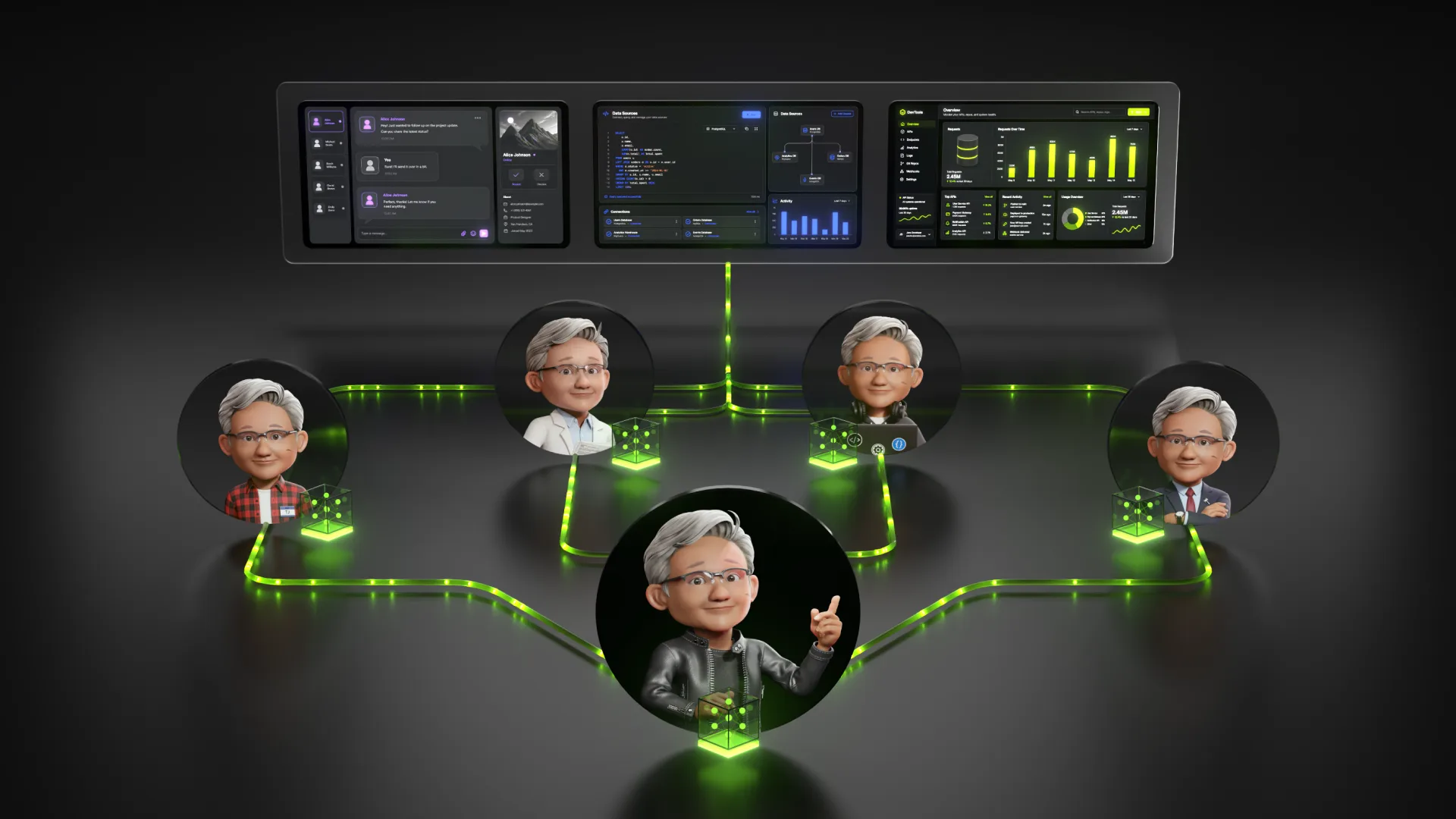
NVIDIA trained the model using reinforcement learning across many environments in NeMo Gym, an open-source library for building and scaling RL environments. These environments evaluate the model's ability to perform sequences of actions, generating correct tool calls, writing functional code, or producing multi-part plans that satisfy verifiable criteria. The trajectory-based reinforcement produces a model that behaves reliably under multi-step workflows and handles structured operations common in agentic pipelines.
Nemotron 3 Ultra is available on Hugging Face, OpenRouter, and build.nvidia.com, with additional distribution through AWS JumpStart, Google Cloud, Microsoft Foundry, CoreWeave, and over twenty other inference platforms. NVIDIA is also packaging it as a NIM microservice for self-hosted deployment.
The Hardware Stack That Makes Local Deployment Possible
Running a 550-billion-parameter model requires meaningful GPU infrastructure. NVIDIA addressed this at Computex with two hardware announcements that change the mid-term trajectory for local inference.
DGX Station for Windows runs the GB300 Grace Blackwell Ultra superchip with 775GB of coherent unified memory. That capacity is sufficient to run Nemotron 3 Ultra at production-grade throughput without cloud dependency. Partners including HP, Dell, Asus, Supermicro, and MSI are bringing DGX Station systems to market in Q4 2026.
RTX Spark, the consumer and developer play, pairs an Arm-based Grace CPU with a Blackwell GPU sharing 128GB of unified LPDDR5X memory. It will not run the full 550B model, but NVIDIA has positioned Nemotron 3 Nano and Nemotron 3 Super, a 120B-parameter variant, for local inference on smaller hardware. RTX Spark systems arrive in fall 2026. The deployment pattern NVIDIA is establishing runs from cloud API for experimentation, to NIM managed API for production, to DGX Station or RTX Spark for on-premises sovereignty.
Where Robotics Fits
Nemotron 3 Ultra does not operate in isolation. At the same Computex keynote, NVIDIA released Cosmos 3, the company's first open omnimodel for physical AI. Where Nemotron 3 Ultra handles reasoning and coding, Cosmos 3 handles world simulation and action generation for robots and autonomous vehicles.
The shared deployment infrastructure, NIM microservices, build.nvidia.com, and Hugging Face, means teams can run Nemotron for their reasoning agent tier and Cosmos 3 for their simulation and action generation tier within the same NVIDIA-native stack. For edge deployment, NVIDIA's Jetson AI Lab provides tutorials and model benchmarks for developers building robotics and edge AI applications with optimized Nemotron models.
The voice component matters too. Nemotron 3.5 ASR uses a cache-aware streaming architecture that processes audio deltas instantly, ensuring sub-100ms latency for real-time voice orchestration. The English version already powers the voice input feature in Microsoft GitHub Copilot CLI, used by more than 20 million developers. The new release extends support to 40+ languages.
What This Means for the Open Model Landscape
The Nemotron 3 family has seen over 50 million downloads in the past year. Thirteen early adopters including Accenture, CrowdStrike, Palantir, and Perplexity are already integrating the models.
NVIDIA is releasing Nemotron 3 Ultra with open weights, training data, and recipes, a more transparent gesture than the open-weights-only approach that has become the industry norm. The model releases are moving to OpenMDW-1.1, the Linux Foundation's permissive license purpose-built for open AI model distributions.
The strategy is consistent: open models across every domain in order to sell the GPUs that run them. For developers and enterprises, the question is whether NVIDIA's efficiency claims hold up under independent testing and whether the total cost of ownership, including hosting, engineering, monitoring, and governance, actually delivers on the promise of 30% lower costs for agentic workflows.
Jensen Huang noted during the keynote that the team is already working on Nemotron 4, with a roadmap stretching beyond it. The competitive pressure on closed-model providers just increased.