The ESP32 is everywhere. It powers smart home gadgets, industrial sensors, hobbyist drones, and countless devices that need cheap Wi-Fi and Bluetooth in a compact package. Designed by Espressif Systems in Shanghai and fabricated by TSMC, the microcontroller family has become the default choice for connected devices because it works, costs almost nothing, and comes with a decade of community support.
For most applications, that's enough. But the question that builders are asking themselves is: what are the implications of a world that runs on foreign (and sometimes adversary) silicon? For manufacturers building products that touch defense procurement, critical infrastructure, or sensitive industrial control systems, this question blares our like an alarm bell. They don't just need a chip that works. They need a chip they can audit. A security mindset is critical.
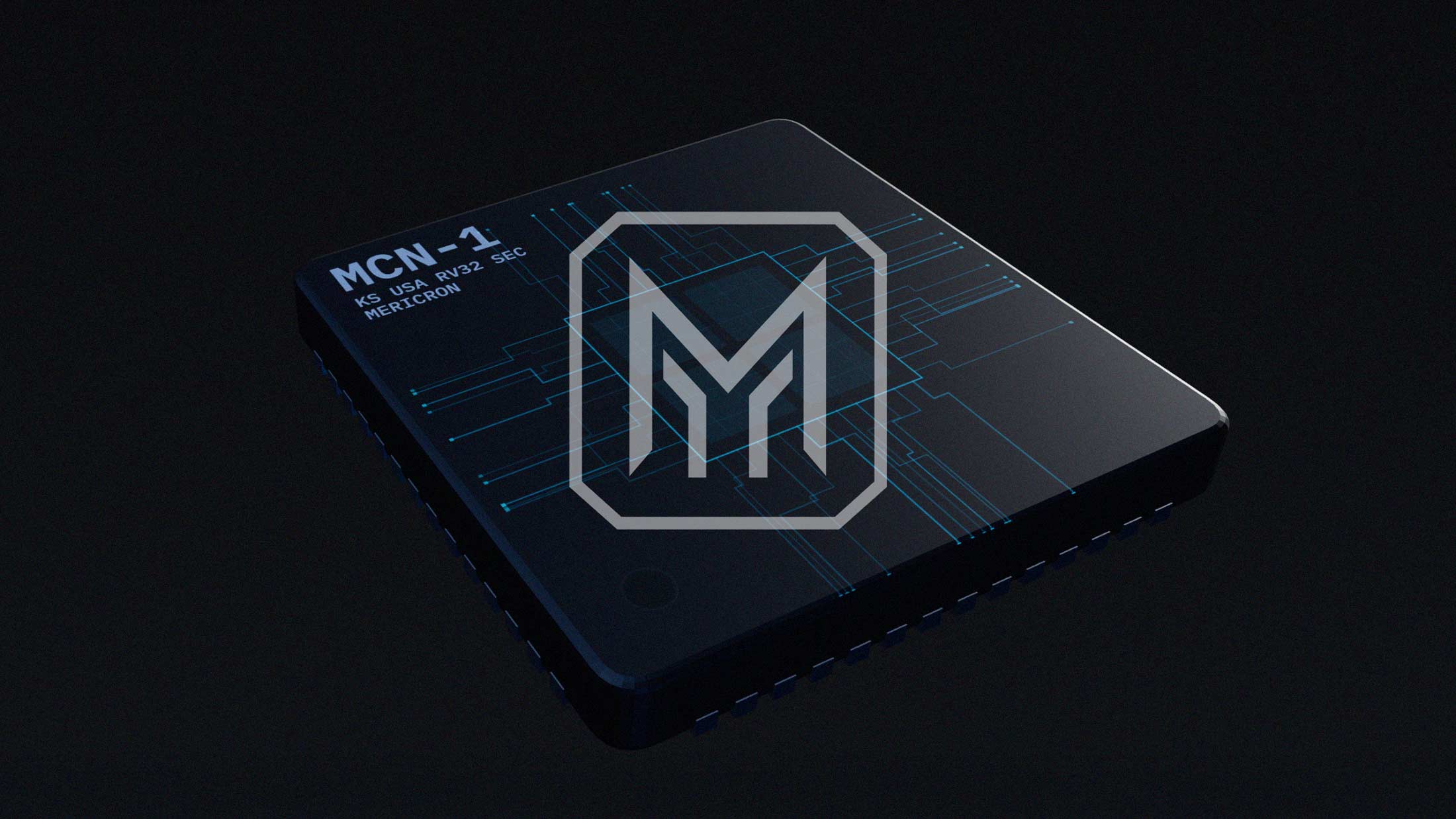
Mericron, a Kansas-based startup, is attempting to build exactly that chip. Cole Studer, the company's founder, spoke with Glitchwire about MCN-1, their pre-silicon wireless microcontroller designed for full-stack transparency. Their stated goal is a part that's designed, fabricated, packaged, and tested entirely in the United States.
The Interview
Why did you start Mericron, and what specifically about the ESP32 made you decide it needed an American alternative?
I have used ESP32s and other MCUs myself for nearly a decade throughout various projects. They are inexpensive, capable, and supported by a huge ecosystem that makes projects easy.
It bothered me to the core that I was in Detroit at an event called Reindustrialize, at a startup company that’s supplying our industrial base with metals as fast as is possible, and here I am holding a Chinese chipset trying to help them run their bandsaws as fast as they can go through a given material.
The problem is that when you need a device that you can trust in a critical environment, it fails the trust part. You don't know what's in the wireless blackbox and you don't know what's in the firmware. You upload your code and it just does things according to their book. You can open the application code, but the radios and cores remain a closed computer handling your data and doing who knows what with it. If the wireless MCU that we really want already existed, I would buy it instead of starting a semiconductor company. Last year I built a Wi-Fi motion detection project with three FeatherS3D's made by Unexpected Maker. I reached the limits of what the hardware, or rather the limiting firmware would allow. It was sometime after that where I jokingly said to my co-founder "What if we made an American ESP32?", and that was just an idea until a few months ago when I was at a hackathon hosted by Nox Metals using the same board. It bothered me to the core that I was in Detroit at an event called Reindustrialize, at a startup company that's supplying our industrial base with metals as fast as is possible, and here I am holding a Chinese chipset trying to help them run their bandsaws as fast as they can go through a given material. I briefly mentioned this idea to several founders whom I made friends with at the conference in Detroit and I was surprised that almost every one of them that I mentioned this to, highly supported the idea. So here I am raising to make this dream a reality. I'm currently serving as CTO of Miltech Manufacturing. We are an AS9100 and ITAR CNC machine shop currently working on our CMMC level 2 certification and while I really want to use ESP32s for all of my machine monitoring and automation projects because they're cheap and easy, I refuse, and it would raise a lot of flags for a C3PAO auditor trying to certify us.
Are there specific global socioeconomic policies that spurred you to kickstart this effort?
No single policy caused it, there is a larger shift where governments and manufacturers are paying closer attention to where technology is designed, who controls it, and whether its supply chain can survive political disruptions.
The CHIPS Act and domestic foundry investment made an American production path more realistic. Defense procurement and cybersecurity requirements are also creating more demand for documented origin and verifiable firmware.
I want to be clear that ESP32 is not broadly banned, and CMMC does not prohibit it. The opportunity exists because some buyers are choosing to remove that risk before a blanket rule forces them to.
When you say 'American,' is the MCN-1 fabbed, packaged, and tested in the US?
That is the production plan, but MCN-1 is still pre-silicon.
The chip is being designed in Kansas, and our target process is GlobalFoundries 22FDX at Fab 8 in Malta, New York. We also intend to use American testing and packaging. I see no reason why we can't keep it all here.
Do you anticipate this product being price-competitive, or is it a premium part for people who will pay for provenance?
It will begin as a premium part. Our current target is roughly $4 to $7 at 10,000-unit volume, but that is not a final quote.
A commodity wireless chip benefits from enormous production volume and years of yield and packaging optimization. MCN-1 will not match a roughly $2 commodity part immediately.
The first customers are comparing it with a more expensive multi-chip design, a failed procurement review, or a redesign late in a product's life. Origin is worth more in those markets. At higher volume, I expect the price difference to narrow.
Who is the customer? Is this mainly for defense and critical infrastructure, or is it for hobbyists too?
Defense programs and regulated commercial manufacturers are the first customers because they feel the problem most sharply. That includes industrial equipment, critical infrastructure, robotics, medical devices, and other products expected to remain in service for years.
Developers and hobbyists still matter. The public development boards, SDK, documentation, and firmware will not be a stripped-down community edition. They will use the same foundation as the commercial product. It's kind of like the difference between Red Hat Enterprise Linux and Fedora.
The defense market creates the initial reason to build MCN-1. A broad developer community is what can make it useful and sustainable.
Espressif has a head start with ESP-IDF and a decade of ecosystem. What will support look like for an MCN-1 developer?
We cannot pretend to recreate a decade of ESP-IDF work at launch. We have to earn developer adoption.
MCN-1 will be Zephyr-first, with bare-metal support and an Arduino path for simpler projects. The SDK, HAL, drivers, radio firmware, bootloader, examples, and build tools will be public. We also plan migration guides for common ESP-IDF patterns rather than claiming existing ESP32 binaries will run unchanged.
The basic experience needs to be simple. A developer should be able to install the tools, flash a board, connect to Wi-Fi, and inspect every layer involved. OEMs will receive direct integration and provisioning support, while public documentation and issue tracking remain available to everyone.
When do you anticipate someone being able to buy one?
I do not have a responsible retail date yet.
MCN-1 is pre-silicon. The multicore security architecture is working on FPGA, but the integrated radio, package behavior, power consumption, and production yield still have to be proven.
The near-term work is an open-radio prototype and the first 22FDX test silicon. Developer access to firmware and FPGA work can happen earlier, but a certified production module is a multi-year semiconductor program. Its schedule depends on funding, RF test results, and regulatory consultation.
I would rather be honest about that than announce a date before the radio has been demonstrated.
What is the 30-second investor pitch, and who should interested investors contact?
American semiconductor independence sits underneath every other effort to rebuild domestic industry. If we do not control the chips, we do not fully control the systems built around them.
If you want to invest in sovereign silicon, we're raising $1 million to finish the Mericron prototype and prepare our first test silicon. Right now, American manufacturers are building long-lived products around foreign-designed wireless chips and radio firmware they cannot inspect. If supply disappears, procurement rules change, or a serious vulnerability emerges, replacing that chip means redesigning the product. No American catalog part solves this today. We're building one, and the digital architecture already works on FPGA. Once this need becomes obvious to everyone, it will no longer be an early opportunity. Interested investors can contact us through Mericron.com or reach me directly on X @photoncmndr or @mericron.
A Movement Gaining Momentum
The sovereign silicon movement is not hypothetical anymore. GlobalFoundries is investing $16 billion to expand its U.S. facilities. The ESP32 ecosystem continues to expand, but so do the questions about supply chain risk in sensitive applications. The Cybersecurity Maturity Model Certification program is tightening requirements across the defense industrial base, pushing contractors to think harder about the provenance of every component in their systems.
Mericron's MCN-1 remains a concept many aspire to see become a reality. But no one, especially the founder, presumes the road ahead to be easy. The company is sober to the fact that pre-silicon is a ways away from production modules sitting in a distributor's warehouse; and yes, RF design is hard and yield optimization takes time. The founder acknowledges all of this.
But the company's pitch rests on a real problem that becomes more pronounced with every geopolitcal flare-up – Sovereign Silicon seems strikingly aligned to the American spirit. American manufacturers building products for defense, industrial, and critical infrastructure applications do not (yet) have an American-designed wireless microcontroller to specify. They either accept foreign silicon and hope procurement rules don't change, or they design around the gap with multi-chip solutions that cost more and take longer. Neither option is great.
Whether Mericron can fill that gap remains to be seen; but the modest $1 million raise seems aimed at proving out a concept that can address a critical gap in open source component sourcing. The funds are expected to fund prototype completion and initial test silicon. If that works, the company will likely need substantially more capital to reach volume production, but the reindustrialization gauntlet will have officially been thrown in the open-source chip category.
The policy environment is shifting. Companies that spent years optimizing for cost are now being asked to optimize for trust. Although a startup building a wireless MCU from scratch in Kansas sounds ambitious and improbable, so did reshoring semiconductor fabrication five years ago – and that's now a $16 billion investment program.