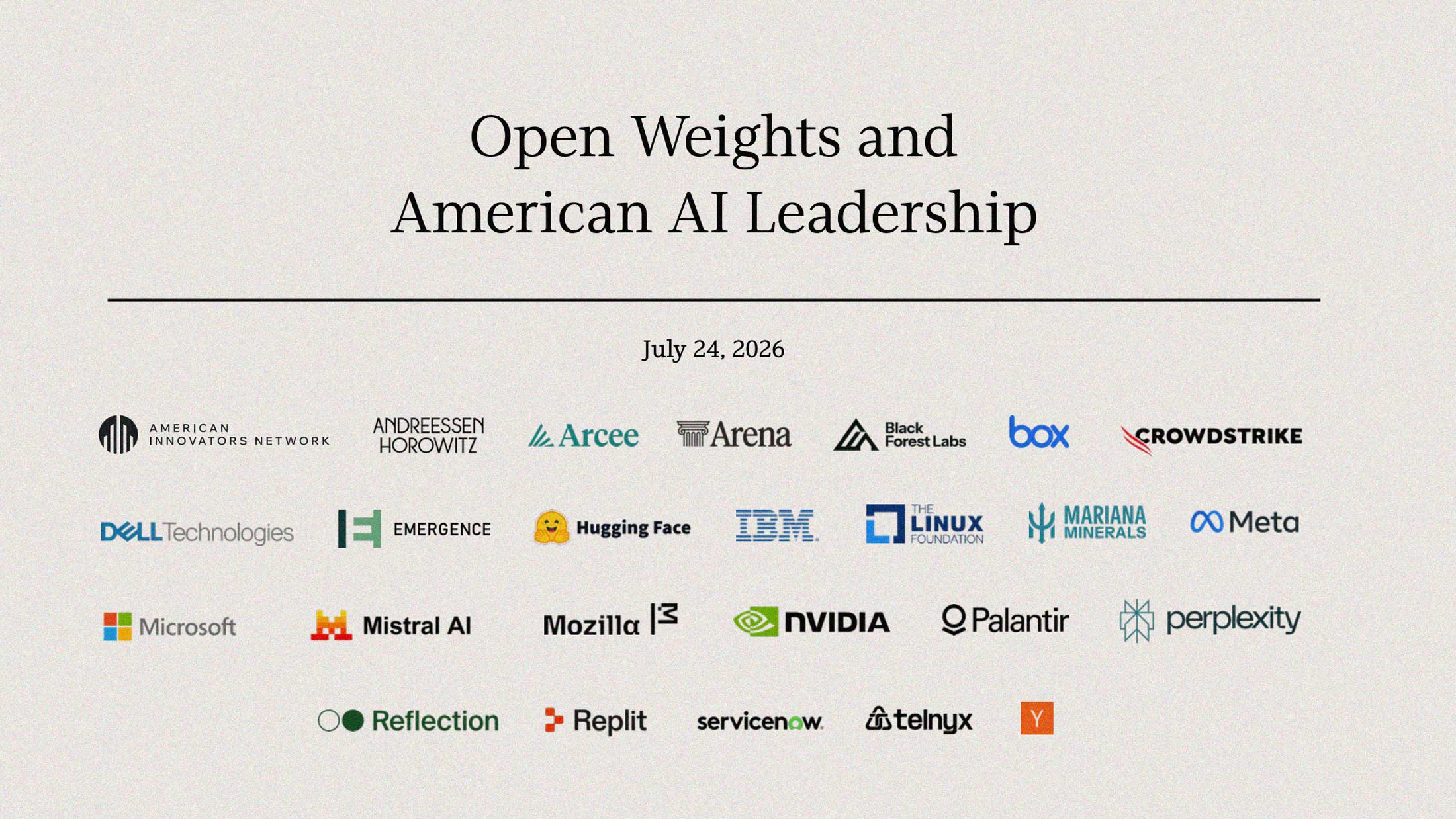
Jensen Huang finally joined X on Friday, and his first post was not about GeForce drivers or Blackwell performance. The NVIDIA CEO used his social media debut to share an open letter signed by 25 tech companies warning Congress that restricting open-weight AI models would weaken American leadership in the technology, not strengthen it.
The letter lands at a fraught moment. Two days earlier, White House Office of Science and Technology Policy Director Michael Kratsios publicly accused Beijing-based Moonshot AI of distilling Anthropic's Fable model to develop its recently released Kimi K3. Treasury Secretary Scott Bessent followed with threats of sanctions against Chinese firms engaged in what he called "industrial-scale distillation attacks." The administration's framing has stoked fears that open-weight models could face broad restrictions, regardless of their origin.
This has my full support.
— Elon Musk (@elonmusk) July 24, 2026
Jensen is right. https://t.co/FubUPT6DVJ
The Signatories Are Sending a Message
The coalition includes Microsoft, Meta, IBM, Palantir, Dell Technologies, Hugging Face, Mozilla, Mistral, CrowdStrike, Perplexity, The Linux Foundation, Andreessen Horowitz, and Y Combinator. Satya Nadella also shared the letter from his account, calling open-weight models "essential to a healthy AI ecosystem."
OpenAI and Anthropic did not sign. Both companies are preparing for IPOs, with Anthropic filing its prospectus confidentially in June and OpenAI following days later. The two labs have been lobbying Washington on the risks of open models, a position critics say amounts to regulatory capture that would entrench the largest frontier labs while boxing out competitors.
Distillation Is the Flashpoint
The core tension is over distillation, a technique where a smaller model is trained using outputs from a larger one. The Trump administration has framed large-scale distillation from closed models as theft. Kratsios claimed Moonshot developed "a sophisticated internal platform to conduct large scale distillation against U.S. models." Bessent put it plainly: "Open source is not open season on American IP."
The letter's signatories draw a different line. They describe distillation as a widely used and legitimate technique "that has helped drive innovation since the rise of the open-source software movement." Unlawful extraction from closed models is a real concern, they argue, but it should be addressed through targeted legal action rather than sweeping restrictions on open-weight AI.
"In shaping this ecosystem, policymakers should be careful not to conflate legitimate model-development techniques with misappropriation," the letter states. It goes on to warn that overly broad rules could drive innovation overseas or concentrate AI capability in a handful of closed providers.
The Broader Stakes
The letter makes a strategic argument as much as a technical one. America's lead in AI, it contends, will not be measured by whether a single frontier model sits at the top of a benchmark. The more important question is whether the U.S. builds an ecosystem where startups, enterprises, universities, and public institutions can access and adapt advanced AI without paying frontier-model prices for every task.
Open weights make that possible. Organizations can deploy models on their own infrastructure, customize them for specialized use cases, and reduce dependency on any one cloud provider. Cost matters here: running smaller, specialized models for routine workloads is far cheaper than routing everything through frontier services.
The letter also addresses security. "Relying solely on closed models is not inherently safe," the signatories write. Closed systems can be breached, misused, or fail in ways that outsiders cannot detect. Concentrating capability behind a few providers compounds the risk.
Where this goes next is unclear. Kratsios has signaled the administration supports a competitive AI ecosystem but will pursue targeted enforcement against covert distillation campaigns. Whether Congress moves toward broader restrictions will depend on how successfully the two camps make their case. The 25 signatories just laid down their marker.