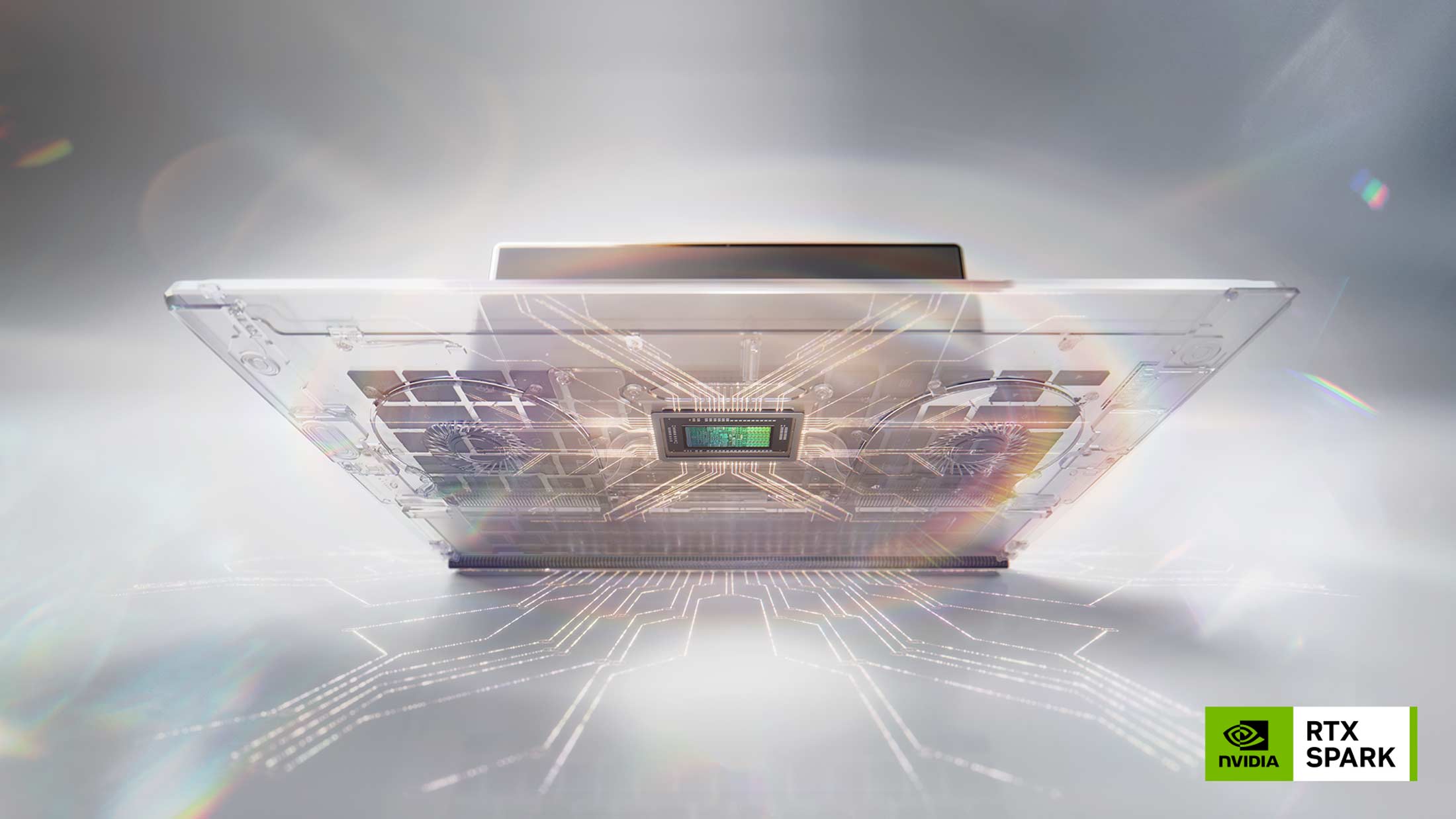
NVIDIA has finally made its move into the Windows PC processor market. At GTC Taipei today, the company unveiled RTX Spark, an Arm-based superchip that combines a 20-core Grace CPU with Blackwell RTX graphics and up to 128GB of unified memory. The official announcement describes it as a system designed for AI, creating, and gaming, all packed into thin laptops measuring as slim as 14mm and weighing around three pounds.
This is not a minor product refresh. NVIDIA is entering direct competition with Qualcomm's Snapdragon X line, AMD, Intel, and Apple's M-series silicon. The company claims RTX Spark delivers graphics performance close to the GeForce RTX 5070 Laptop GPU, making it the first Windows on Arm chip with serious gaming credentials. During the keynote, Jensen Huang demonstrated the platform running 007 First Light and Forza Horizon 6 on stage, both running on battery power.
The Hardware
RTX Spark integrates a Blackwell RTX GPU with 6,144 CUDA cores, fifth-generation Tensor cores with FP4 support, and a 20-core Arm CPU co-developed with MediaTek. The GPU and CPU are connected via NVLink-C2C with 600 GB/s of bandwidth. NVIDIA claims the chip delivers 1 petaflop of FP4 AI performance. The entire package is built on TSMC's 3nm process.
The unified memory architecture is the technical differentiator here. Unlike traditional laptops where CPU and GPU have separate memory pools, RTX Spark shares a single pool of LPDDR5X memory between both processing units. Configurations will range from 16GB up to 128GB in the top-tier models. This eliminates VRAM bottlenecks for AI workloads and allows the system to handle 120-billion-parameter language models with context windows stretching to 1 million tokens, according to NVIDIA's claims.
Gaming and Performance
NVIDIA says RTX Spark laptops can play AAA games at 1440p resolution and over 100 frames per second with ray tracing enabled, powered by DLSS 4.5 and Frame Generation. The company did not disclose specific graphics settings, power limits, or independent benchmarks. This is worth noting: NVIDIA's 100 FPS claim comes from internal testing, and we have not seen third-party verification.
What makes this unusual for a Windows laptop is the claimed battery behavior. According to Tom's Hardware, RTX Spark systems will deliver similar performance whether plugged in or running on battery. This removes the performance cliff that has plagued gaming laptops for years. NVIDIA's own marketing lead, Mark Aevermann, told PC Gamer that gaming battery life should be "much better than anything you've seen before on RTX laptops," though he declined to give specific hour estimates.
The laptop designs are targeting 45W to 80W thermal envelopes. That's aggressive for a chip with RTX 5070-class graphics, and suggests NVIDIA is making serious efficiency tradeoffs. Whether those tradeoffs affect sustained performance remains to be tested.
Software and the Agent Pitch
The hardware reveal was paired with an aggressive software strategy. NVIDIA is positioning RTX Spark primarily around AI agents, not gaming. The company is introducing OpenShell, a runtime environment designed to let AI agents operate locally with user control. Microsoft is adding new Windows security and containment features to support this. Satya Nadella called RTX Spark "a real breakthrough" toward delivering local intelligence to every desk.
Adobe is rearchitecting Photoshop and Premiere from the ground up for the platform, promising 2x faster AI and graphics performance. Blackmagic Design, Blender, DaVinci Resolve, CapCut, ComfyUI, and OTOY will also have native Arm support at launch. On the gaming side, NVIDIA has secured commitments from Xbox, Riot Games (League of Legends and Valorant), KRAFTON (PUBG), and Remedy Entertainment. Support for Easy Anti-Cheat and BattlEye means competitive multiplayer titles should work from day one.
This addresses the main weakness of previous Windows on Arm efforts. Qualcomm's Snapdragon X devices struggled with game compatibility and performance. NVIDIA's full RTX stack, including CUDA, DLSS, Reflex, and G-SYNC, should give developers more familiar tools and fewer reasons to avoid the platform.
Who's Shipping What
RTX Spark laptops will arrive this fall from ASUS, Dell, HP, Lenovo, Microsoft, and MSI. Acer and GIGABYTE will follow later. Microsoft's Windows Blog specifically highlights the Surface Laptop Ultra as a flagship implementation. NVIDIA expects more than 30 laptop models and around 10 compact desktops to launch in the initial wave.
Confirmed models include the ASUS ProArt P14 and P16, Dell XPS 16 Creator Edition, HP OmniBook X 14 and OmniBook Ultra 16, Lenovo Yoga Pro 9n, and MSI Prestige N16 Flip AI. Premium models will feature tandem OLED displays with G-SYNC support. Pricing has not been announced, but NVIDIA indicates the first systems will target premium price points, with lower-tier configurations featuring less memory expected to follow.
The Questions That Remain
NVIDIA withheld almost every comparative benchmark. There are no published numbers showing RTX Spark against Intel, AMD, Apple, or Qualcomm silicon. There are no sustained gaming benchmarks, no thermals data, and no real-world battery figures. The company is asking buyers to trust its performance claims until independent reviews arrive.
The Arm software compatibility question also lingers. Traditional x86 Windows applications will need to run through Microsoft's Prism emulator unless native Arm versions exist. NVIDIA says it's working with over 100 Windows software providers to ensure compatibility, but the history of Windows on Arm suggests transition periods are rarely smooth.
RTX Spark systems will not support pairing with additional discrete GPUs. This limits the chip's appeal for power users who want upgradeable graphics, but fits NVIDIA's focus on thin-and-light portables and compact mini PCs.
RTX Spark represents NVIDIA's largest bet on the consumer PC space to date. If the claims hold, it could fundamentally change what buyers expect from portable Windows machines. Fall 2026 will tell us whether the numbers are real.