A four-page note appeared on mathematician Levent Alpöge's personal website on November 20. It opens with a direct sentence: "I believe I have, working with Claude, discovered a proof of the Riemann Hypothesis."
Alpöge is a number theorist employed by Anthropic. He completed his PhD at Princeton under Fields Medalist Manjul Bhargava, held an NSF postdoctoral fellowship at Columbia and Harvard, and was a Junior Fellow in the Harvard Society of Fellows before leaving academia for the AI company. His 2026 has been unusually productive. In July, he used Claude to find a counterexample to the Jacobian conjecture, an 85-year-old problem in algebraic geometry.
The note, titled "Remark" and hosted at alpo.ge, says the same method "easily extends much further, resolving the so-called Generalized Riemann Hypothesis." It adds that Alpöge expects the Extended Riemann Hypothesis to follow "with more time."
What the Riemann Hypothesis Actually Says
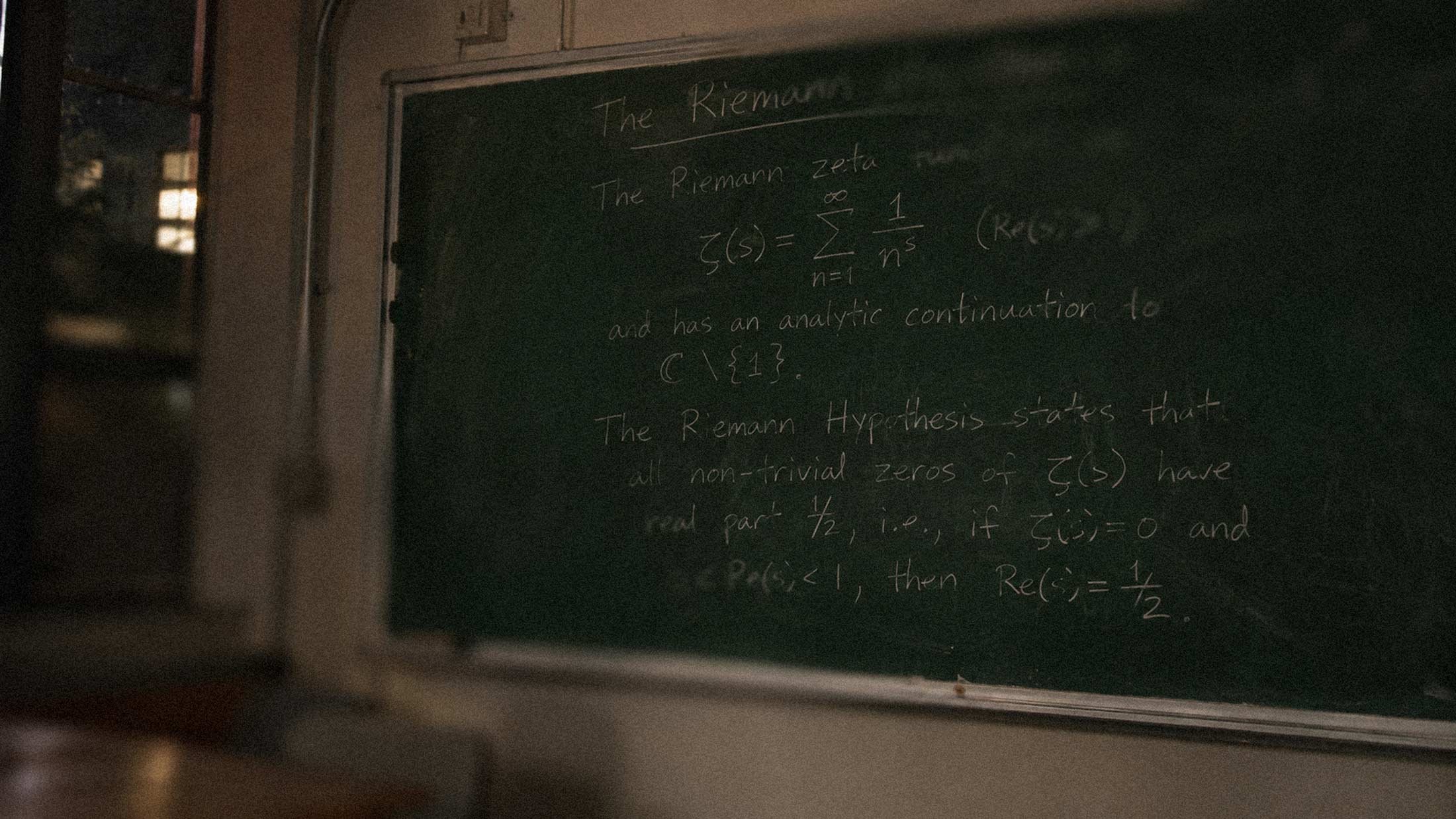
Bernhard Riemann proposed the hypothesis in 1859. It concerns the Riemann zeta function, a mathematical object whose behavior encodes information about the distribution of prime numbers. The hypothesis states that all nontrivial zeros of the zeta function lie on a single vertical line in the complex plane, known as the critical line, where the real part equals one-half.
Prime numbers underpin modern cryptography. RSA encryption, the system protecting most internet commerce, relies on the difficulty of factoring large numbers into primes. A proof of the Riemann Hypothesis would refine our understanding of how primes are distributed among the integers. Some researchers have speculated that this could have implications for cryptographic security, though experts disagree on how direct or immediate those consequences would be.
The hypothesis is one of the seven Millennium Prize Problems designated by the Clay Mathematics Institute in 2000, each carrying a $1 million reward. Only one, the Poincaré Conjecture, has been solved. Grigori Perelman proved it in 2003 and declined the prize.
How the Claimed Proof Works
The note includes a 20-step timeline, which Alpöge says Claude compiled, with dates running from early October to mid-November 2026. The final step, covering the Generalized Riemann Hypothesis, is dated November 16.
According to coverage from OfficeChai, the argument uses a chain of "theta lifts," which move mathematical objects called automorphic forms between symmetry groups. The note credits the key step to Claude.
Crucially, Alpöge released no traditional paper. Instead, he published the proof formalized in Lean, a proof assistant that mechanically verifies every logical step. The Lean project is split into 14 compressed archive parts on his website. As one observer put it on social media: "So it actually needed one mathematician, one model, six weeks."
This approach inverts the usual order of mathematical publication. A machine can confirm that a proof is internally valid. Humans still have to confirm that it proves the right statement. No outside expert has yet verified that the Lean archive builds correctly or that its final theorem matches the Riemann hypothesis as mathematicians understand it.
Three Months After "We Don't Think This Method Leads to a Proof"
The timing is striking. In August, Anthropic announced that an unreleased version of Claude had improved the known lower bound on zeta zeros lying on the critical line from 41.6% to 67.2%. That result was significant but partial. Proving 67% of zeros are where they should be is not the same as proving all of them are.
At the time, Anthropic said the approach was unlikely to lead to a full proof of the hypothesis. Mathematician Youness Lamzouri independently recovered the same bounds using a different method shortly after, describing Claude's argument as "technically intricate" with a "main mechanism" that was "not immediately transparent."
Now, three months later, Alpöge claims to have done what Anthropic's earlier work explicitly disclaimed.
What It Would Unlock
The Riemann Hypothesis sits at the center of a web of related conjectures. Hilbert's eighth problem, from his famous 1900 list, bundles it with the twin prime conjecture and Goldbach's conjecture. Progress on one has historically illuminated paths toward others.
A confirmed proof would settle hundreds of conditional theorems in number theory that begin "Assuming the Riemann Hypothesis is true." Weak versions of the Goldbach conjecture, for instance, have been proven contingent on the generalized hypothesis.
Beyond pure mathematics, the zeros of the zeta function connect to energy spectra in quantum systems and eigenvalues of random matrices. Physicists have speculated about links between the hypothesis and quantum mechanics for decades. Confirmation would not automatically unlock those connections, but it would validate the intuitions driving that research.
The Verification Gap
The claim remains unverified. OfficeChai notes that several mathematicians are thanked in the document, but being thanked does not mean they have checked the proof. The Clay Mathematics Institute requires a proposed solution to be published in a qualifying outlet, to receive general acceptance in the mathematical community, and to have been published for at least two years before it will consider awarding the prize.
History counsels skepticism. Claimed proofs of the Riemann Hypothesis appear regularly. Louis de Branges claimed one in 2004; it was rejected. Dozens of preprints on arXiv over the years have announced solutions. None have held up.
What distinguishes this claim is the Lean formalization, which shifts some of the verification burden from human reviewers to machine checking. If the archive builds and the statement it proves is correctly aligned with the hypothesis, the community will have to take it seriously. If it does not build, or proves a weaker statement, the claim will join the long list of near misses.
Anthropic did not respond to a request for comment by publication time. Alpöge has not shared the note on social media or made public statements beyond the document itself. The company's shares began trading on Nasdaq one day before the note appeared.