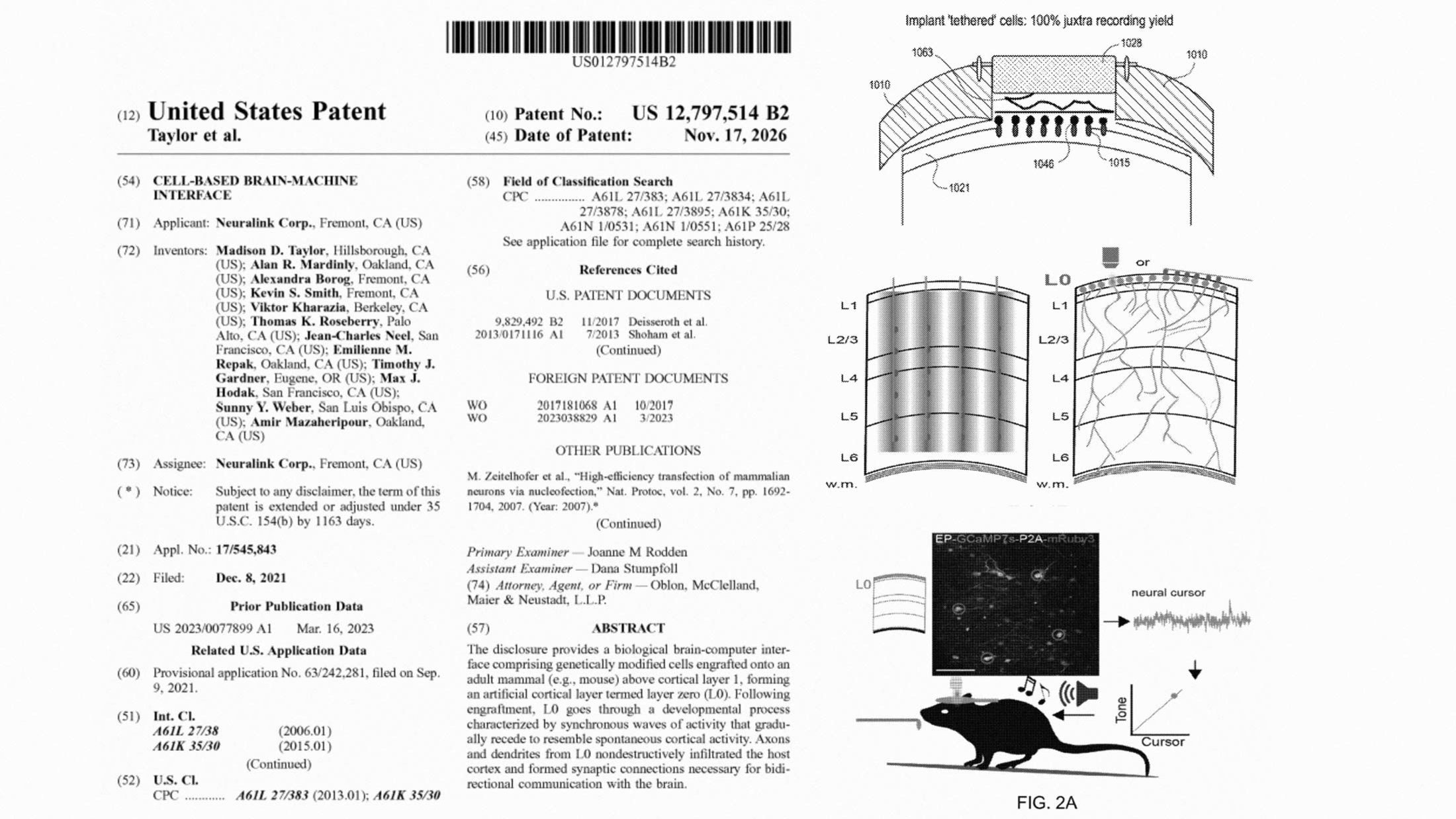
The U.S. Patent and Trademark Office granted U.S. Patent 12,797,514 to Neuralink on November 17, 2026, covering a brain-computer interface built from living neurons rather than the electrode threads used in the company's current N1 implant.
The patent, titled "Cell-Based Brain-Machine Interface," describes a process in which genetically modified neuronal cells are grafted onto the surface of the cerebral cortex. Those cells form what the patent calls "layer zero," an artificial cortical layer positioned above the brain's outermost natural layer. Axons and dendrites from layer zero then grow into the host brain, forming synaptic connections that enable bidirectional communication between external hardware and cortical tissue.
Neuralink's current clinical device, the N1, inserts 1,024 electrodes on 64 flexible polymer threads into brain tissue. As of January 2026, the company reported 21 participants enrolled across its trials worldwide, with Neura Pod tracking more than 27 implant recipients by October. The N1 reads neural signals, allowing people with paralysis to control cursors and other devices by thought. But electrodes do not write signals back into the brain through synapses.
A Different Architecture
The cell-based approach described in the new patent uses an optical interface in its primary claim: a camera reads signals from the grafted neurons, and a light source, combined with optogenetic modification, sends signals back in. Other claims in the patent tether the cells to electrodes instead. Either way, the design could in principle provide both input and output through synaptic connections, a capability the electrode-only N1 lacks.
According to the patent filing, grafted cells in adult mice first exhibited synchronized waves of activity that gradually settled into patterns resembling normal brain activity. The patent states that neurites penetrating the brain "avoid cell death, damage, disruption of vasculature and gliosis," a claim that remains to be validated in humans.
The Inventors Left
Twelve inventors are listed on the patent. Two of them, Max Hodak and Alan Mardinly, departed Neuralink in 2021 and co-founded Science Corporation, a competing brain-computer interface company now headquartered in Alameda, California. Hodak was a co-founder and president of Neuralink. Mardinly joined Neuralink's leadership team in 2019 after developing holographic optogenetic stimulation techniques at UC Berkeley.
Science Corporation is now pursuing its own biohybrid neural interface, a device that embeds lab-grown neurons modified with light-sensitive proteins. The company says its architecture can anchor hundreds of thousands of engineered neurons to a device; their projections then form connections with neurons in the host brain. MicroLEDs stimulate the embedded neurons, while electrodes record their activity. Alan Mardinly leads the biohybrid project, according to Science's website.
"The principal advantages of a biohybrid implant are that it can dramatically change the scaling laws of how many neurons you can interface with versus how much damage you do to the brain," Mardinly told New Scientist in 2024.
Science has not yet implanted its biohybrid device in a human. The company's most advanced product, the PRIMA retinal implant for macular degeneration, has CE marking in Europe but still requires FDA review before sale in the United States. Science recently raised $400 million in a Series D round, bringing total funding to approximately $890 million.
What the Patent Does and Does Not Grant
A patent conveys the right to exclude others from making, using, or selling a claimed invention. It does not prove the invention works in practice, nor does it guarantee regulatory approval or clinical viability. Neuralink filed the original application on December 8, 2021. The grant arrived nearly five years later.
Neuralink has not publicly stated whether it intends to develop the cell-based approach into a product. The company's current product roadmap focuses on the N1 and its successor implants with higher channel counts. In September 2026, Neuralink confirmed that a participant in its VOICE trial received a 3,000-channel implant, roughly three times the N1's electrode count.
Whether living cells can form a stable, long-term interface with the human brain remains an open question. Research published by Science Corporation in late 2024 showed that after 21 days in mice, only 50 percent of grafted neurons had survived. The patent's claims about avoiding gliosis and damage will face skepticism until human data emerges. For now, what Neuralink has is legal protection for an idea that two of its inventors are already chasing elsewhere.