Pierre-Jean Lorentz remembers when the five-tonne loader first swung itself onto two wheels without human help. "The machine had no prior knowledge of itself," he told Science Robotics, the journal that published the work on November 11. "It learned from scratch."
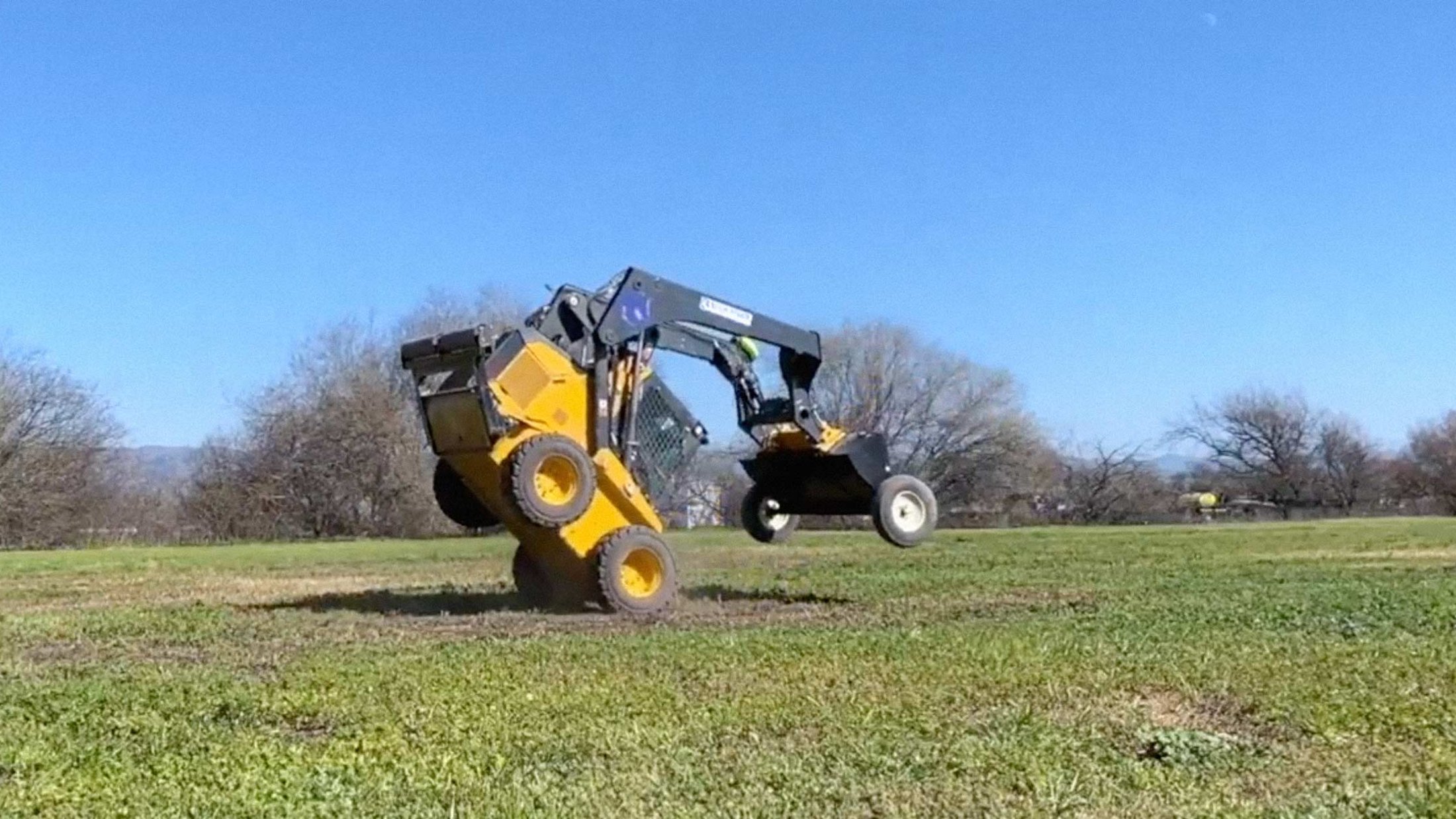
The paper, titled "Heavy Metal Acrobatics," documents what happens when you point reinforcement learning at a piece of construction equipment most operators spend their careers keeping upright. The research team, spread across ETH Zurich's Robotic Systems Lab, Blue River Technology, Gravis Robotics, and Intel's Intelligent Systems Lab, trained a John Deere 332G to do things only a handful of human stunt drivers have managed in official world-record attempts: swing up from four wheels onto two, balance there, spin, drive over rough terrain, swing its bucket back and forth, then land softly.
The videos look like a glitch. Construction loaders are not supposed to pirouette.
Researchers have used reinforcement learning to teach a 5-tonne John Deere skid-steer loader to perform complex acrobatic manoeuvres autonomously. Trained in simulation and transferred to a real machine, the system can balance on two wheels, navigate rough terrain, spin, and control its bucket before landing safely. The research demonstrates the potential of AI-driven automation for heavy construction and industrial machinery. Video Credit: @leggedrobotics / @ETH Paper: https://t.co/MT7fyZ54Hk #engineering #technology
— Wevolver (@WevolverApp) November 17, 2026
Sim-to-Real Without the Hydraulic Model
The technical breakthrough isn't the acrobatics themselves. Skid-steer loaders have been doing two-wheel stunts at county fairs for decades, piloted by operators who spent years developing intuition for how 5,000 kilograms of steel and hydraulics will respond to their joystick inputs. What's new is that the learned policy arrived at something comparable without anyone modeling the machine's hydraulics.
Conventional wisdom in heavy-equipment automation says you need a faithful model of how fluid moves through the actuators. The researchers bypassed that. They trained a small neural network on about 90 minutes of data, letting it learn the relationship between wheel commands and actual wheel speeds. That network, three layers of 32 neurons each, became the actuator model inside the simulator.
The reinforcement learning policy itself trains in that simulator, accumulating the equivalent of thousands of hours of practice in minutes of wall-clock time. When transferred to the physical machine, the policy worked. Controllers trained without simulated sensor noise failed; those with noise injection handled the real world's messiness.
The sensing suite is minimal. No cameras. No joint-pressure sensors. No arm-angle feedback. The policy operates on wheel speeds, body orientation, and angular velocities. That's it.
Blue River and the Deere Connection
Blue River Technology, a John Deere subsidiary since the company's $305 million acquisition in 2017, contributed several of the paper's co-authors. Deere has been pushing autonomy across its product lines, from retrofit kits for tractors to experimental autonomous dump trucks in quarries. This research sits outside that commercial roadmap. No one is shipping a wheelie-capable loader. But the underlying sim-to-real methodology could eventually inform how Deere approaches dynamic control problems in rough terrain.
Gravis Robotics, an ETH Zurich spin-off that raised $200 million at a one-billion-dollar valuation earlier this year, also shows up in the author affiliations. The company already deploys AI systems on construction equipment from multiple manufacturers. Marco Hutter, the paper's senior author and director of ETH's Center for Robotics, co-founded both Gravis and ANYbotics, the quadruped robotics company.
What It Does and Doesn't Prove
The researchers are careful to frame the work as a proof of concept for dynamic control, not a commercial product. The maneuvers the loader performs mirror Guinness World Records for skid-steer stunts: longest wheelie, most 360-degree spins on two wheels in a minute, longest balancing duration. Those records were set by human operators who had practiced the specific machines for years.
The policy matched that level of control after training in simulation for what the authors describe as a computationally modest period. It suggests that for certain dynamic tasks, learning can get you to expert-level performance faster than traditional control engineering, particularly on machines with nonlinear hydraulic systems that resist first-principles modeling.
Whether the technique scales to more practically useful tasks remains open. Rough-terrain traversal on two wheels is a party trick. The paper hints at applications like loading trucks without ramps or navigating obstacles that would stop a four-wheeled stance, but those scenarios involve perception and planning problems the current work doesn't address.
The soft-landing controller is perhaps the most immediately relevant result. When the policy decides to come down from two wheels, it modulates the descent so the rear wheels touch the ground gently instead of crashing down. The comparison video shows what happens when you cut the commands to zero at the top of the balance: the bucket slams into the dirt. The learned controller avoids that. For any future application where a machine needs to recover from an unstable pose, the landing behavior matters more than the stunt itself.
Science Robotics accepted the paper on October 14. The data and figure-generation scripts are available through Dryad.