A television is playing in the background. The caller says no. The television says yes. Which answer does the AI record?
This is the problem Bland, the San Francisco voice-AI startup, says it built Tofu-1 to solve. The company unveiled the model yesterday, describing it as a full-duplex speech-to-speech system designed for the calls that happen in hospitals, moving cars, and rooms where multiple people are talking at once.
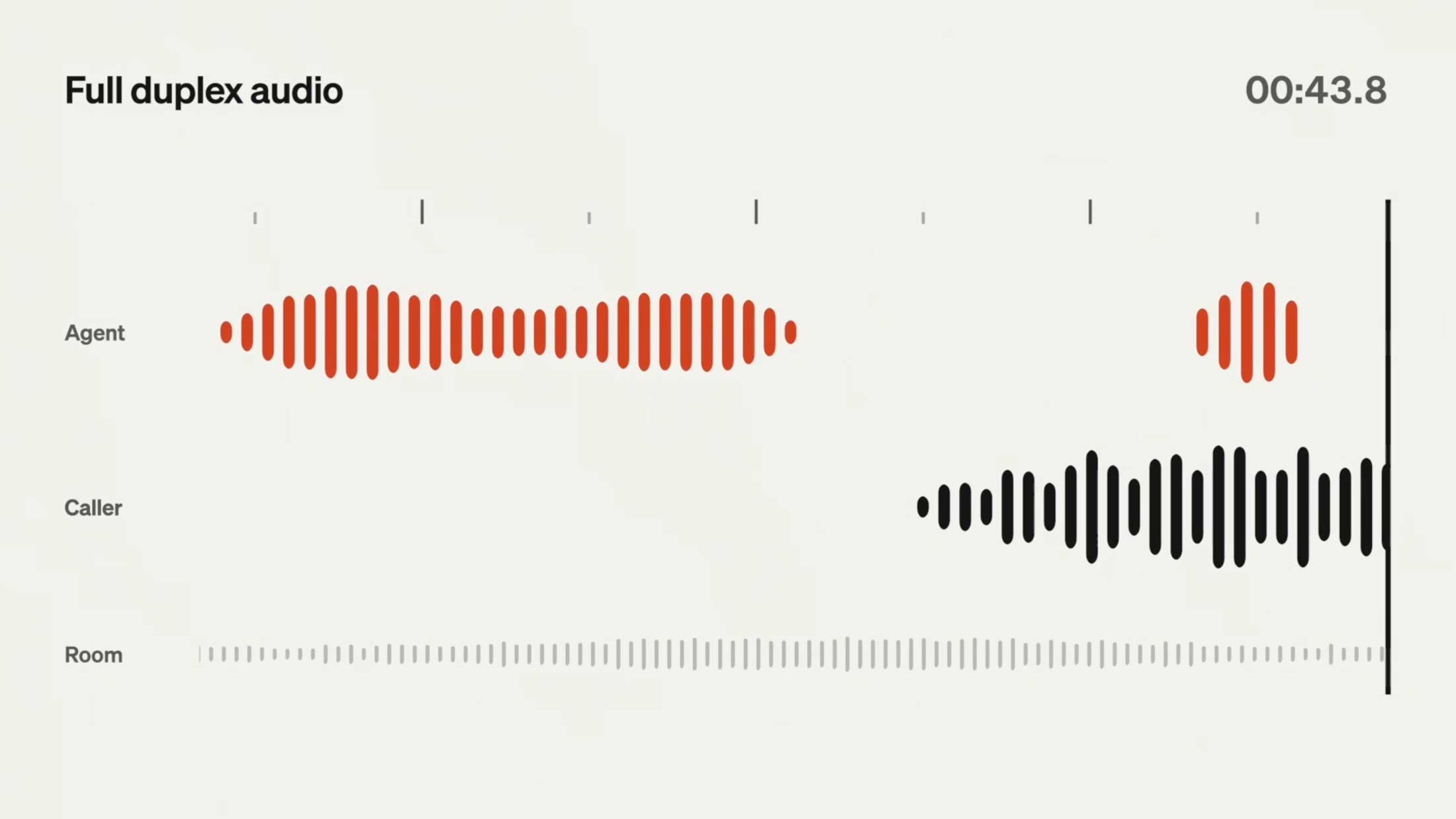
Tofu-1 does not wait for a speaker to finish before responding. According to Bland's product page, it listens while it speaks and reasons while it talks. Callers can interrupt mid-sentence, as they would a human, and the model will adapt.
The pitch: understanding the whole scene
Bland claims Tofu-1 can separate a caller's voice from everything else on a line: a crying child, a television, road noise, a hospital intercom. The company says the model identifies which speaker each phrase is meant for and filters accordingly.
The more striking claim is what Tofu-1 can generate. According to Bland, the model does not just synthesize an AI agent's voice. It can produce an entire audio environment in a single inference pass, including a second speaker, background sounds, and room acoustics. In the demo video posted with the announcement, Bland says every sound was generated by Tofu-1. If accurate, this would mark a departure from conventional voice synthesis, where agent speech and environmental audio are typically layered separately.
In closed screenings, the company says, more than 92 percent of listeners could not distinguish Tofu-1 output from a real recording. The methodology behind that statistic has not been published.
Today we’re introducing Tofu-1, Bland’s speech-to-speech model. The highest-stakes calls rarely happen in good conditions: from moving cars and hospital rooms, over weak signal, with several people talking at once. Tofu-1 is built for those calls. It listens while it speaks, reasons while it talks, and can tell a caller apart from everything else on a line, like a TV or a crying baby. Join the preview: https://t.co/1fDxXRe9ok
— Isaiah Granet (@zaygranet) November 13, 2026
Full duplex in a crowded field
Full-duplex speech models, where an AI can speak and listen simultaneously, have become a point of competition in voice AI. OpenAI's GPT-Live-1, NVIDIA's open-weight NemotronLabs VoiceChat, and Block's Dessa all operate in this mode. The technical challenge is handling interruptions, backchannels, and overlapping speech without losing track of the conversation.
Bland has built its own voice models in-house since the company's founding, a decision CEO Isaiah Granet has described as necessary for tuning the messy parts of live calls. "Most voice AI systems are built for simple interactions," Granet told SiliconANGLE earlier this year. "We are focused on the calls that are hardest to automate."
That focus has drawn enterprise customers. Bland says it now handles upward of 3.5 million calls a week, primarily in healthcare, financial services, and other regulated sectors. A typical call on the platform runs 30 to 45 minutes, longer than the scripted interactions most competitors target.
Funding and infrastructure
The company closed a $50 million Series C round led by Dell Technologies Capital in June 2026, bringing total funding past $100 million. Elana Lian, a partner at Dell Technologies Capital, called Bland "one of the few companies tackling" enterprise voice AI "at the level required for real-world deployment."
Unlike platforms that wrap third-party foundation models, Bland runs on proprietary speech recognition, language models, and text-to-speech. Customers cannot swap in external models.
Verification gaps
The claims around Tofu-1 are substantial, and verification remains thin. No independent testing has been published. The demo video showcases scenarios that, as one analyst noted, are standard for product launches but do not confirm consistent performance across production workloads.
There are also open questions about how the model handles accented speech, highly overlapped dialogue, or edge cases in noisy environments. Pricing and integration details have not been disclosed.
Bland is accepting requests for the research preview and says it is looking for teams in banking, healthcare, insurance, and government to test where the model works and where it breaks. General availability has not been announced.
If Tofu-1 performs as described, the implications extend beyond customer service. A model that can generate realistic caller voices, background audio, and environmental sounds in real time raises obvious concerns for voice deepfakes and caller verification. For now, treat the demo as a company claim worth watching, not a confirmed capability.