Toyota Motor North America announced Tuesday that Scion is back. The brand that sold boxy xBs to millennials before being shuttered in 2016 will return as Scion by Toyota, a division Toyota describes as a "freedom lab" for unconventional mobility ideas.
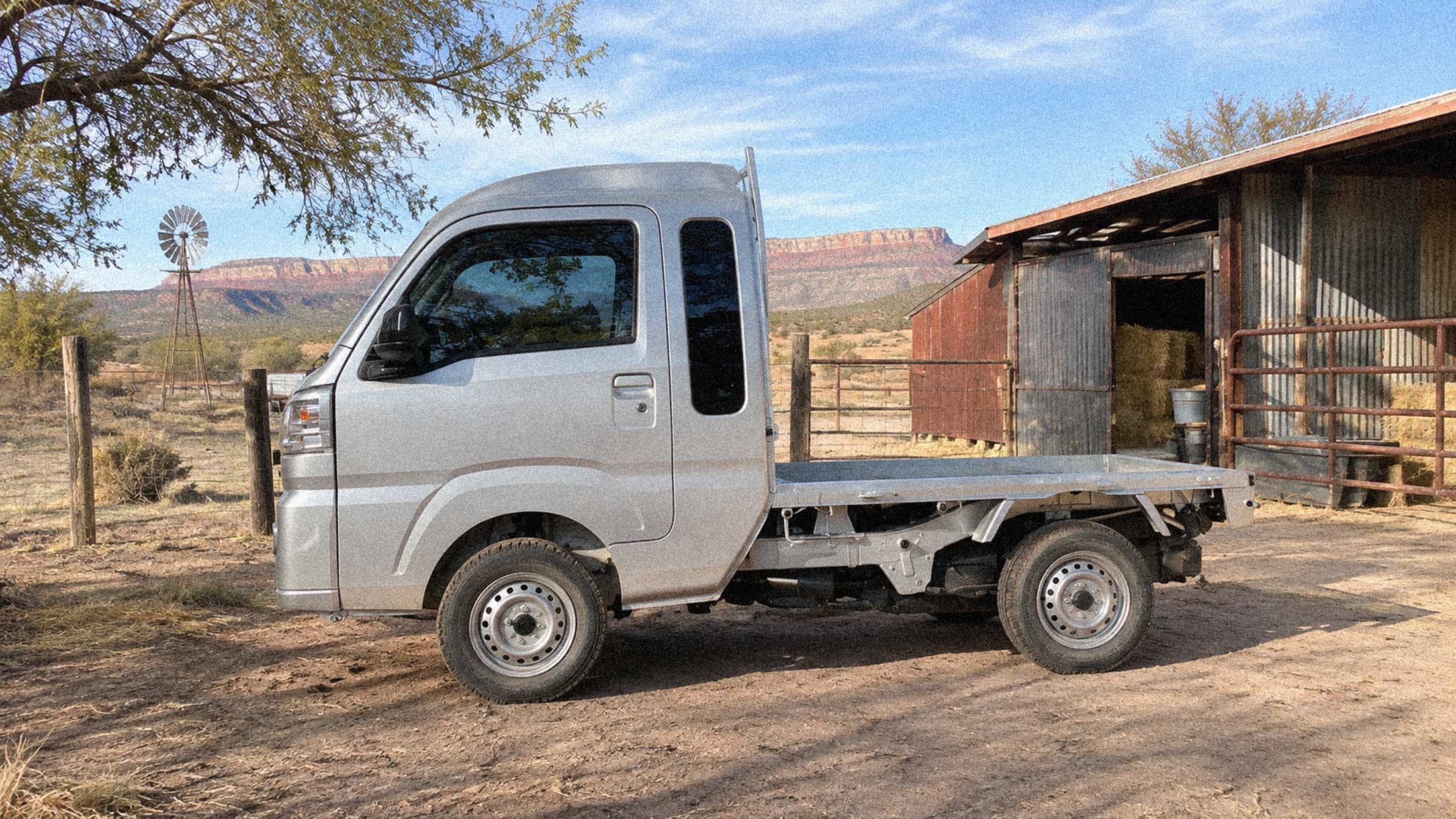
The first product is not a youth-market sedan. It is the KEI-01, an ultra-compact utility truck modeled on Japan's kei-class pickups. Toyota will build it at its Indiana manufacturing facility starting in the second half of 2027.
What the KEI-01 Is
The truck is based on the Toyota Pixis, which is itself a rebadged Daihatsu Hijet Jumbo Cab. It carries a 660cc three-cylinder engine connected to a continuously variable transmission and selectable four-wheel drive. The cargo bed folds down on three sides and is rated for 600 pounds of payload. Heat and air conditioning are standard.
At just over 11 feet long and under 5 feet wide, the KEI-01 is smaller than most UTVs sold in the United States. It is also right-hand drive, matching the layout of the Japanese-market Pixis. That choice remains in place for the U.S. version.
The LSV Strategy
Here is the catch: the KEI-01's top speed is 25 mph.
Toyota designed the truck to comply with Federal Motor Vehicle Safety Standard No. 500, which governs low-speed vehicles. That designation exempts it from full crash testing and federal emissions rules that would apply to a standard highway-legal pickup. The tradeoff is obvious. Buyers cannot legally drive the KEI-01 on roads with posted limits above 35 mph in most states, and it will not be making trips on the interstate.
Don Federico, chief engineer at Toyota Motor North America, told Automotive News that the automaker's engineering teams in Ann Arbor, Michigan, have created a "skunkworks lab" to explore mobility concepts under the Scion by Toyota name. The KEI-01 is the first result of that work.
Fleet First
Individual buyers will not be able to walk into a Toyota dealer and order one. At launch, the KEI-01 is limited to fleet customers through a small network of dealers selected from Toyota's existing network. Toyota says initial volumes are intentionally low.
The company is investing $34 million in Indiana assembly and adding approximately 50 jobs to support the truck's production. Pricing has not been announced. For context, the Japan-market Toyota Pixis truck starts at about 1.3 million yen, around $9,000 at current exchange rates.
Whether Toyota will eventually open sales to retail buyers remains unclear. The press release describes the KEI-01 as a pilot program intended to help the company learn how American customers use the vehicle.
Concepts in the Background
Alongside the KEI-01, Toyota displayed two additional concepts at its announcement events in Ypsilanti Township, Michigan, and Frisco, Texas. The SxS Concept, first shown at SEMA 2025, is a side-by-side vehicle with a turbocharged four-cylinder hybrid powertrain producing more than 300 horsepower. The BKE Concept explores compact personal mobility, though Toyota disclosed few details.
Neither concept has been confirmed for production. Toyota says it will continue developing the SxS and evaluating whether to bring it to market.
A Limited Experiment
The original Scion debuted in 2003 as Toyota's attempt to reach younger buyers with lower-cost cars and no-haggle pricing. Sales peaked at over 170,000 units in 2006 and collapsed to fewer than 46,000 by 2010. Toyota wound down the brand after the 2016 model year, absorbing the remaining vehicles into its main lineup or discontinuing them outright.
The new Scion by Toyota is not a standalone brand. It will exist as a sub-label under the Toyota badge, positioned as a testing ground for products that do not fit conventional dealer portfolios. Whether a 25-mph truck limited to farms, campuses, and warehouse lots counts as a meaningful return remains to be seen.
Japanese kei trucks are already sold in the U.S. through independent distributors, often imported under the 25-year rule that exempts older vehicles from federal standards. What distinguishes the KEI-01 is its route to market: a major automaker building and selling the vehicle directly, with factory support. For Americans who have imported aging Hijets and Sambars, that alone may be worth something.
The KEI-01 is scheduled for the second half of 2027. Fleet buyers will be the first to find out whether Toyota's curiosity project has legs.