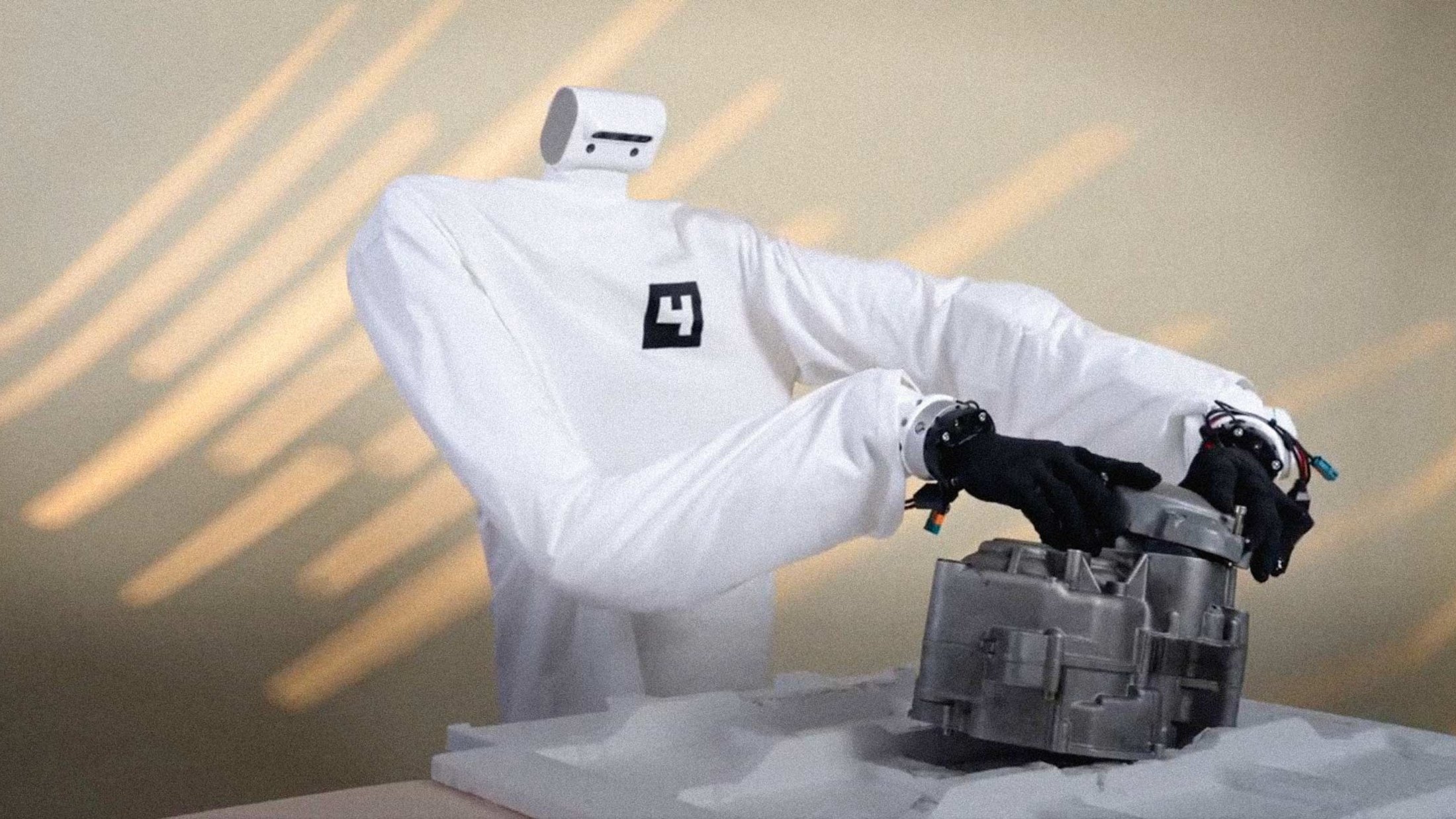
April Robotics, a Zurich-based startup barely eight months old, began taking orders this week for April Gloves, a wearable teleoperation device the company says can teach a robot arm an industrial manipulation task from a single human demonstration. The announcement came alongside the unveiling of April Transfer, the software pipeline that processes the glove data and deploys learned skills to compatible robots.
According to the company's website, the gloves record touch, finger motion, and a view from the wrist-mounted camera. The hardware packs 225 tactile sensing points across the fingertips and palm, 12 IMUs for finger tracking, and a global-shutter camera running at 30 frames per second. Lead time is listed as three to four weeks.
In under 6 months, we built a way to teach any robot a task by doing it once with your own hands. 🧤🤖 Today we're launching April Gloves and unveiling April Transfer. https://t.co/WvSbGsBvnz
— April Robotics (@april_robotics) November 26, 2026
From Human Hands to Robot Arms
The pitch rests on a technique called one-shot imitation learning, an area of active research that aims to let robots acquire new behaviors from minimal training data. April claims its system handles the complete human-to-robot skill transfer pipeline, from capturing what the company calls "skilled hand work" in the glove to deploying that skill on a compatible robot. The idea is to automate fine manipulation tasks in manufacturing without the thousands of demonstrations typically required for robust robot learning.
"Teaching a robot should be as simple as showing it what to do," the company states on its landing page.
Robotics researchers have been chasing one-shot learning for years. A Nature paper published last year described a framework that achieved a 93.3% success rate in multi-step assembly tasks from a single demonstration. Similar work has emerged from Imperial College London and IIT, often combining sensorized gloves with diffusion-based policy models. Where April sits relative to academic benchmarks remains unclear; the company has not released public performance metrics.
Early Stage, Limited Details
April Robotics was incorporated in Zurich in April 2026, according to Swiss commercial registry filings. The company lists three employees and closed a $575,000 seed round in October, with Barcelona-based Yellow as the sole disclosed investor. Co-founder and CEO Joni Rakipi is an ETH Zurich alumnus; the company's website notes affiliations with the university's Robotic Systems Lab and Computer Vision and Geometry Lab, as well as prior experience from Mercedes-Benz, the European Space Agency, and ByteDance Seed.
The startup is positioning its gloves not only for in-house use but also as standalone hardware for external labs and operations. Pricing has not been publicly disclosed. For comparison, haptic teleoperation gloves from established vendors like SenseGlove and Manus range from $4,000 to $12,500, depending on configuration.
April's approach differs from companies like those using reinforcement learning for heavy equipment or large foundation models for general reasoning. The focus here is narrower: capturing the specific tactile and kinematic information that lets a robot replicate a human's hand movements on a factory line.
Whether one-shot transfer generalizes to the variability of real industrial environments is the open question. Factories do not behave like lab benches. Parts shift, tolerances change, lighting varies. The company's claim that its foundation models "learn dexterity directly from human demonstrations" will face that test once hardware ships and customers start running their own evaluations.