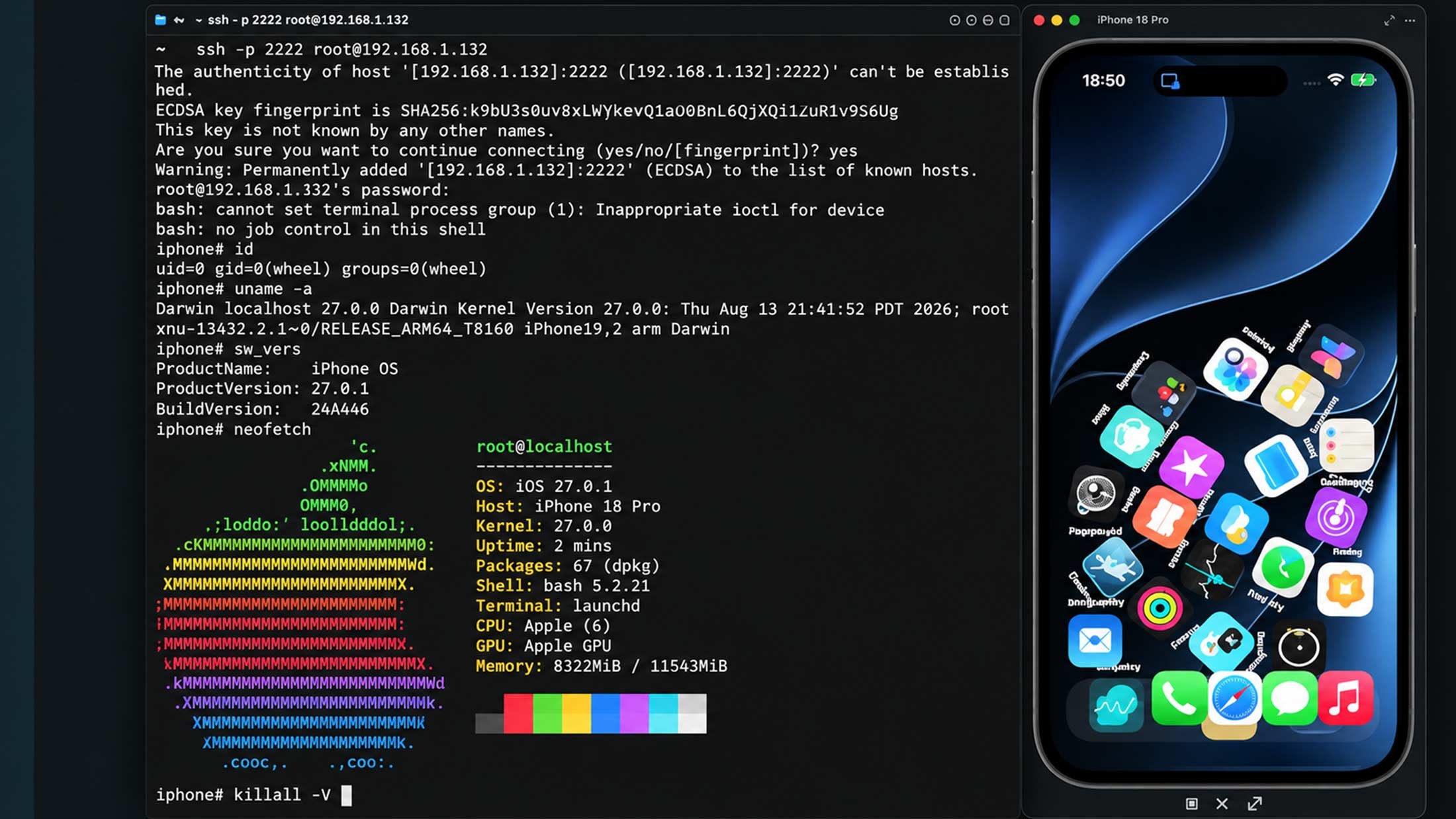
Calif, the Palo Alto security research firm, walked onto the Hexacon stage in Paris today and rebooted an iPhone 18 Pro. The phone came back up with root access intact. That is an untethered jailbreak on iOS 27.0.1, Apple's current public release, and by several accounts the first untethered break since iOS 9.
The demonstration happened at Hexacon 2026, a two-day offensive security conference organized by Synacktiv at Palais Brongniart. Billy Ellis, a jailbreak researcher, posted video from the stage showing the phone booting and opening an SSH session as root. Neofetch displayed an uptime of two minutes, indicating how long the phone had been on after the restart. Calif did not disclose which vulnerabilities it used or release any public tool.
AI in the Exploit Chain
According to Heise, artificial intelligence helped Calif find the bugs. The firm has made AI-assisted vulnerability research a specialty. In August, Calif used AI to reverse a macOS patch into a working exploit for a screen-sharing flaw. In September, it built WeWorm, a self-spreading proof-of-concept worm that could hijack WeChat accounts through unanswered phone calls. Thai Duong, Calif's CEO, told the New York Times at the time that the WeChat project would have taken months with a larger team; AI compressed it to about a week.
Duong's background lends weight to the work. He spent 12 years at Google on security and cryptography, helped create the Tink and Wycheproof cryptographic libraries, and co-discovered the BEAST, CRIME, and POODLE SSL vulnerabilities with Juliano Rizzo. The two won a Pwnie Award for Best Server-Side Bug.
Messaging Attacks Teased
Calif's newsletter post published alongside the demo is brief but suggestive. It lists four items: a Signal one-click attack, an iMessage attack introduced with the line "who cares about a third-party app when everyone uses iMessage, right?", a third demo asking "can your iPhone do this?", and a fourth captioned "APT stands for Apple Persistent Threat."
No technical details accompanied the list. The post ends with a single sentence: "Everything will be released in due time."
Social media posts citing attendees claim the iMessage demo involved a booby-trapped PDF that, when opened on iOS 26.5, sent the device's messages to an external server. Glitchwire could not independently verify those claims at publication.
Context: The CoreGraphics Bug
Calif has been probing Apple's PDF rendering path for weeks. On September 30, researchers Dion Blazakis, Josh Maine, and Anna Groza published an analysis of CVE-2026-86950, a CoreGraphics vulnerability that Apple credited to Meta Product Security. The bug stems from a unit conversion error triggered by malicious fonts in PDF files, causing an out-of-bounds write. Calif demonstrated a proof-of-concept crash on both macOS and iOS but noted that converting the crash into working code execution was separate work. The firm also examined new PDF-scanning code that appeared in WhatsApp around the same time, describing it as circumstantial evidence that WhatsApp may have been a delivery vector.
Whether today's Hexacon demos use the same underlying flaw or something new remains unclear. Calif has not said.
What It Means
An untethered jailbreak proves that Apple's latest hardware and software contain exploitable bugs severe enough to grant persistent root access. For most users, the immediate risk is low. No public exploit exists. But spyware vendors operate with similar capabilities. Citizen Lab published research just yesterday on AdFection, a zero-click attack delivered through targeted ads. The techniques shown at Hexacon sit in the same class.
Apple has not commented. The company typically does not acknowledge vulnerabilities until a patch ships. Calif's disclosure timeline, if any, is unknown.
The next scheduled iOS release is iOS 27.1, currently in beta. Whether it addresses the bugs Calif used, or whether Calif coordinated with Apple before the demo, the company has not said.