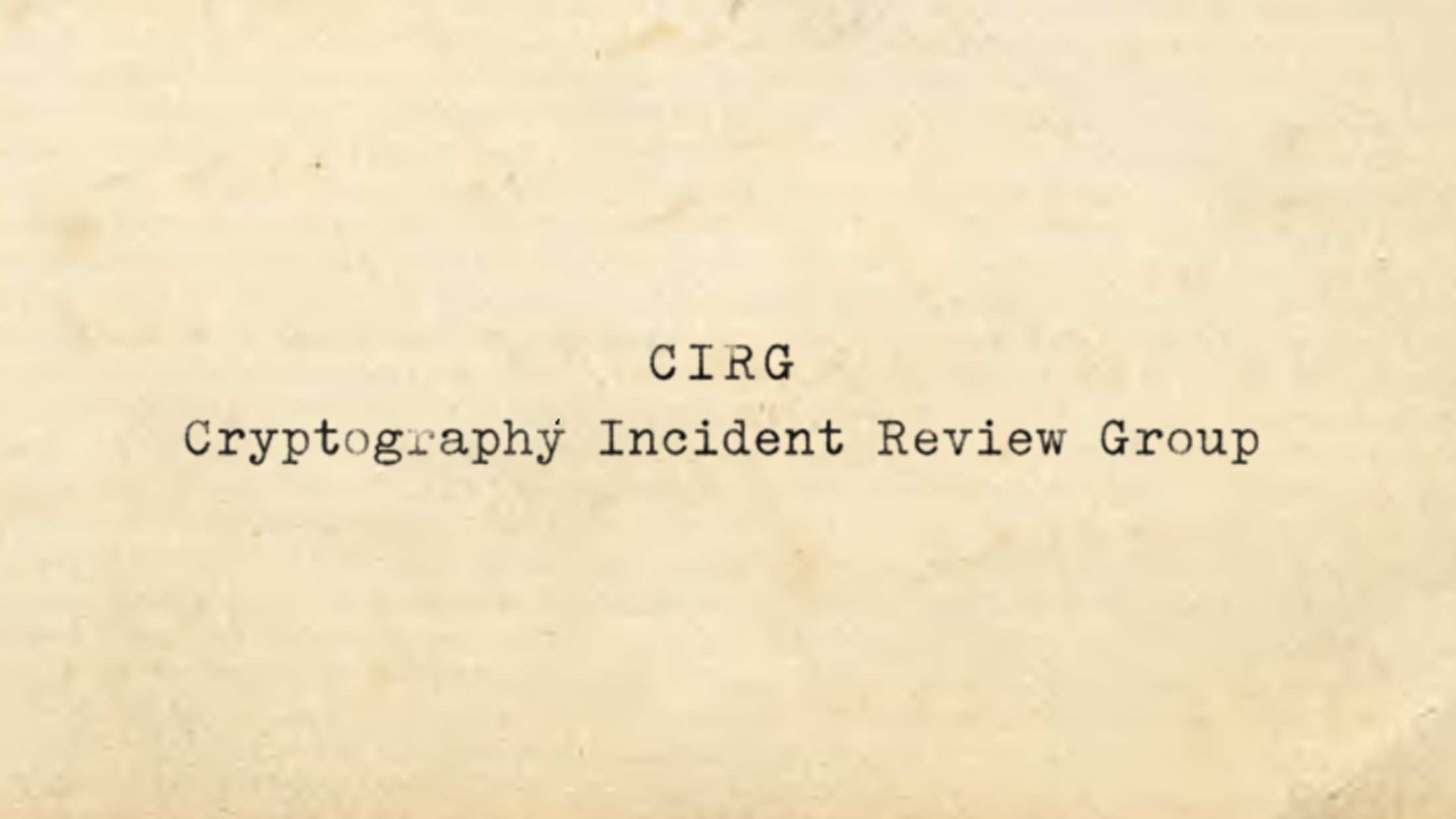
The Cryptography Incident Review Group went live on November 28 and 29. The site describes a body of 21 cryptographers who will advise on how to disclose a break, communicate with affected parties, and plan for cryptographic resilience. Its statements page contains one entry. That entry says only: "A forthcoming statement by the Cryptography Incident Review Group."
No incident is named. No timeline is given. The page exists, waiting.
Steve Weis, a software engineer on Anthropic's Secure Frameworks team, shared a link to the group's homepage on the morning of November 29. Weis holds a PhD from MIT, where RSA co-inventor Ronald Rivest advised him. He factored RSA-896 in September using Claude and up to 2,048 GPUs. His post contained only the URL and the group's name.
Within hours, speculation had spread. "Anthropic employee posting cryptography incident review group with unreleased statement," one user wrote on X. "Yep its over."
The Roster
CIRG's membership reads like an honor roll of applied cryptography. Dan Boneh of Stanford, who heads the university's applied cryptography group and co-directs its computer security lab, is listed. So is Matthew Green of Johns Hopkins, one of the creators of the Zerocash protocol. Yael Tauman Kalai and Vinod Vaikuntanathan of MIT appear alongside Chris Peikert of the University of Michigan, Nadia Heninger of UC San Diego, and Justin Thaler of Georgetown University and a16z.
Members serve in a personal capacity, the site notes; affiliations are listed for identification only. What they have in common, beyond credentials, is a research focus on the mathematics that underpins public-key encryption.
The Context
The group's launch follows a week of unusual activity. On November 25, Scott Aaronson, a theoretical computer scientist at the University of Texas at Austin, wrote on his blog that he is "virtually certain, from multiple reliable sources, that the AI labs are now sitting on one or more bombshells" in cryptography. Aaronson, who worked at OpenAI from 2022 to 2024, stressed that he feels "much, much less confident about the specific nature of those bombshells."
Rumors have circulated since mid-November that an AI lab has produced a polynomial-time integer factoring algorithm, the kind of result that would break RSA. Neither Anthropic nor OpenAI has confirmed anything. In a November 27 post, Aaronson clarified that the parts he is virtually certain about "fall well short of Factoring in P." A rumor is a rumor is a rumor, he wrote.
What is documented: AI labs have published a burst of mathematical results this month. OpenAI released nine manuscripts on November 24, including a claimed solution for the matrix multiplication exponent. Google DeepMind published research on November 9 showing that AI agents could reduce the cost of attacking legacy 1024-bit RSA systems. Cognition's Devin factored RSA-260 in September. Weis followed sixteen days later with RSA-896.
Aaronson observed that the labs' recent papers covered "just about all areas of math, but with this very conspicuous exception that there was nothing in cryptography." He told Defense One: "And that can't possibly be an accident."
What CIRG Says It Does
The group's stated scope covers three tasks. First, disclosure: advising researchers or organizations on how to announce a cryptographic weakness. Second, communication: explaining scope, risk, and migration steps to affected parties. Third, resilience planning: replacement algorithms, key rotation, long-term system design.
The site invites contributions but lists no process, no timeline, and no contact method beyond the invitation itself.
For practitioners who maintain cryptographic systems, the useful signal is the roster and the stated focus. Teams can track the group's statements, when they appear, and compare them with vendor advisories, standards updates, and their own risk assessments.
What Remains Unknown
No AI company has shown that artificial intelligence can break the encryption protecting bank transfers, messages, or crypto wallets. RSA-2048, the standard for most deployed keys, remains roughly a billion times harder than RSA-896, according to Cognition's Eric Lu. Coinbase has said it sees no actual threat to current cryptography from AI.
The only specific claim on record, Aaronson's of November 27, says the coming breakthrough, if it exists, will not cause imminent danger. Even a polynomial-time factoring algorithm, Nature notes, could have an exponent so large it stays useless against deployed keys.
CIRG has not said what prompted its formation. Weis has not said why he shared the link when he did. The statement page remains empty.
The next verifiable date is whenever CIRG publishes.