The United States has a housing problem that defies simple solutions. Goldman Sachs Research estimates the country needs 3-4 million additional homes beyond normal construction just to restore affordability to 1990s levels. Meanwhile, construction labor productivity has fallen more than 30 percent since 1970, even as the broader economy's output has doubled. For every seven construction workers retiring, only one enters the workforce to replace them.
Into this structural gap steps Cuby Technologies, a company that has spent years engineering what it calls Mobile Micro-Factories. The core thesis is deceptively simple: the product isn't the home, it's the factory.
The Factory in a Box
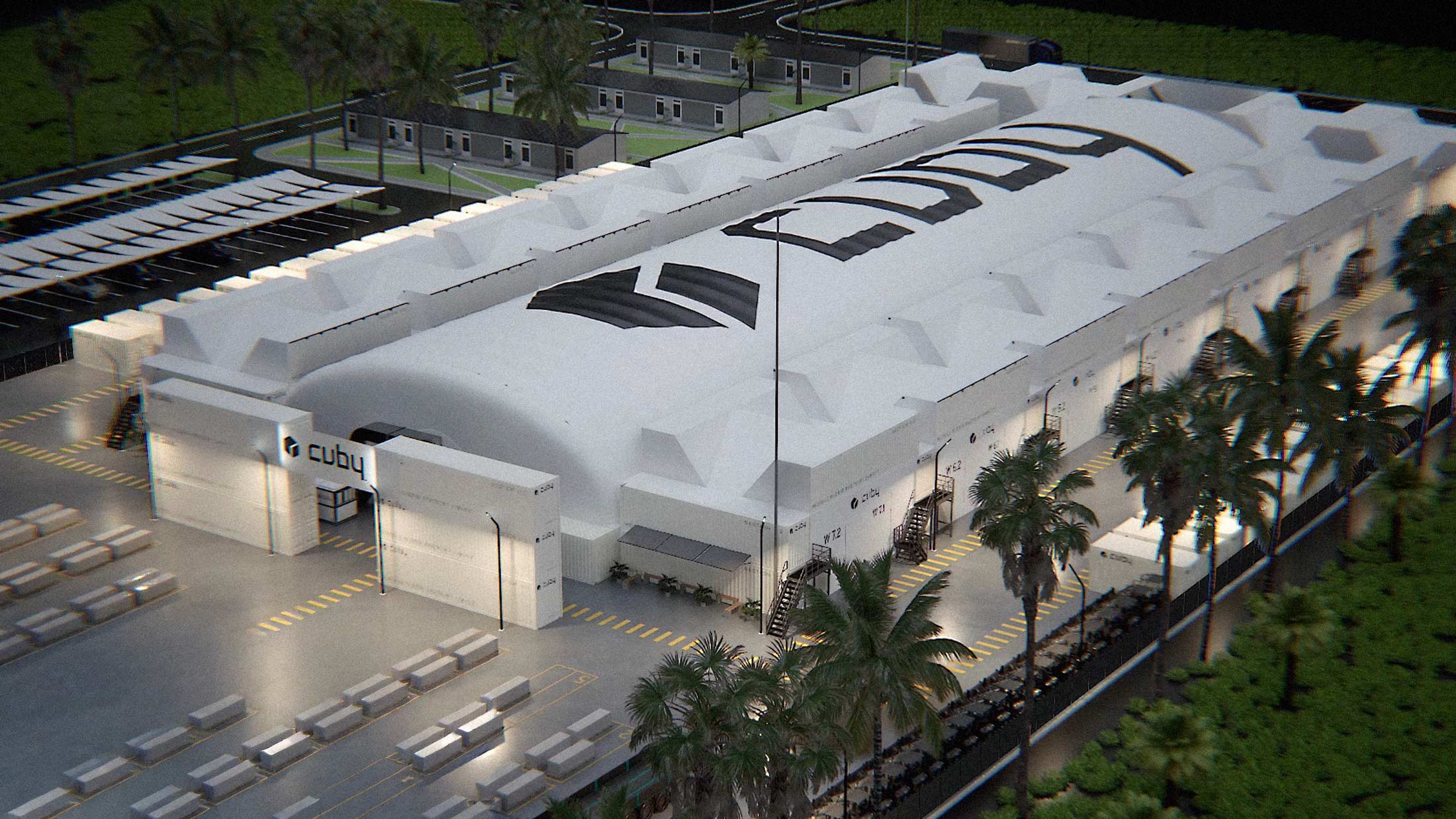
Cuby's Mobile Micro-Factory occupies roughly 30,000 square feet and can produce kit-of-parts for approximately 200 homes per year. The entire system ships in about four dozen containers and can be erected in roughly eight weeks. An inflatable pneumatic structure, repurposed from military air hangar technology, serves as the factory shell. Inside, conveyors and machinery produce wall panels, windows, HVAC components, plumbing assemblies, and other standardized parts that get packed into sequenced kits for delivery to job sites within a 150-200 mile radius.
What distinguishes this from traditional prefab is the labor model. Cuby has broken the construction process into 30 stages, each with three discrete tasks. Workers follow step-by-step digital guides generated from building plans to complete each micro-task. The company claims four unskilled workers can assemble a code-compliant home in about 30 days, compared to the typical seven to nine months using a dozen or more skilled tradespeople across specialized disciplines.
The company targets a self-cost in the $100-110 per square foot range, against a national average that often exceeds $150. Steel framing replaces lumber, which Cuby argues is less prone to cutting errors, more consistently available, and less volatile in pricing. The savings from reduced labor costs, the company says, allow it to use higher-quality materials while still undercutting incumbent builders.
Why Previous Attempts Failed
The graveyard of industrialized construction startups looms large over any new entrant. Katerra raised over $2 billion from SoftBank and others before filing for bankruptcy in 2021. Veev reached unicorn status in 2022 with $600 million raised, then collapsed less than two years later. Both pursued large, centralized factories and aggressive vertical integration. Both burned through capital trying to scale before their unit economics worked.
Cuby's co-founder Aleksandr Gampel has been explicit about avoiding their mistakes. The company describes centralized gigafactories as fundamentally misaligned with construction's economics: they take years to build, require enormous capital, and struggle with utilization when demand fluctuates. A typical gigafactory might cost $50-350 million. An MMF costs Cuby roughly $5.5 million to produce.
The capital structure is different too. Cuby licenses MMFs to local developers through special purpose vehicles. The developer puts up around $10 million, $6.5 million of which covers upfront capital expenditure for the factory. Cuby then receives ongoing revenue share at software-like margins. This makes the company more of an infrastructure provider than a builder, and it shifts capacity risk to operators who have committed offtake.
The PAPA Factory: Making Factories at Scale
Cuby's scaling strategy hinges on what it calls PAPA factories, which produce the Mobile Micro-Factories themselves. The company is establishing production capacity that can manufacture roughly 5 MMFs per year from each PAPA facility. Plans call for 5-7 PAPA factories across different geographies to de-risk supply chains and accelerate deployment.
The math is aggressive: within a decade, the company aims to deploy 275 MMFs capable of producing approximately 200,000 homes, creating around 300,000 jobs, and reducing roughly 800,000 tons of construction waste. The first U.S. MMF is being built in Pahrump, Nevada, targeting Q3 2026 for operations and tied to a local developer's pipeline of 3,300 single-family homes.
Whether this model can actually scale remains an open question. Construction is notoriously resistant to standardization. Local building codes, zoning requirements, and consumer preferences create endless variation. Cuby's response has been to design within existing regulatory frameworks rather than fight them. The homes look conventional. They use non-proprietary materials that can be sourced from big-box retailers in any market. The kits comply with International Building Code and allow for customization within limits.
The Labor Arbitrage
The real bet here is on labor, not technology. Skilled construction labor accounts for 60-70 percent of home building costs in first-world economies. That cost share is climbing as the workforce ages out. The Associated Builders and Contractors estimated the industry needed 439,000 new workers in 2025 alone. About 41 percent of the current workforce will retire by 2031.
Cuby's answer is to redefine what labor construction requires. By breaking work into quantized, software-guided tasks, the company argues it can hire workers at warehouse labor rates and pay them based on completed tasks rather than hours. This is less a construction company than a logistics and manufacturing operation that happens to produce homes.
The approach borrows heavily from automotive lean manufacturing: sequenced tasks, verified quality checkpoints, standardized kits, tight feedback loops between design and production. Whether those principles translate from cars to houses across hundreds of local markets will determine if Cuby becomes infrastructure or another cautionary tale.
The company's Nevada factory will be the first real test. If it delivers homes at projected costs and timelines, the copy-and-paste thesis becomes credible. If it struggles with the same utilization, scaling, and market adoption problems that killed its predecessors, the housing crisis will continue waiting for its assembly line moment.