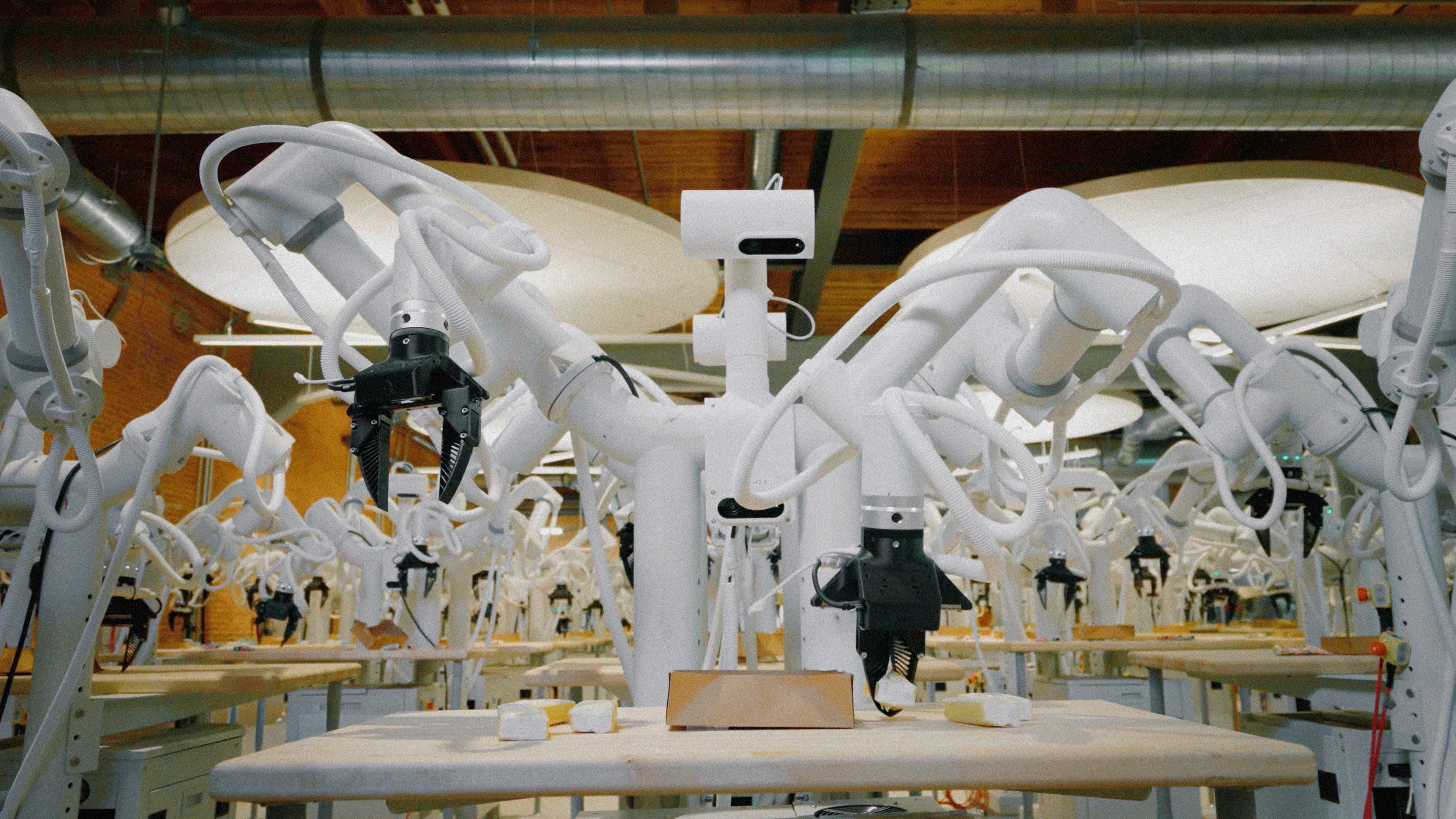
In a building along the Charles River in Watertown, Massachusetts, where textiles were once made, 100 robots are now learning to work. Tutor Intelligence, the MIT CSAIL spinout, has opened Data Factory 1 (DF1), a 35,000-square-foot headquarters that includes what CBS News Boston called "America's largest AI robot data factory."
The setup is unusual. These aren't production robots shipping consumer goods. They're students. DF1 generates roughly 10,000 hours of training data per week from robots practicing basic warehouse tasks: picking up snack packages, placing them in boxes, stacking pallets. The facility looks like a factory but functions like a school.
The Data Problem Physical AI Can't Ignore
Generative AI thrives on language data scraped from the internet. Physical AI has no such luxury. There's no corpus of robot manipulation data sitting on the web waiting to be harvested. It has to be manufactured from scratch.
"Artificial intelligence works when computers learn from data that is readily available," CEO Josh Gruenstein told CBS News Boston. "But there is no data to teach robots to do simple human tasks. It needs to be created."
That's what DF1 exists to do. When a robot fails a task, a human "tutor" can remotely take control and demonstrate the correct approach. Those demonstrations become training data, which flows back into the company's shared intelligence layer. The gap between "the robot has never seen this" and "the robot can now handle this autonomously" collapses, according to Union Square Ventures, which led Tutor's $34 million Series A last December.
Why This Matters for U.S. Manufacturing
The timing isn't accidental. According to Roland Berger, the United States leads in AI research but trails China by a factor of 30 in robot unit shipments. That disparity has real consequences. Deloitte estimates industrial humanoid shipments will reach 15,000 units globally in 2026, with Chinese manufacturers like Unitree and UBTECH pushing prices below $20,000 per unit. The International Federation of Robotics identifies humanoid robotics as one of its top five global trends for 2026, noting that companies are moving beyond prototypes to real-world deployment.
Tutor's approach sidesteps the traditional automation playbook. Instead of selling expensive capital equipment that takes years to deploy, the company offers robots through a Robot-as-a-Service model. Its Cassie palletizer can be hired for as little as $14 per hour. Systems arrive within 30 days and typically become operational within a day. That accessibility opens automation to small and mid-sized manufacturers who have historically been priced out.
The data flywheel compounds this advantage. Every deployed robot generates training data that strengthens the entire fleet. Tutor claims to have logged tens of thousands of hours of real-world production experience across facilities from coast to coast, with customers including Fortune 500 companies in food, personal care, and consumer tech.
The Trend Taking Shape
Tutor isn't alone in betting on concentrated training environments. In China, dedicated centers are teaching humanoid robots to fold clothes and wipe tables, generating large-scale datasets for eventual deployment. Tesla is converting its Fremont facility for Optimus production while breaking ground on a dedicated humanoid factory at Giga Texas. The bottleneck in robotics has shifted from hardware to intelligence, and intelligence requires data.
The humanoid robotics market is projected to reach $4 to $6 billion in 2026, growing toward $38 billion by 2035 according to Goldman Sachs estimates cited in industry reports. At projected operating costs of roughly $2 per hour, humanoid robots present a compelling case for regions facing labor scarcity. Working-age populations in key industrial regions are projected to decline by up to 22% by 2050.
For the U.S. to compete, it needs to close the deployment gap. Facilities like DF1 represent one path: generate proprietary training data domestically, use it to accelerate fleet intelligence, and make automation accessible through subscription pricing. It's a bet that the robots of the future will be trained, not just programmed.
Tutor expects to deploy its Sonny humanoid for industrial work starting late 2026. The company now employs nearly 90 people across its Watertown campus.