The AI industry has a physics problem. Data centers are now straining electrical grids across the United States, with Goldman Sachs projecting a 45-gigawatt power shortfall for data centers by 2028. Permitting delays stretch for years. Communities are blocking new builds. Northern Virginia, the world's largest data center market, faces wait times of up to seven years for grid connections.
So the industry is looking elsewhere. Specifically, offshore.
Panthalassa: Wave-Powered AI Floating on the Pacific
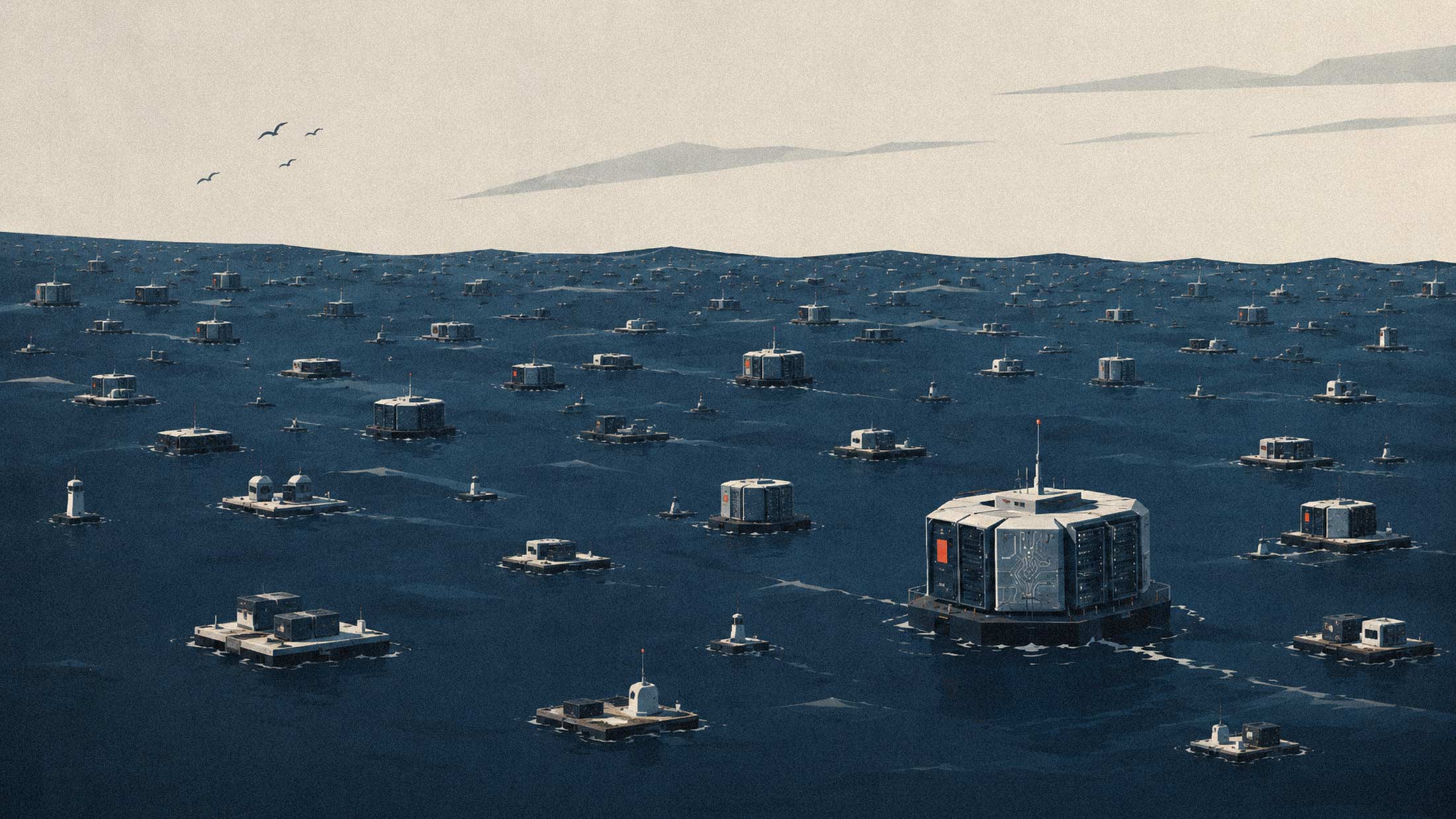
Oregon-based Panthalassa raised $140 million in a Series B round led by Peter Thiel, bringing its valuation close to $1 billion. The company builds autonomous, floating spheres that generate electricity from wave motion and run AI inference workloads onboard, transmitting results via low-Earth-orbit satellites.
Each node is an 85-meter steel structure that sits mostly below the waterline. As waves pass, the node bobs while the surrounding water moves in small orbital paths. This relative motion forces seawater through internal turbines, generating electricity. The surrounding ocean also handles cooling, eliminating the need for the massive chiller systems that drive up costs and water consumption at land-based facilities.
Thiel's position is characteristically blunt: "Extra-terrestrial solutions are no longer science fiction. Panthalassa has opened the ocean frontier." The round also attracted Marc Benioff's TIME Ventures, Max Levchin's SciFi Ventures, and returning investors including Founders Fund and Lowercarbon Capital.
Panthalassa plans to deploy its Ocean-3 pilot nodes in the northern Pacific Ocean later this year, with commercial deployments targeted for 2027.
Samsung Heavy Industries Enters the Arena
Korean shipbuilder Samsung Heavy Industries is pursuing a different approach. At Data Center World 2026 in Washington, D.C., the company secured Approval in Principle from both the American Bureau of Shipping and Lloyd's Register for a 50-megawatt floating data center design.
Unlike Panthalassa's wave-powered orbs, Samsung's floating data centers are built using standardized shipyard construction processes. The company says this enables faster delivery than conventional land-based facilities while also allowing on-board power generation systems to reduce grid dependence. Samsung has signed MOUs with ABB for power system development and with Mousterian Corporation to pursue floating data center projects in the United States.
The OpenAI connection makes this more than a speculative play. In October 2025, Samsung announced a strategic partnership with OpenAI spanning memory chips, data centers, cloud services, and notably, floating infrastructure. Samsung C&T; and Samsung Heavy Industries will collaborate with OpenAI on floating data center development. The companies have also discussed floating power plants and control centers.
The Problem They're All Trying to Solve
The rush to the ocean reflects how dire the land-based constraints have become. Sightline Climate reports that nearly 50 percent of global data center projects scheduled for 2026 face delays directly attributable to power supply limits and grid equipment shortages. Up to 11 gigawatts of capacity expected this year remains stuck at the announcement stage, unable to move forward because grid connections simply cannot be secured.
Traditional data centers also consume enormous quantities of water for cooling. Panthalassa's approach sidesteps that entirely by using seawater, addressing a constraint that has already caused friction between data center operators and local communities in water-stressed regions.
Microsoft's now-discontinued Project Natick offered early validation for the underwater concept. The company's Northern Isles prototype, deployed on the Scottish seafloor from 2018 to 2020, showed a server failure rate one-eighth that of comparable land-based systems. The sealed, nitrogen-filled environment and consistent cold-water cooling produced remarkable reliability results. Microsoft ended the project in 2024, citing challenges with scaling and GPU upgrades in sealed containers, but the lessons are now informing a new generation of offshore experiments.
Skepticism Remains
The idea is not without critics. Floating data centers face maintenance challenges that land-based facilities do not. Saltwater corrosion, marine fouling, and the sheer logistics of servicing equipment hundreds of miles offshore all add complexity. Satellite connectivity, while improving, cannot yet match fiber-optic bandwidth for training workloads. The current wave-powered concepts appear better suited for inference tasks than the massive data transfers required for model training.
Insurance, permitting in international waters, and fleet-scale deployment are all open questions. The economics of maintaining distributed floating nodes rather than consolidated land-based campuses remain unproven at commercial scale.
Why It Matters Now
What has changed is the severity of the alternative. When agentic AI workloads require 1,000 times more compute than current generative models, and when grid operators in some markets cannot even accept new connection requests, the calculus shifts. The ocean becomes less exotic and more pragmatic.
The convergence of venture capital, Korean shipbuilding expertise, and hyperscaler partnerships suggests this is no longer a fringe concept. Whether wave-powered orbs or ship-based floating platforms become meaningful infrastructure or remain expensive experiments will depend on execution over the next two to three years. The pilot deployments announced for 2026 and 2027 will provide the first real operational data.
The land-based data center industry's assumptions about cheap land, available power, and cooperative planning authorities are collapsing under the weight of AI demand. The companies betting on floating infrastructure are wagering that the ocean can absorb what the grid cannot.