The executives who built the most capable AI systems on the planet want Congress to intervene before those systems help someone build a bioweapon.
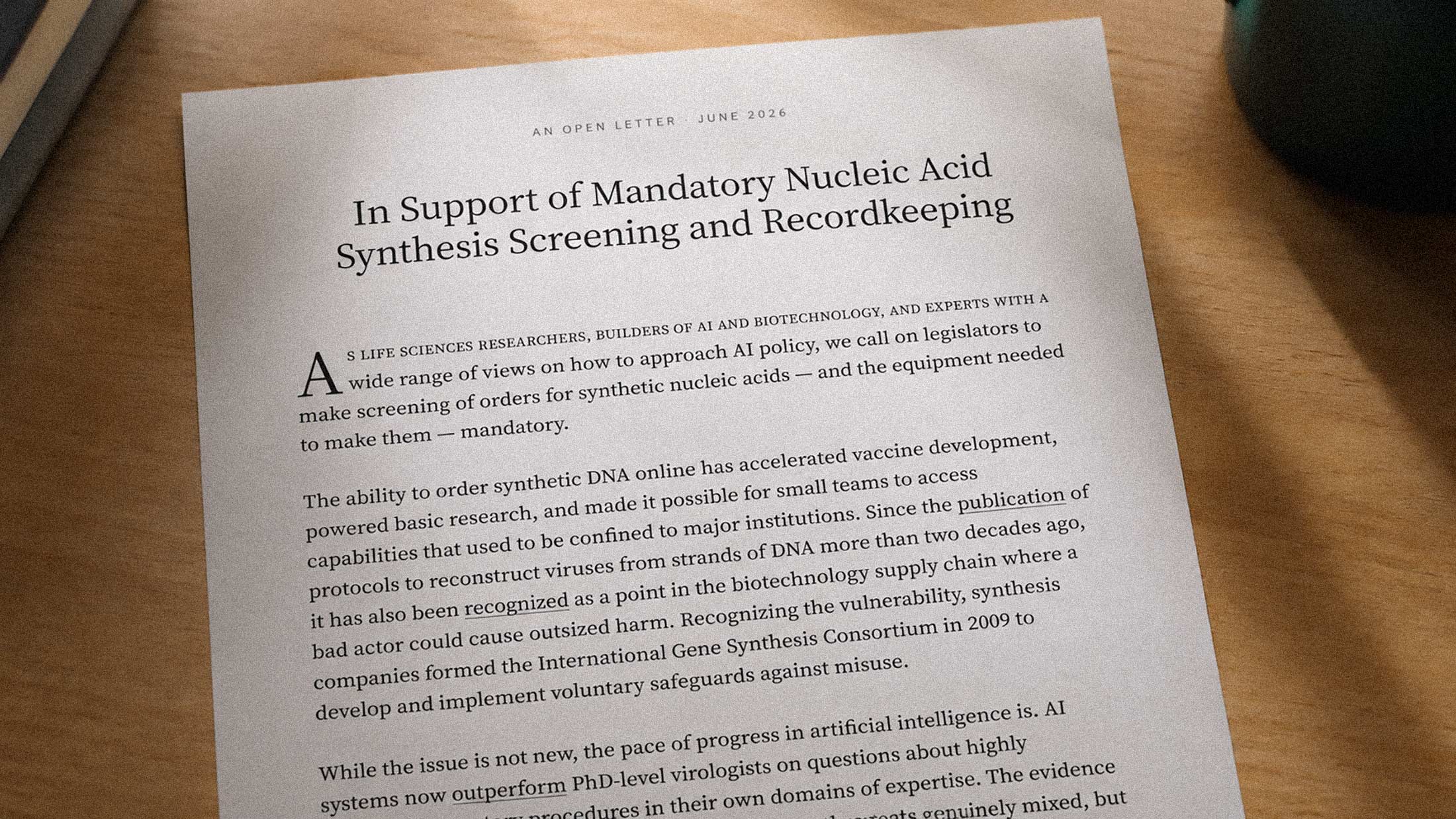
Sam Altman, Dario Amodei, and Demis Hassabis are among the signatories on an open letter calling for mandatory screening of synthetic DNA and RNA orders in the United States. The letter, organized by the nonpartisan Institute for Progress and the Foundation for American Innovation, argues that the pace of AI development creates "a real possibility that the knowledge barriers which have historically prevented bad actors from obtaining biological weapons will meaningfully erode."
The signatories include Mustafa Suleyman, CEO of Microsoft AI; Patrick Collison, CEO of Stripe; Paul Graham, founder of Y Combinator; Nobel laureate David Baker; and former Army Secretary Christine Wormuth. Executives from gene synthesis companies Twist Bioscience and Ansa Biotechnologies also signed.
The Case for Screening
Ordering synthetic DNA online has become routine. Dozens of companies use commercial synthesizers to print custom genetic sequences for research, drug development, and diagnostics. Many already screen orders voluntarily through the International Gene Synthesis Consortium, formed in 2009. But the letter argues that voluntary measures are no longer sufficient.
According to Stanford microbiologist David Relman, who signed the letter, AI tools can quickly identify vendors that do not screen orders. They can also advise users on how to modify sequences so that screeners cannot detect what is being made.
The letter calls for two measures: mandatory screening of all synthetic DNA and RNA orders against databases of dangerous sequences, and mandatory recordkeeping so that any threat that evades initial screening can be traced back to its source. The recordkeeping component is designed to deter misuse even when individual sequences would not raise concern in isolation.
The AI Dimension
The biosecurity case for screening predates large language models by decades. Protocols to reconstruct viruses from synthetic DNA have been published since the early 2000s. What has changed is the trajectory of AI capabilities.
The letter notes that AI systems now outperform PhD-level virologists on highly technical laboratory questions. The International AI Safety Report 2026, authored by over 100 experts and overseen by nominees from more than 30 countries, concluded that AI systems match or exceed expert-level performance on benchmarks measuring knowledge relevant to biological weapons development. Multiple frontier AI companies released models in 2025 with additional biosecurity safeguards after pre-deployment testing could not rule out that the systems might meaningfully help novices develop biological weapons.
The letter stops short of claiming an immediate threat, acknowledging that the evidence is "genuinely mixed." But it argues the trajectory warrants action now, not after the risk materializes.
Legislative Momentum
A bipartisan Senate bill, the Biosecurity Modernization and Innovation Act of 2026, would require the Secretary of Commerce to issue mandatory regulations on nucleic acid synthesis security. A less stringent House bill, H.R. 3029, passed the Science Committee in April 2025 but targets voluntary standards rather than mandates. The letter calls for congressional action "this session" and urges states to adopt requirements based on existing federal guidelines to avoid a patchwork of conflicting laws.
Expect More of This
The biosecurity letter is not an isolated event. It reflects a broader pattern: as AI capabilities expand into dual-use domains, expect more interventions at the supply chain level. Cybersecurity researchers have documented AI tools being weaponized to automate reconnaissance, generate polymorphic malware, and execute multi-stage attack campaigns. Similar cross-industry coalitions may emerge around autonomous cyber weapons, chemical synthesis, and even nuclear physics as AI tools become more capable.
The fact that Altman and Amodei, whose companies are locked in direct competition, co-signed the same letter is telling. So is the presence of gene synthesis executives, who face new compliance costs if Congress acts. When the builders of a technology and the industries it disrupts agree on regulation, the underlying risk is probably real.
Screening synthetic DNA is not a perfect solution. Microsoft researchers published a study last year showing that AI protein design tools could generate potentially dangerous sequences that slipped past existing screening software. But imperfect solutions beat waiting for perfect ones.