South Korean robotics startup WIRobotics has closed a 95 billion won (approximately $68 million) Series B funding round, the company announced on May 14. JB Investment led the round, with participation from InterVest, Hana Ventures, Smilegate Investment, SBVA, NH Investment & Securities, Company K Partners, GU Investment, and FuturePlay.
The funding comes roughly two years after the company's 13 billion won Series A in March 2024, and according to the company, every investor from that earlier round participated again. That kind of repeat commitment is notable in the current funding environment.
Korean WIRobotics just raised ~$68M.
— 𝐀𝐆 (@AGkorthos) May 15, 2026
Known for its WIM wearable robots and ALLEX humanoid platform, the company plans to supply a mobile ALLEX research platform this year and target initial commercialization readiness by late 2027. pic.twitter.com/ZzHWFleHVL
From Wearables to Humanoids
WIRobotics started as a wearable robotics company. Founded in June 2021 by four former engineers from Samsung's robotics development team, it initially built products like the WIBS industrial back-support robot and the WIM daily mobility-assist robot. The company has won CES Innovation Awards three years running.
WIM, a wearable walking-assist robot, has now surpassed 3,000 cumulative units sold and expanded into Europe, China, Turkey, and Japan. The company has been scaling retail distribution domestically through department stores and its own experience centers. Revenue has more than doubled annually, growing from 560 million won in 2023 to 1.3 billion in 2024 and 2.79 billion in 2025. In Q1 2026 alone, WIRobotics exceeded its full-year 2024 revenue.
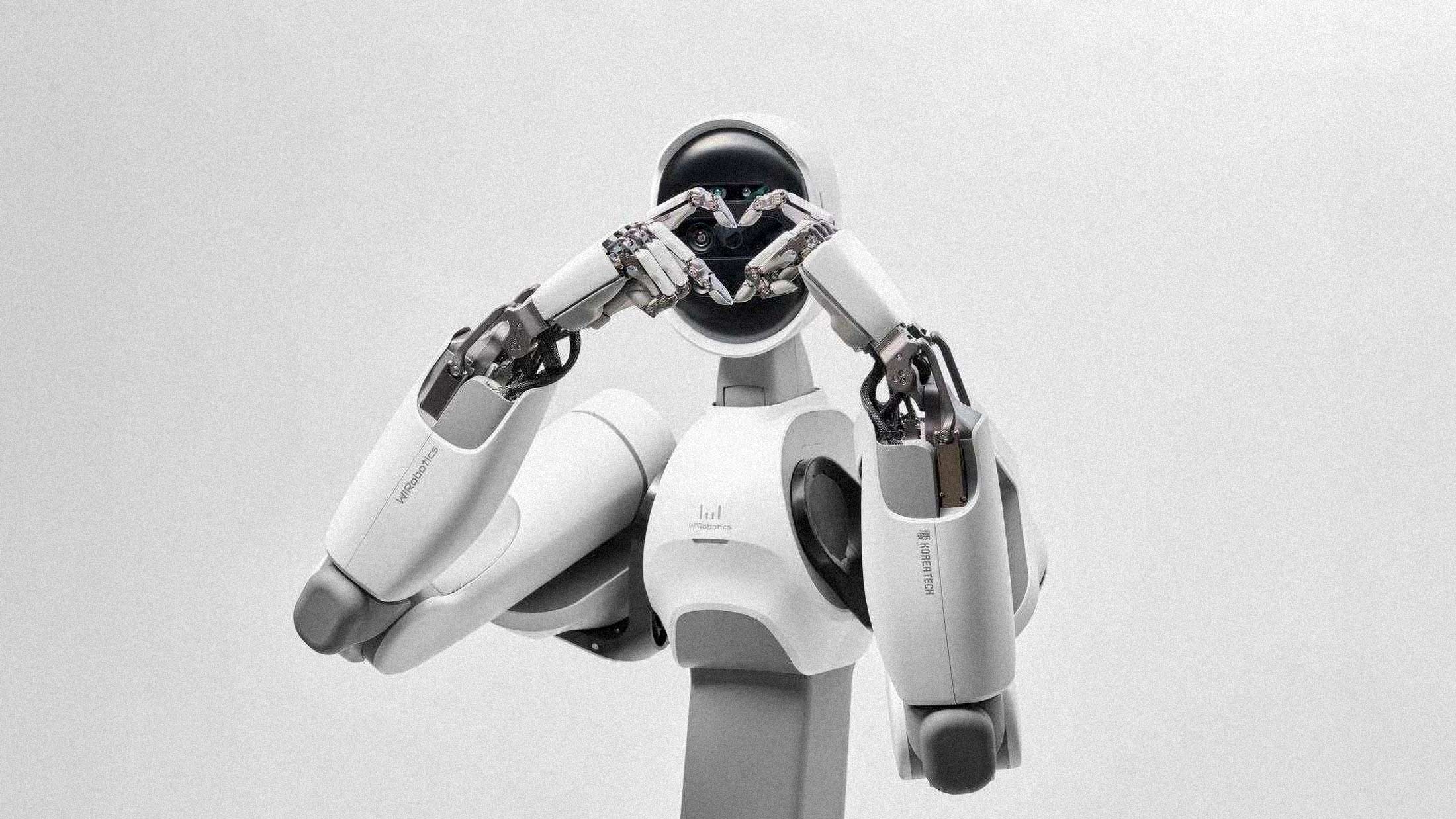
But the company is now making a bigger bet. In August 2025, WIRobotics unveiled ALLEX, a general-purpose humanoid robot platform. The name stands for "ALL-EXperience."
What Makes ALLEX Different
According to WIRobotics, ALLEX is the first humanoid capable of force-based responses across the arms, fingers, and waist without relying on force sensors. This inherent compliance, the company claims, allows for safer physical interactions with humans.
The technical specs are noteworthy. The hand weighs approximately 700 grams, and the full arm assembly from shoulder down is about 5 kilograms. The company says each arm can handle more than 3 kg across its full workspace, roughly matching the capability of mid-size collaborative robots that weigh over 20 kg. The 15-degree-of-freedom robotic hand delivers 40 N of fingertip force and more than 30 kg of hook grip, with fingertip repeatability of 0.3 mm or less.
At CES 2026, the company showcased both WIM and ALLEX. According to a post-show announcement, ALLEX attracted interest from NVIDIA, Meta, and Amazon, with "purchase interest expressed by several organizations." WIRobotics also says it began technical collaboration discussions with "select AI big-tech companies."
The Physical AI Play
In March 2026, WIRobotics was selected for the Physical AI Fellowship, an eight-week program powered by AWS, NVIDIA, and MassRobotics. The company was the only humanoid robotics company in the cohort. Fellows receive $200,000 in AWS credits, access to NVIDIA's Isaac frameworks and Cosmos world foundation models, and mentorship from MassRobotics' network.
Co-CEO Yong-Jae Kim, a professor at Korea University of Technology and Education, said the company's mission is to build "humanoids capable of fundamentally human-like interaction and force control." WIRobotics plans to launch a research-focused mobile humanoid platform called "Mobile ALLEX" this year and is targeting mass-production readiness for late 2027.
The company is also establishing a North American entity in California. It is reportedly in discussions with a global automotive manufacturer for manufacturing-environment proof-of-concept work.
Context Matters
The humanoid robotics market is heating up quickly. Figure, Unitree, and others are racing to commercialize platforms for industrial and consumer applications. WIRobotics' angle is that its years of real-world deployment data from WIM gives it an advantage in understanding human movement patterns and control systems that competitors lack.
Whether that data moat translates into a competitive edge remains to be seen. The company's revenue growth is real, but still modest in absolute terms. A $68 million war chest and backing from NVIDIA and AWS gives it runway to find out.