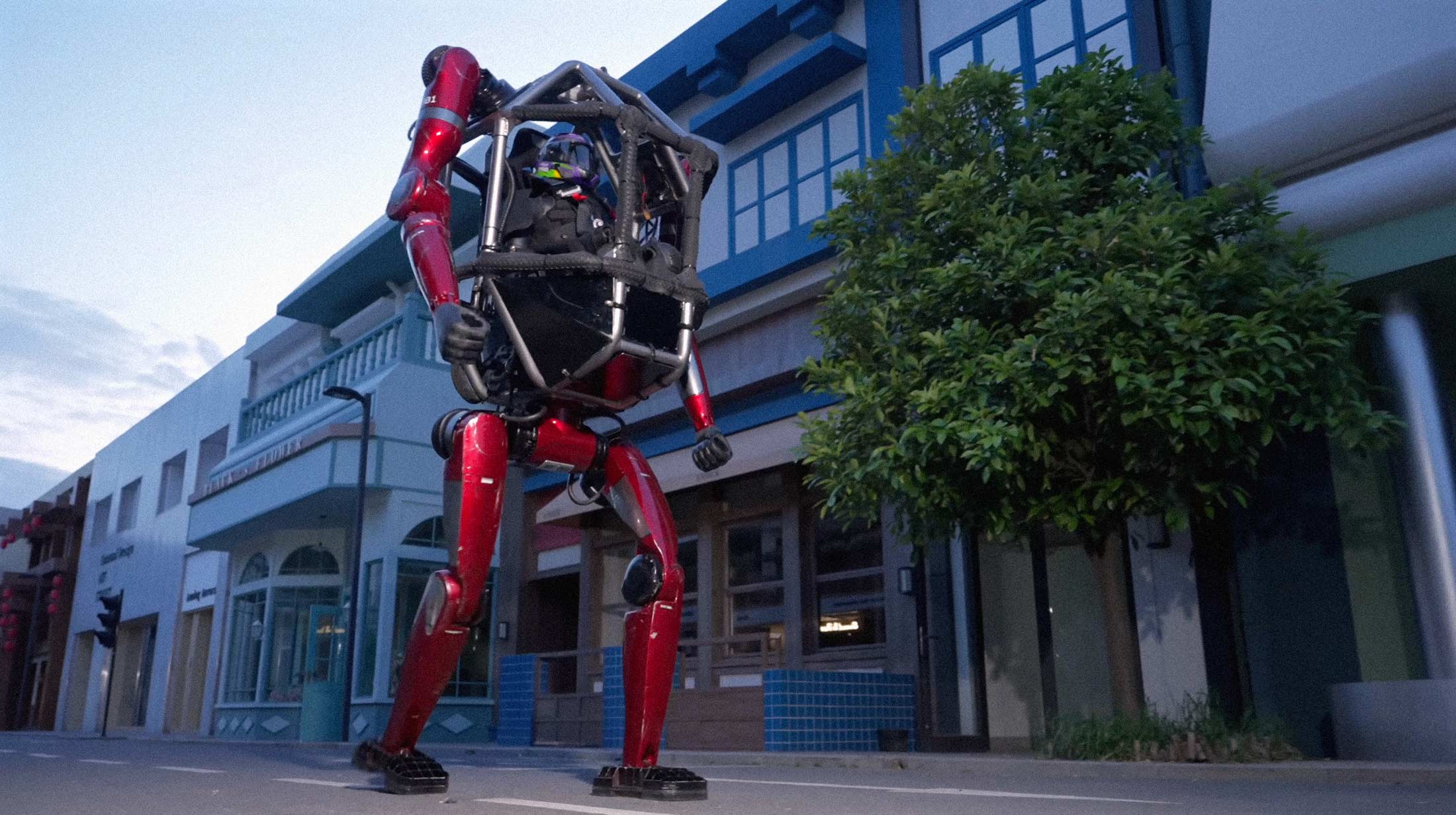
Unitree Robotics has unveiled the GD01, a manned mecha that the company claims is the first mass-produced vehicle of its kind. The machine carries a pilot inside a torso-mounted cockpit and can switch between bipedal walking and a four-legged crawling mode. Unitree announced the GD01 on May 12, with a starting price of 3.9 million yuan, or roughly $574,000. The company's own marketing uses a rounder $650,000 figure.
In a demonstration video, Unitree founder and CEO Wang Xingxing climbs into the cockpit, buckles in, and pilots the mecha across a workshop floor. The robot responds with deliberate steps on red-paneled legs. At one point, it punches through a brick wall. Then, in a sequence that looks straight out of a Transformers film, the chassis folds down and the legs reconfigure into quadruped mode. The whole transformation takes a few seconds, requires no external assistance, and the machine walks away on all fours with Wang still inside.
What It Is and What It Isn't
Unitree describes the GD01 as a civilian vehicle built for transport across rough terrain, exploration, and potentially rescue work. At approximately 500 kilograms with a pilot on board, it weighs about as much as a grand piano. The frame uses high-strength alloy and a precision servo drive system, according to company materials.
That said, the specification sheet remains thin. Key details like battery runtime, operational range, and per-limb payload capacity have not been disclosed. Potential buyers are left to estimate performance from a one-minute video rather than an engineering datasheet. Unitree's announcement also offered no commercial deployment timeline.
Distribution is currently limited to China. No regulatory pathway for the US or Europe has been announced, and the EU's updated Machinery Regulation, which takes full effect in 2027, would impose strict safety requirements on any manned robot intended for commercial use.
The Company Behind the Machine
The GD01 represents a sharp departure from Unitree's core business. The Hangzhou-based company made its name selling affordable quadruped robots that undercut Boston Dynamics on price while closing the performance gap. Its Go2 robot dog starts at $1,600, compared to Boston Dynamics' Spot at $74,500. Unitree claims roughly 60-70 percent of the global quadruped market.
More recently, the company has pivoted toward humanoid robots. The G1 humanoid starts at $13,500, while the higher-end H2 runs $29,900. Humanoid robots accounted for 51.5% of Unitree's revenue by late 2025, up from under 2% in 2023. The company shipped more than 5,500 humanoid units last year and is targeting 20,000 in 2026.
Unitree's financials have grown rapidly. Revenue hit 1.71 billion yuan in 2025, a 335% increase from the prior year. The company is now pursuing a 4.2 billion yuan ($608 million) IPO on Shanghai's STAR Market, which would make it the first humanoid robotics company to list on China's A-share market. The Shanghai Stock Exchange accepted the application in March.
A $650,000 Question
The GD01 sits in a category that barely exists. Piloted mechas have historically been the domain of concept art, anime, and one-off promotional builds. Unitree's announcement claims production-readiness, but without disclosed specs or customer references, the distinction between "production-ready" and "concept-that-ships" remains unclear.
Likely buyers, if any emerge, would include theme parks, industrial operators seeking novel inspection platforms, or deep-pocketed collectors. Unitree's release suggests tourism displays, special-purpose work scenarios, and high-end private mobility as projected applications. Whether any of those use cases justify a half-million-dollar walking vehicle is a question the market will answer.
Unitree's polite request on social media for users to operate the robot "in a Friendly and Safe manner" captures the tone of the announcement. This is a company that built its reputation on affordable developer hardware and practical robotics research platforms. The GD01 is something else: a statement product, a demonstration of manufacturing ambition, and perhaps a way to generate attention ahead of an IPO. Whether it becomes a real product category depends on whether anyone actually buys one.