Forestry has looked roughly the same for decades: 15-ton diesel harvesters roll through the woods, carving access roads that consume about 20 percent of usable forest land and compacting soil in ways that damage root systems and release mercury runoff. AirForestry, a Uppsala-based startup founded in 2020, believes it can replace those machines with something lighter, quieter, and entirely airborne.
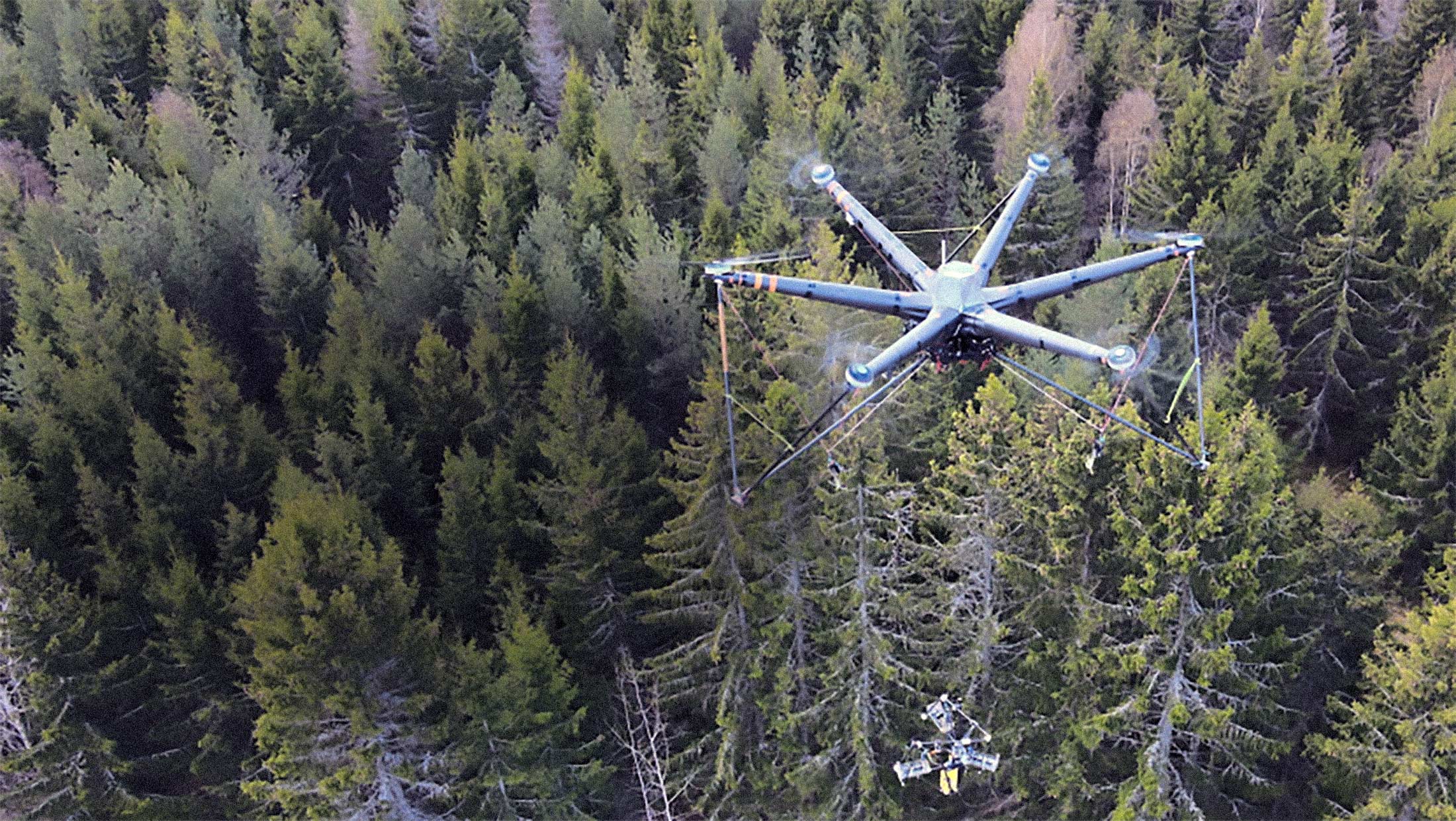
The company's system centers on a six-rotor electric drone measuring 6.2 meters across, built from carbon fiber with angled rotors for precision flight. The drone carries a 60-kilogram harvesting tool, bringing the total airborne weight to around 265 kilograms. The system can lift approximately 200 kilograms, which is enough to extract thinning-stage trees from dense stands.
Sweden’s AirForestry makes a 20 ft.-wide 6-prop electric drone that drops a branch-shearing tool on a tree, grips the trunk, and whisks it away
— Evan Applegate (@youwillmakemaps) May 22, 2026
I think the tree it grabbed here is like 9" DBH? pic.twitter.com/gESrTCj5Ld
How It Works
The process unfolds in stages. Multiple drones operate simultaneously from an operator station, using AI and computer vision to identify trees that are overcrowded, lower-quality, or suppressing the growth of their neighbors. Once a target is selected, the drone positions itself above the tree and the harvesting tool grips the top. The tool then releases and descends the trunk under gravity, stripping branches as it goes. The branches fall to the forest floor where they decompose into natural fertilizer. After the trunk is cut near the ground, the tool re-grips the tree and the drone lifts it out to a roadside drop-off point before heading back for the next one.
Traditional thinning requires stickvägar, the Swedish term for access corridors cut through the forest to let ground machines reach their targets. AirForestry's aerial approach eliminates this entirely. The company claims its method uses about half the energy per thinned tree compared to conventional techniques.
The Business Case
The environmental pitch is straightforward: traditional forestry consumes more than 3.5 billion liters of diesel annually. AirForestry says its fully electric technology could reduce CO2 emissions by up to 10 megatons per year if adopted at scale. By eliminating logging trails, the company estimates an additional 0.8 tonnes of CO2 per hectare could be sequestered annually.
These are ambitious projections, but the company has drawn serious institutional backing. In October 2024, AirForestry closed a €10.3 million seed round led by Northzone, the venture fund behind Spotify and iZettle. Investors included Sveaskog, one of Europe's largest forest owners, along with climate-focused funds like Kiko VC and SEB Greentech VC. The round included €1.7 million in grant financing from the Swedish Energy Agency.
In early 2026, the company added SEK 28 million in pre-Series A convertible financing from existing investors, along with a €4.4 million grant from Vinnova, Sweden's innovation agency, to advance its autonomous systems.
Commercial Commitments
Sveaskog, Sweden's state-owned forest company, signed a seven-year off-take agreement in 2023 committing to purchase drone thinning services on 1,000 hectares annually starting in 2028. The contract runs through 2035 and represents a concrete commercial commitment, not just a pilot.
The company is also expanding geographically. In January 2025, AirForestry launched a collaboration with Statskog, Norway's state-owned forest enterprise, to test the system in the more rugged terrain outside Trondheim. According to a Norwegian government report, Statskog aims to begin test thinning with drones in 2027.
Leadership and What Comes Next
The company transitioned leadership in late 2025, with co-founder Caroline Walerud taking over as CEO from Olle Gelin, who shifted to head customer relations. Northzone partner Pär-Jörgen Pärson now chairs the board.
Whether drone-based forestry can scale to the productivity of ground machines remains to be seen. AirForestry's stated target is 100 trees per hour using multiple drones operating in a coordinated fleet. The AI-driven automation underlying that goal is still in advanced field validation, not commercial deployment.
But the company has moved from concept to system-level proof faster than skeptics expected. In its most recent milestone, the drone completed a full autonomous harvest sequence, including navigation, tree identification, delimbing, felling, and transport. The next test is whether that process can repeat at industrial scale, in terrain ranging from Swedish flatlands to Norwegian mountains. If it does, the pattern of moving heavy industries into unconventional environments will have claimed another sector.