For two decades, cooling massive data centers meant the same basic strategy: move enormous quantities of chilled air or water to siphon heat away from processors before they throttle or fail. That assumption broke sometime around 2023 when GPU rack densities outpaced air cooling's physical limits, and it is now being dismantled piece by piece by chip designers who view thermal management as a silicon-level problem rather than a facility-level afterthought.
The most visible example arrived at CES 2026, when NVIDIA CEO Jensen Huang announced that the company's Vera Rubin platform can be cooled with 45°C water, warm enough that mechanical chillers become unnecessary in most climates. "We are basically cooling this supercomputer with hot water," Huang said onstage. "It is so incredibly efficient." Shares of HVAC manufacturers cratered within hours: Johnson Controls fell 6.2%, Modine Manufacturing dropped more than 7%, and Trane Technologies slid over 5%.
The Physics Behind 45 Degrees
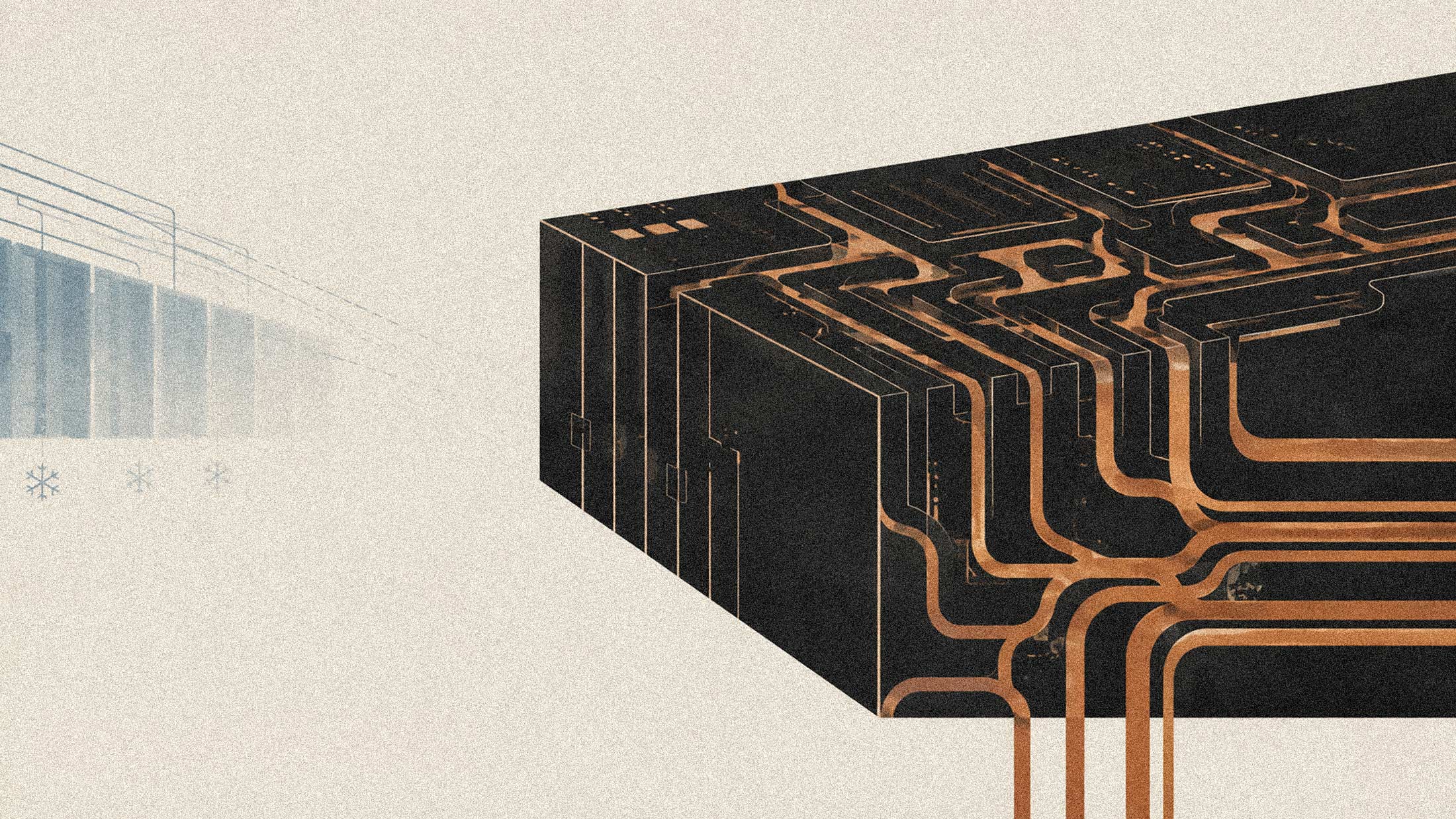
Traditional data centers often require water at around 35°C or colder. Achieving that temperature in warm weather demands compressor-driven chillers, which consume substantial power and add mechanical complexity. By designing chips that tolerate warmer inlet water, NVIDIA shifts the equation. At 45°C supply and up to 65°C return temperature, facilities can reject heat using dry coolers and ambient air for most operating hours, without running refrigeration cycles.
Analysts note that cooling accounts for roughly 30% to 40% of a typical AI data center's electricity consumption. NVIDIA claims the approach could save about 6% of global data center power overall. Vertiv, a major cooling-infrastructure vendor, cautioned that higher-temperature water "does not eliminate the need for heat rejection," but acknowledged the shift toward liquid-to-liquid heat transfer and dry-cooler architectures. Investors may have overreacted, but the directional change is real.
The Vera Rubin NVL72 rack, expected to ship in the second half of 2026, is 100% liquid cooled and designed for power densities exceeding 200 kW per rack. At that thermal load, air cooling is not an option. A standard 42U rack of current-generation H100 GPUs hits 60 to 80 kW of heat. Vera Rubin roughly triples that ceiling.
Microfluidics: Cooling From the Inside Out
While NVIDIA attacks the problem at the rack level, Microsoft is going deeper, literally into the silicon itself. In late 2025, the company disclosed a breakthrough in microfluidic cooling: tiny channels etched directly on the back of a chip, about the width of a human hair, through which liquid coolant flows to remove heat at the source.
Lab tests showed the technique can reduce peak silicon temperatures by up to 65% and remove heat up to three times more effectively than conventional cold plates. Microsoft collaborated with Swiss startup Corintis and used AI to design bio-inspired channel patterns modeled after leaf veins and butterfly wings. The company says the technology is ready for production and will be licensed through Microsoft Technology Licensing, LLC.
The implications extend beyond efficiency. Microfluidics could enable 3D-stacked chip architectures that are currently impossible because inner layers would overheat. It also allows servers to be packed more densely without thermal runaway, reducing data center footprint requirements. "Microfluidics allows for more powerful designs, better performance, and smaller, more efficient chips," said Judy Priest, Microsoft's CTO for Cloud Operations and Innovation.
The Water Question
Data center water consumption is a growing concern. U.S. data centers directly consumed 17.4 billion gallons of water in 2023, and projections suggest that figure could more than double by 2028. Northern Virginia alone saw data center water use climb 63% between 2019 and 2023, reaching nearly 2 billion gallons. A 100 MW data center using evaporative cooling can consume 200 to 400 million gallons annually.
Microsoft is deploying closed-loop water recycling systems at new facilities in Arizona and Wisconsin starting this year, each projected to save an estimated 125 million liters annually. Amazon claims to have reduced water use per kilowatt-hour of server capacity by 40% since 2021. Warm-water direct liquid cooling and microfluidics represent the next generation of that efficiency push, potentially eliminating the evaporative cooling towers that drive much of the industry's freshwater demand.
For operators evaluating new builds, the calculus is shifting. Cooling decisions made at the feasibility stage are difficult to reverse. A building designed for 20 kW per rack cannot easily be converted to serve 80 kW clusters. Thermal economics are becoming a primary design driver, not an afterthought.
What Comes Next
IDTechEx forecasts the liquid cooling component market for data centers will exceed $4 billion by 2036. Ecolab's $4.75 billion acquisition of CoolIT Systems in March 2026 signals that non-traditional tech vendors see opportunity in the thermal transition.
The industry is moving toward a model where GPUs, CPUs, networking, and cooling are co-designed as a single system rather than optimized in isolation. The era of the "meat locker" data center, kept artificially cold by brute-force air conditioning, appears to be ending. What replaces it is warmer, wetter, and considerably more complex, but also far more efficient per watt of useful compute.