Hitachi and Hitachi High-Tech announced on April 24 that they have developed an edge AI semiconductor designed to serve as foundational technology for physical AI in industrial applications. The chip, intended to power everything from manufacturing equipment and inspection systems to industrial robots and logistics machinery, marks Hitachi's clearest commitment yet to the idea that AI's future runs through the shop floor, not the data center.
A Chip for the Tangible World
The semiconductor is built around a hybrid architecture that combines convolutional neural networks for fine-grained image analysis with transformer models for broader pattern recognition. This approach, according to Hitachi, enables lightweight deployment without sacrificing the accuracy needed for industrial inspection and monitoring tasks.
In practical terms, the chip performs real-time analysis of image, audio, and vibration data entirely within the device itself. Testing with real-world production data showed power efficiency more than ten times higher than running equivalent lightweight AI models on leading GPUs. The comparison uses catalog specifications for the GPU side, so actual results may vary. But the overall message is clear: advanced AI inference no longer requires a dedicated server room.
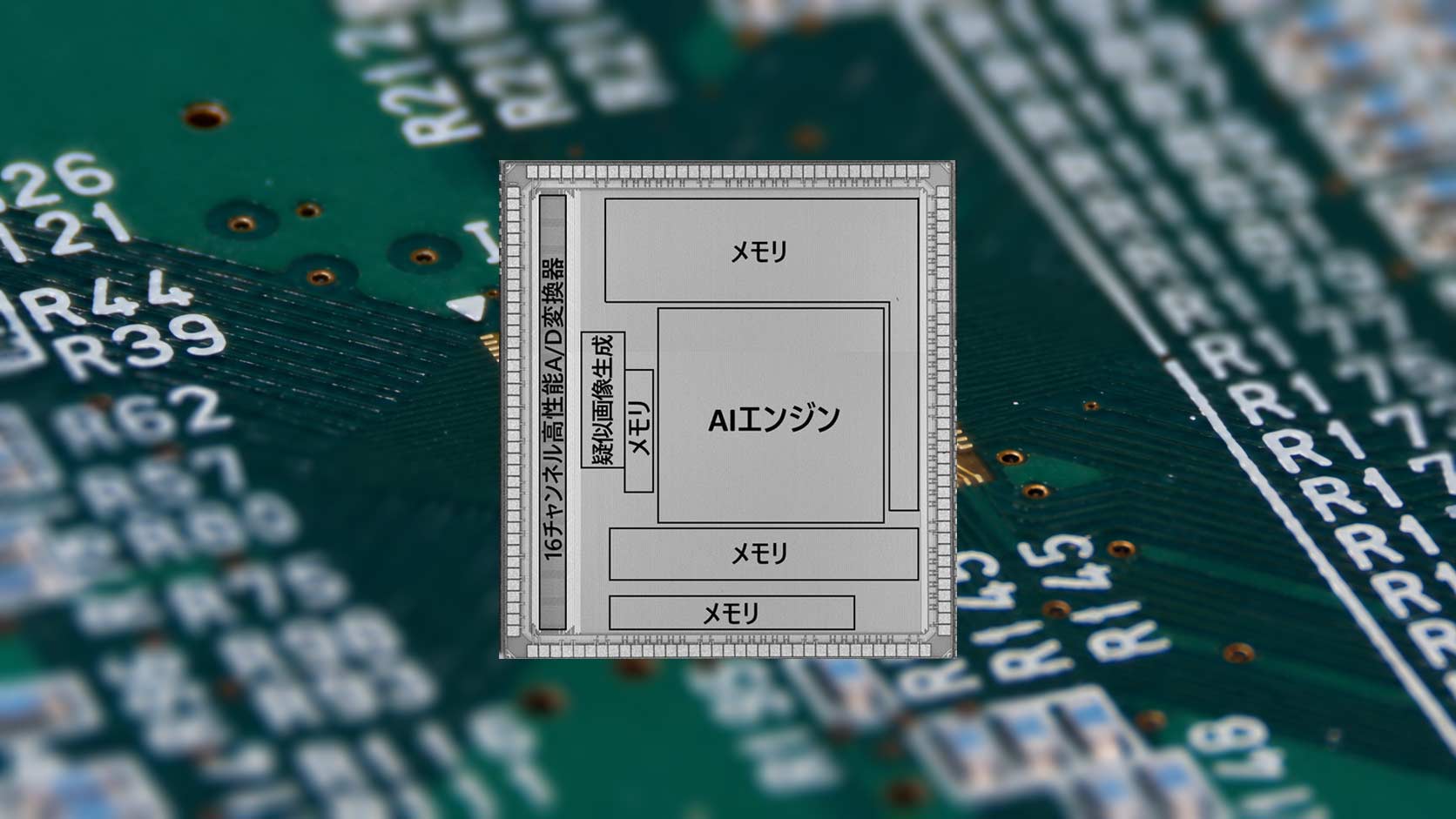
The prototype measures 3 by 3.3 millimeters and integrates an AI engine, memory, a 16-channel high-performance ADC, and a pseudo-image generator. Hitachi says it operates stably within the power constraints typical of manufacturing equipment.
Physical AI and the Industrial Edge
The announcement slots neatly into Hitachi's broader physical AI strategy, which the company has been building since CES 2026 and its partnership sessions with NVIDIA. Physical AI, as Hitachi defines it, applies intelligent systems to real-world infrastructure: railways, power grids, factories, and buildings. Unlike generative AI, which creates text and images, physical AI creates value through predictive maintenance, complex system optimization, and robotics. The market for AI in robotics is projected to reach roughly $125 billion by 2030, according to Grand View Research data Hitachi cited.
The company's HMAX suite of solutions spans mobility, energy, and industrial applications. The new edge semiconductor serves as the execution layer for HMAX Industry, allowing data to be processed at the point of collection rather than shuttled to a cloud or on-premise server. For semiconductor manufacturing specifically, Hitachi says the chip can enable single-image defect detection in inline inspection processes, accelerating quality control while reducing the need for computational overhead.
Why Edge AI Matters Now
The strategic logic here tracks with broader industry trends. Physical AI applications require inference at the point of action. A humanoid robot grasping a component cannot afford the latency of a cloud round-trip. An inspection camera on a production line needs immediate results, not queued processing. Edge AI addresses these constraints by moving the intelligence closer to the sensor.
Semiconductor industry analysis from HTEC's 2026 survey of C-level executives reinforces this view. The era of monolithic GPUs as the default AI platform is ending. Chiplet architectures and specialized silicon are becoming economically viable at scale. For edge inference specifically, power efficiency and thermal management matter more than peak compute. Hitachi's 3x3mm chip checks those boxes.
Hitachi has not disclosed pricing, volume production timelines, or whether the chip will be offered as a standalone component to third parties. The company says it will combine the edge AI semiconductor with lightweight AI models and software tooling to create an evaluation environment, then work with customers to integrate the technology into their equipment and production lines.
Context and Competitive Positioning
This announcement landed the same week Hitachi finalized the sale of its home appliance business to Nojima for approximately 110 billion yen. The timing underscores a company in the midst of a portfolio reshaping, pivoting resources toward infrastructure and industrial AI while shedding consumer-facing businesses.
Hitachi's competitive position in physical AI draws on more than a century of operational technology experience in railways, energy, and manufacturing. That domain expertise, embedded in AI models trained on real-world equipment data, represents something that pure-play AI companies cannot easily replicate. The new semiconductor is the hardware manifestation of that strategy: a chip designed not for general-purpose AI workloads, but for the specific demands of industrial environments where Hitachi already operates.
Whether this approach can compete with more generalized edge AI solutions from companies like Qualcomm, Intel, or AMD remains to be seen. The fragmented NPU landscape and lack of unified software tooling present challenges for anyone trying to scale edge inference across heterogeneous equipment. Hitachi's bet is that vertical integration, from domain expertise to silicon to software, offers a more defensible position than competing on hardware alone.