For more than two decades, Software-as-a-Service defined how businesses bought and deployed technology. Cloud delivery, subscription pricing, rapid deployment. The model worked. But according to NVIDIA CEO Jensen Huang, that era is ending.
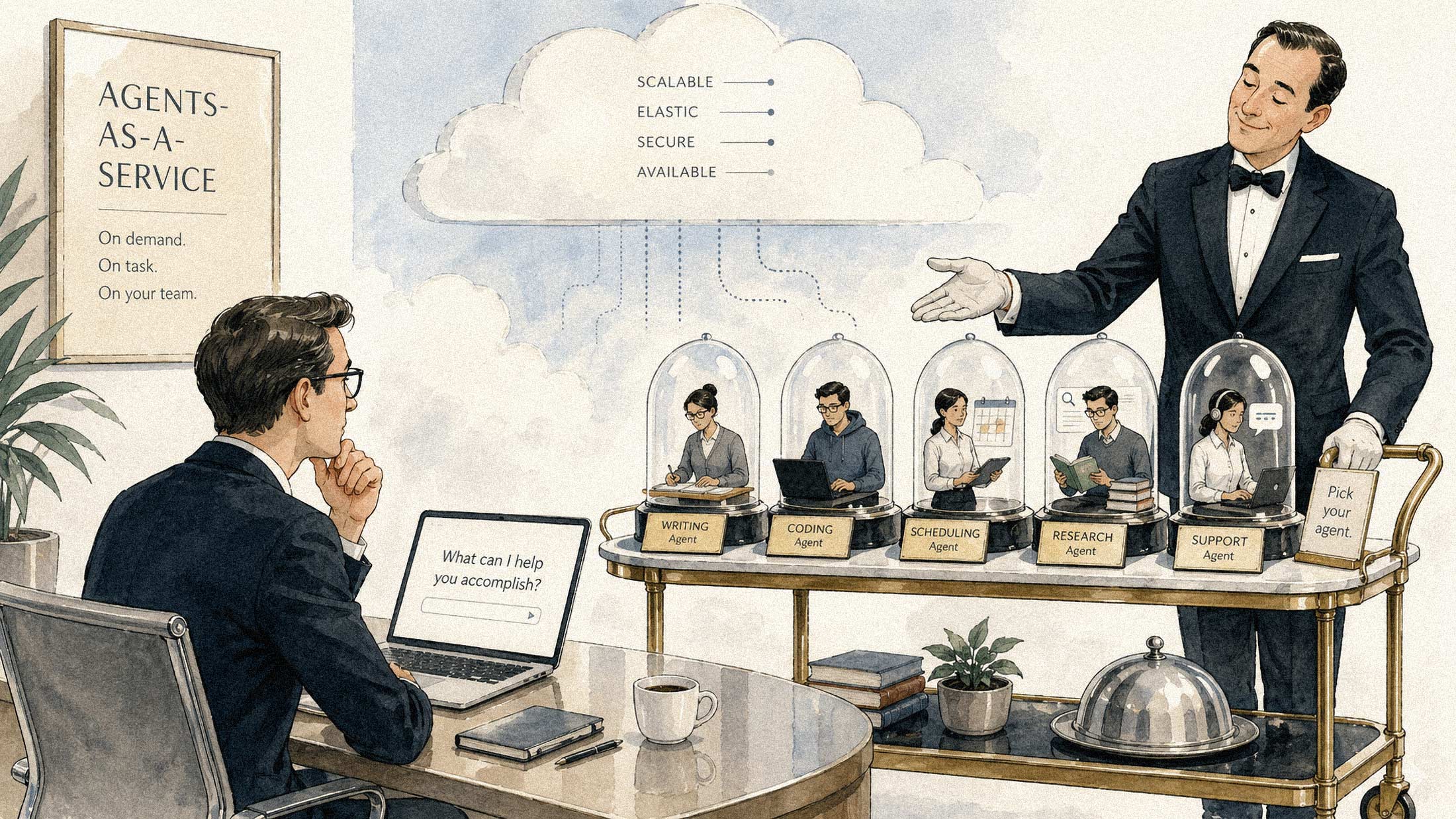
At GTC 2025, Huang made a claim that enterprise leaders should take seriously: AI agents are no longer a research project but the next operating model for enterprise computing. "Every SaaS company will become an AaaS (Agent-as-a-Service) company," he predicted at GTC 2026, signaling a paradigm shift in how software delivers value.
The argument is straightforward: the era of humans using software is giving way to an era where AI agents use software on behalf of humans. With SaaS, a human sits in front of the tool and does work. With AaaS, the agent performs work autonomously, continuously, and often across multiple systems simultaneously.
From Observation to Action
One of the clearest articulations of what this looks like in practice comes from Dassault Systèmes, the French software giant behind the 3DEXPERIENCE platform used by Boeing, Lucid Motors, and hundreds of thousands of engineering teams worldwide.
Nicolas Cerisier, Vice President of 3DEXPERIENCE Platform R&D at Dassault Systèmes, has been championing what the company calls "Industry World Models." These are advanced neural networks that understand the dynamics of the physical world and use input data to create internal simulations, allowing AI to learn and understand before recommending or taking action.
Dassault's executive vice president of R&D, Florence Hu-Aubigny, described the shift explicitly as a move from SaaS to "agents as a service," enabled by NVIDIA's AI models and orchestration tools.
The concept is physics-informed industrial AI. Unlike ChatGPT and similar large language models that excel at text, Dassault is building what it calls Industry World Models that understand how the physical world actually works. "The real world doesn't consist of text and images," CEO Pascal Daloz stated. "It consists of physics, materials, energy and constraints."
Virtual Companions as Autonomous Teammates
Dassault has introduced three "Virtual Companions" that embody this agent-first approach: Aura orchestrates knowledge and context across requirements, projects, and changes. Leo solves complex engineering challenges across disciplines from design to production. Marie applies deep scientific expertise in materials, chemistry, formulations, and therapies.
These virtual companions will be powered by combining NVIDIA Nemotron open models with Dassault Systèmes' industry world models to tap into deep industrial context and deliver trusted, actionable intelligence. Virtual companions are AI-driven capabilities that assist professionals by leveraging validated world models and industrial knowledge. They support a new way of working by augmenting human expertise rather than replacing it.
The practical implications are significant. Dassault's implementation involves virtual companions launching mid-2026. The company introduced three AI agents with distinct domain expertise. Aura functions as a business analyst with programme management and strategy capabilities. Leo focuses on engineering, design, and manufacturing. Marie handles scientific disciplines including materials and testing.
Training in Virtual Twins
What makes Dassault's approach distinctive is how these agents learn and operate. Industry world models embed first-principle physics, engineering laws, and system constraints with four decades of industrial knowledge accumulated with clients. They combine multi-scale, multi-discipline modeling and simulation with AI, spanning materials, components, machines, factory, and the entire industrial ecosystem.
Virtual twins are not applications, "they are knowledge factories," Daloz said. The partnership aims to establish industry world models as science-validated AI systems grounded in physics that can serve as mission-critical platforms across biology, materials science, engineering, and manufacturing. The value moves upstream: virtual twins become the place where knowledge is created, tested, and trusted before anything is built in the physical world.
Consider how this works in practice on the 3DEXPERIENCE platform. Physics Simulation Advisor is the role for interacting with AI-powered Virtual Twins Physics Behavior, which provides quick evaluations of the performance of a design to compare design alternatives or show the impact of a design change. The 2026x release sees enhanced management of favorite designs and access to requested KPI results from predictions. The agents can reconstruct parts from images, run stress tests, and present validated engineering solutions to users.
The Economic Shift
The business model implications are substantial. NVIDIA CEO Jensen Huang's GTC 2026 keynote signaled a profound shift from SaaS to AaaS driven by autonomous AI agents. Traditional seat-based SaaS revenue models face an existential threat as AI agents enable greater productivity with fewer human users, forcing a pivot to usage- or outcome-based pricing.
For forty years, Dassault sold licenses per user. But how do you count AI assistants? "Virtual companions aren't real users," Daloz noted. "Do we keep counting users, or must we measure something else?" The answer lies in what Daloz calls 'units of know-how' and 'units of work.' Instead of paying per logged-in user, you might soon pay for expertise and availability.
This connects directly to the infrastructure NVIDIA is building. Leading software platforms including Adobe, Atlassian, Amdocs, Box, Cadence, Cisco, Cohesity, CrowdStrike, Dassault Systèmes, IQVIA, Red Hat, SAP, Salesforce, Siemens, ServiceNow, and Synopsys are advancing enterprise and physical AI agents with NVIDIA Agent Toolkit software.
The stakes are not abstract. Huang said fusing these technologies into Dassault's environment is intended to bring accelerated computing and AI to users at significantly larger scale, citing "100 times, 1,000 times, and very soon a million times greater" than before. He emphasized a goal of shifting tasks that were previously "pre-rendered" or "offline simulations" into real time, including real-time wind-tunnel simulations, real-time robot operation in virtual factories, and real-time validation workflows.
Both executives emphasized that the goal isn't to replace engineers but to amplify them. As AI agent companions take on more exploratory and repetitive tasks, designers and engineers gain leverage and creativity, not redundancy. Every designer will have a "team of companions," Huang said. That framing matters. The transition from SaaS to AaaS will reshape how enterprises think about AI-driven decision systems, and the companies building the infrastructure now will define how it unfolds.
The 3DEXPERIENCE virtual companions launch mid-2026. They'll be cloud-only due to computing requirements. For industrial AI, the shift from software that assists to software that acts is underway.