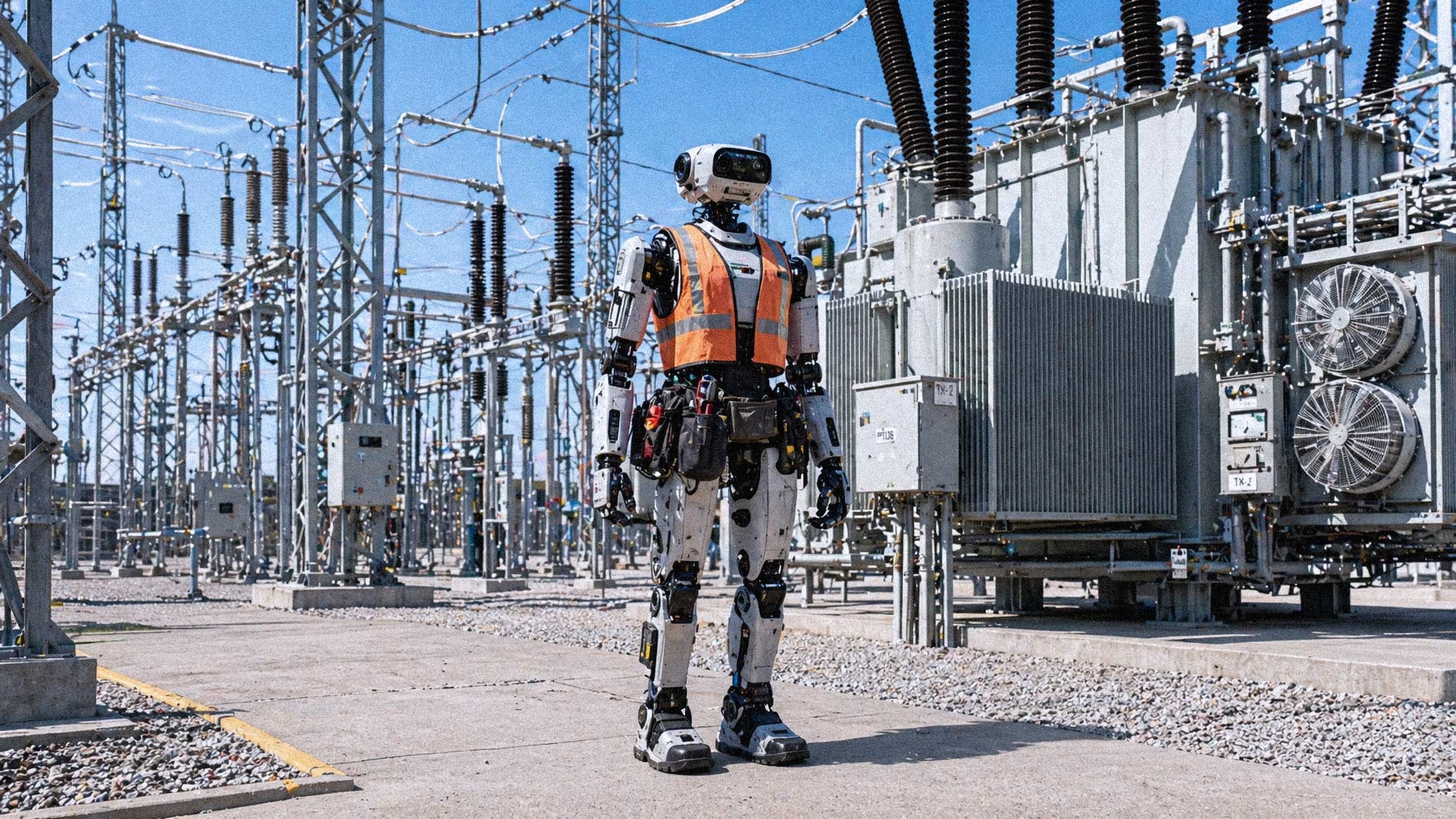
While the West debates AI alignment and safety frameworks, China is deploying robots to crawl across its power grid.
The State Grid Corporation of China has earmarked 6.8 billion yuan ($1 billion) for the procurement of AI-enabled robots in 2026 alone. The company plans to acquire roughly 8,500 units this year, focusing on four major scenarios: power inspection, live-line work, emergency rescue, and warehousing logistics.
The procurement centers on 5,000 quadruped robots designed to inspect substations and transmission lines in mountainous terrain, alongside an army of humanoid and dual-arm robots assigned to higher-stakes tasks like maintaining the country's ultra-high-voltage grid.
Physical AI Versus Software-Only Models
The contrast with Western AI development is stark. As NYU Law professor Winston Ma noted, roughly 90% of U.S. venture capital flows into software, leaving a critical financing gap in hard tech that sovereign wealth funds are now filling. American startups like Figure AI command valuations north of $39 billion, but Tesla, Figure AI, and Agility Robotics each shipped about 150 humanoid units in 2025. Meanwhile, China's largest humanoid robot company, Unitree, sold 5,500 units last year, making it the world's top seller.
Chinese companies now dominate the humanoid robot market, capturing over 90% of global sales with thousands of units shipped last year. China controls about 26% of the global actuator market compared with roughly 5% for the United States, and that supply chain advantage is translating into real deployments, not demo reels.
The robots themselves are already working. At China Southern Power Grid's Guangdong laboratory, humanoid robots, drones, and quadruped robots have been deployed alongside human engineers. "We are starting with simple skills," says Li Duanjiao, head of the company's robotics laboratory. The company is training robots to perform inspections covering six scenarios and 15 skills, with some machines already tested since last year.
The Feiyun quadruped robot, developed by China Southern Power Grid, is equipped with multimodal sensing, all-terrain adaptive mobility, and high-precision intelligent recognition algorithms for autonomous inspection of power equipment. A subsidiary of China Southern Power Grid has reached an agreement with a partner in Chile to deploy the robot at power substations in remote areas later this year.
The Power Hunger Crisis
This robotic push arrives as global electricity demand strains against aging infrastructure. The International Energy Agency now projects that global data center electricity consumption will exceed 1,000 TWh by the end of 2026, an amount equivalent to Japan's entire annual electricity usage.
In the United States, 2026 is being called a pivotal year for the power grid. Most of it was built between the 1950s and 1970s, and approximately 70% is approaching the end of its life cycle. The result is a system struggling to keep pace with soaring AI data center demand while lacking the workforce to maintain what already exists.
For the 2026 to 2030 cycle, State Grid plans to invest 4 trillion yuan ($574 billion) in grid modernization, representing a 40% increase over the previous five-year period. Robots are part of a broader strategy to reinforce long-distance transmission lines on the west-east axis, bringing electricity from renewable generation bases in less populated regions to urban and industrial centers.
Supply Chain Implications
State Grid Corporation is a Chinese state-owned electric utility and the largest utility company in the world. In 2023 it reported having 1.3 million employees, 1.1 billion customers, and revenue equivalent to $546 billion. When a company of this scale commits to robot-first operations, the ripple effects reach far beyond China's borders.
Domestic robotics firms including Deep Robotics, Unitree, Ubtech, and Fourier are becoming central suppliers to national infrastructure programs. State Grid's development plan calls for 30% embodied intelligence penetration in key areas by 2026, over 80% application penetration for intelligent agents by 2027, and full autonomous operation and maintenance of the power grid by 2030.
The West is watching. Tesla CEO Elon Musk recently acknowledged China's strength at the World Economic Forum: "China is very good at AI, very good at manufacturing, and will definitely be the toughest competition for Tesla. To the best of our knowledge, we don't see any significant competitors outside of China."
For Western economies grappling with their own grid bottlenecks and transformer shortages, China's robotic grid army represents both a preview and a warning. The AI race is no longer just about who builds the smartest chatbot. It is increasingly about who can deploy intelligence into the physical world at scale. Right now, Beijing has a commanding lead.