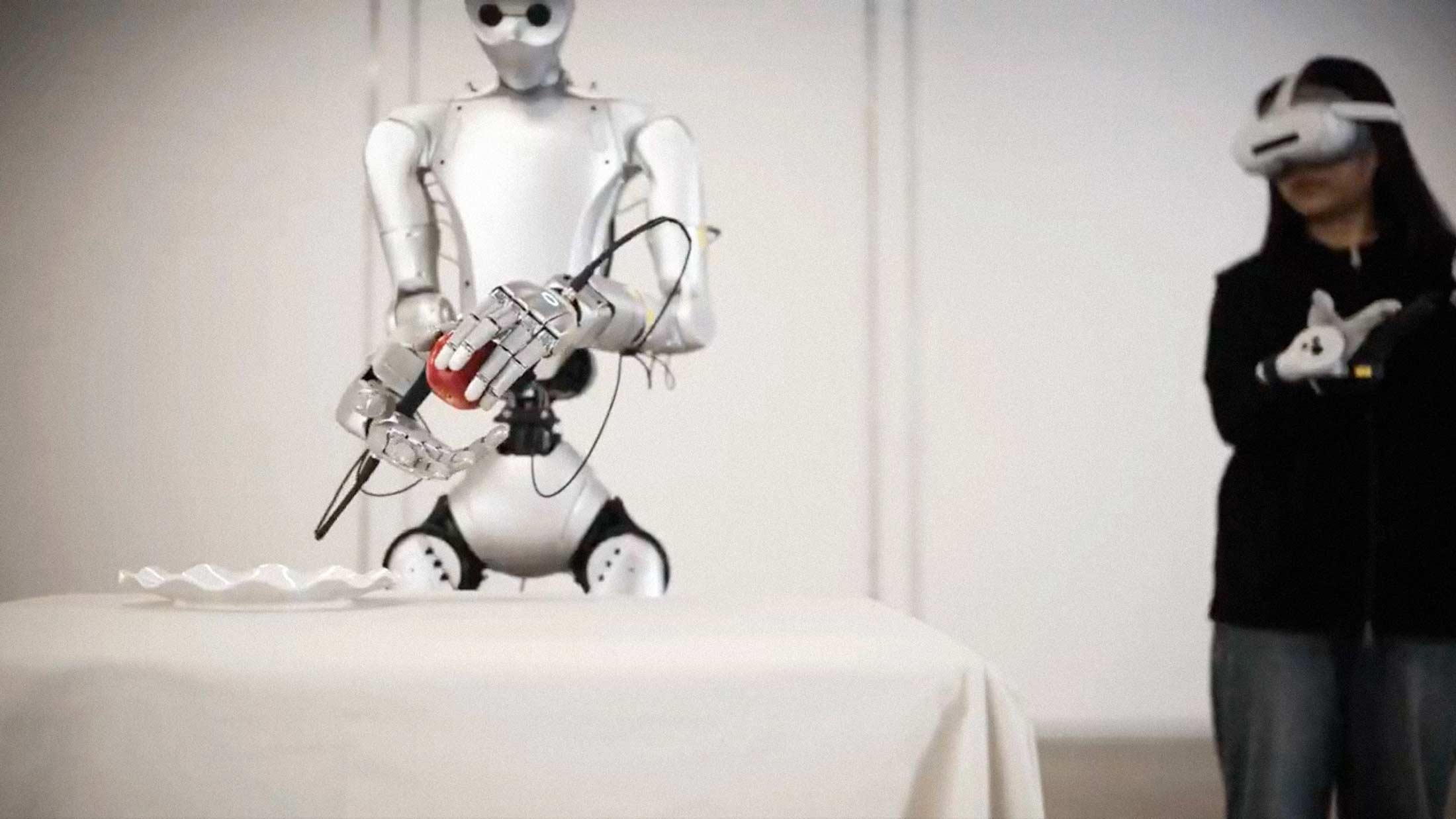
NVIDIA announced the Isaac GR00T Reference Humanoid Robot at GTC Taipei, marking the company's first open humanoid robot reference design. The platform integrates a Unitree H2 Plus humanoid body, Sharpa Wave tactile hands, and Jetson Thor onboard compute into a single research-ready package.
NVIDIA announces the first open humanoid robot reference design built for robotics research.
— NVIDIA Robotics (@NVIDIARobotics) June 1, 2026
The NVIDIA Isaac GR00T Reference Humanoid Robot combines the @UnitreeRobotics H2 humanoid robot, @SharpaRobotics Wave five-fingered hands for dexterous manipulation, Jetson Thor onboard… pic.twitter.com/iQU6n8EIOs
The design addresses a persistent problem in robotics research: fragmentation. Teams typically spend months cobbling together hardware, software stacks, and data pipelines before getting to actual research. NVIDIA's approach bundles the body and brain together, giving researchers a validated starting point rather than a blank slate.
What's in the Package
The Unitree H2 Plus chassis stands nearly six feet tall and weighs 150 pounds, with 31 degrees of freedom across the body. The robot's hands come from Sharpa, a Singapore-headquartered company that began shipping its Wave dexterous hands last year. Each hand adds 22 degrees of freedom, bringing the platform to 75 total. The hands include what Sharpa calls a Dynamic Tactile Array, with over 1,000 tactile pixels per fingertip and pressure sensitivity down to 0.02 newtons.
Powering the onboard intelligence is NVIDIA's Jetson AGX Thor T5000, built on the Blackwell architecture. The module delivers 2,070 FP4 teraflops with 128GB of unified memory, configurable between 40 and 130 watts. NVIDIA claims it provides 7.5 times the AI compute and 3.5 times the energy efficiency of its predecessor, Jetson Orin.
The software layer includes Isaac Teleop for capturing demonstration data, Isaac Sim and Isaac Lab for simulation and training, Isaac ROS middleware for deployment, and GR00T foundation models for reasoning and multitask behavior. Researchers retain control of their robot data, training data, and telemetry.
Research Adoption
Ai2, ETH Zurich, the Stanford Robotics Center, and UC San Diego's Advanced Robotics and Controls Laboratory have committed to using the platform. Steve Cousins, executive director of the Stanford Robotics Center, said the design gives students and collaborators an open humanoid reference with dexterous hands and onboard AI compute for creating, comparing, and sharing robot behaviors.
The H2 Plus will be available from Unitree in late 2026. NVIDIA will also release a reference workflow for the smaller Unitree G1 on GitHub and Hugging Face.
The Edge Computing Strategy
The announcement fits into a broader pattern. AI incumbents are pushing compute to the edge, where latency constraints and connectivity limitations make cloud-dependent systems impractical. A humanoid robot cannot wait for a remote server to decide whether to catch itself during a fall. The response window is measured in milliseconds.
The global AI edge computing market reached $29.98 billion in 2026, up 20.3% from the prior year. NVIDIA controls roughly 39% of edge AI computing revenue, according to market research. Its Jetson platform has approximately 2 million developers. Boston Dynamics is integrating Jetson Thor into Atlas. Agility Robotics plans to adopt it for the sixth generation of Digit. Figure AI is building on it. The list keeps growing.
Jensen Huang has framed this as a multitrillion-dollar opportunity, arguing that humanoid robots will bring physical AI to industries that software alone cannot reach. Whether that timeline plays out depends on whether the hardware and models can handle the messiness of real environments, where physics does not cooperate and sensor data is never clean.
For now, NVIDIA is building the picks and shovels. The Isaac GR00T reference design gives researchers a common foundation. If robotics development follows the pattern CUDA established for AI training, the company that defines the platform captures value long after the hardware ships.
The reference design has no disclosed price. Given that the Unitree H2 lists at $29,900 and the Sharpa Wave hands reportedly cost around $50,000 each, researchers should expect a complete system to run well into six figures. That cost may come down as production scales, but frontier robotics research has never been cheap.