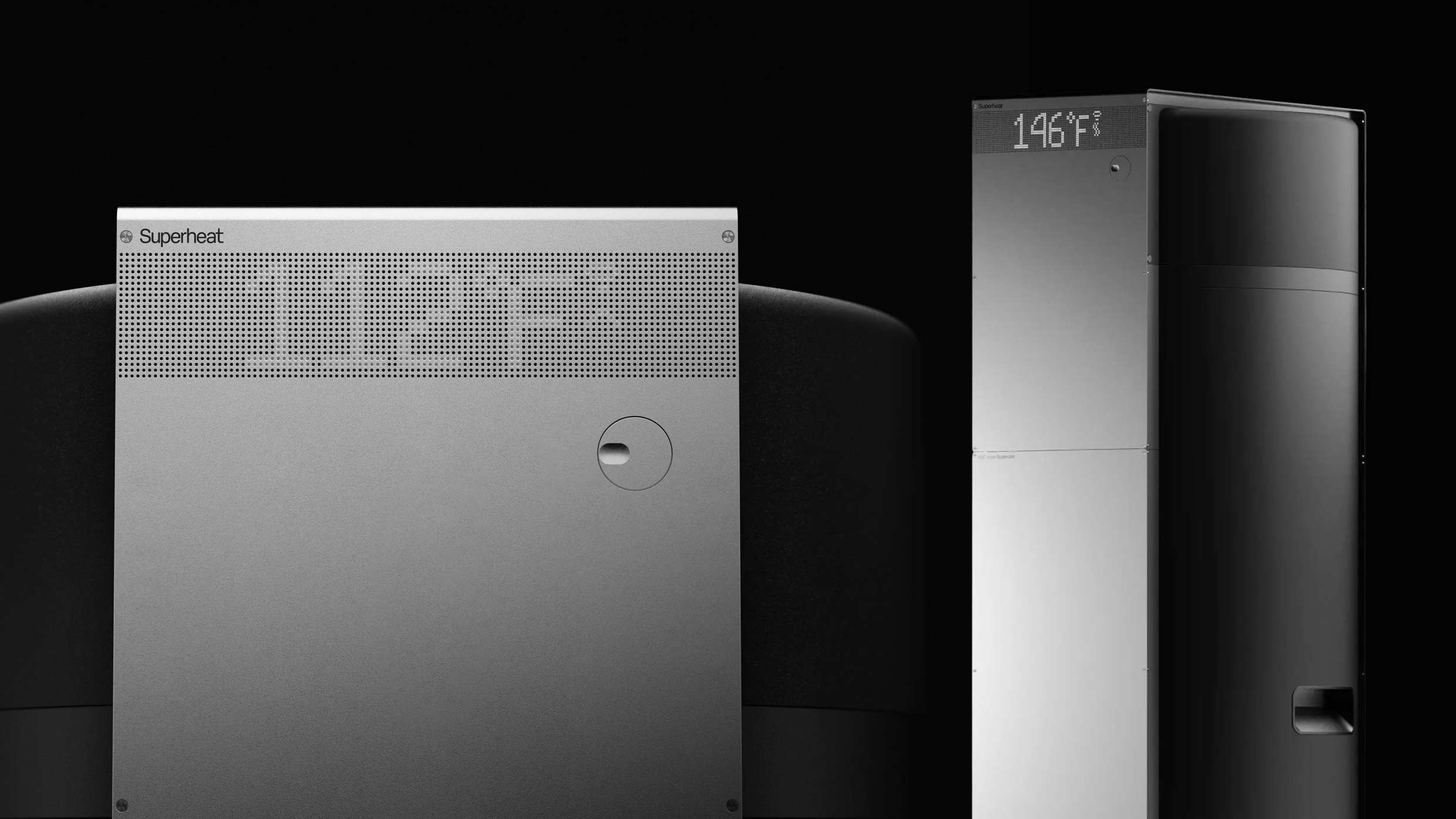
Superheat, a startup positioning itself as a company that redefines energy infrastructure, debuted its H1 water heater at CES 2026 in Las Vegas with a pitch that sounds almost too elegant: a 50-gallon tank that heats water using the thermal byproduct of Bitcoin mining, turning a household necessity into a passive income stream. The device costs approximately $2,000 and, according to the company, can generate up to $1,000 in annual Bitcoin earnings while offsetting up to 80% of electricity and water costs.
The underlying physics are straightforward. Every watt consumed by an ASIC mining chip becomes a watt of heat. Traditional electric water heaters use resistive elements to achieve that same conversion. The H1 replaces those elements with SHA-256 mining hardware. The electricity flows through the chips, generates heat as a byproduct of computation, and that thermal energy is transferred to the water through a heat exchanger. You get hot water. You also get Bitcoin.
What's Actually Inside
The H1 is a residential water heater with a built-in Bitcoin mining ASIC, housed in a modular aluminum enclosure that Superheat says is designed for long-term serviceability. The company claims swappable internals will allow compute components to be upgraded over time. According to D-Central's technical analysis, the unit draws approximately 3.3 kW and operates at roughly 120 terahashes per second, implying an efficiency of about 27.5 W/TH. That's less efficient than current-generation dedicated miners, but the form factor and thermal constraints make direct comparison difficult.
Andrew Geng, Superheat's co-founder and CTO, has framed the product in broad terms. In press materials, he called heat "one of the world's most overlooked resources" and suggested the company plans to expand into distributed AI and cloud computing workloads over time.
Where Skepticism Is Warranted
The company's economic claims require scrutiny. Tom's Hardware noted that the projected service life is roughly 10 years, comparable to a traditional domestic water heater. The $1,000 annual return would, in theory, pay off the hardware in two years. But profitability hinges entirely on Bitcoin's price and network difficulty, both notoriously volatile. The 80% cost offset is a marketing claim, not a guaranteed outcome.
There's also a structural question embedded in the pitch. A standard 50-gallon electric water heater cycles on and off based on demand. It does not run 24/7 at full power. Mining hardware, by contrast, runs continuously. Superheat claims the H1 uses roughly the same energy as a conventional unit, but D-Central's analysis points out that 120 TH/s of continuous mining would consume significantly more electricity than intermittent resistive heating. The company's stated savings likely factor in Bitcoin revenue as a credit rather than a pure energy equivalence.
Broader Implications
The H1 sits within a growing category of dual-use mining hardware. At CES 2025, Canaan showcased consumer miners designed to double as space heaters. Bitcoin space heaters, however, have a seasonal limitation: you only need the heat part of the year. Water heating solves that problem. Every household needs hot water, regardless of season.
Superheat's ambition extends beyond a single appliance. Chief Operating Officer Julie Xu has discussed a vision where thousands of H1 units could be networked into a distributed computing infrastructure, potentially serving AI inference workloads in addition to mining. That model, if realized, would turn residential Bitcoin mining into something closer to embedded infrastructure.
The H1 matters less because someone put a miner inside a water heater and more because it attempts to make mining invisible within an appliance category already present in millions of homes. Whether the economics actually work depends on variables Superheat cannot control: Bitcoin's price trajectory, electricity costs, and how well the hardware holds up over a decade of continuous operation.
First shipments to early supporters began in March 2026. Installation is reportedly similar to a standard water heater, with Superheat's certified technicians handling setup. Users manage performance, earnings, and withdrawals through a mobile app, with a web dashboard available for commercial deployments across multiple properties.
For now, the H1 is best understood as a first-generation product from a startup still proving its thesis. The device needs real-world verification before anyone should take its claimed returns as reliable.