Around 2:30 p.m. Eastern on Saturday, something rattled windows across greater Boston. Within minutes, 911 dispatchers were fielding floods of calls describing what sounded like an explosion. Police units headed to Brighton. Residents in Wellesley, Scituate, Winchester, Arlington, Cambridge, Concord, Lynnfield, and neighborhoods throughout the city reported hearing two distinct booms. Some felt the percussion in their chests.
Explosion sound heard in Boston Cambridge MA registered as an impact on my dashcam. You can hear a double bang. #explosion #boston #cambridge not a scientist, but it sounds like a sonicboom to me. Leaves on the tree don't move at all. Might be a clue pic.twitter.com/CoQBy1Oc0g
— Stanley Fung (@stanleyfung4) May 30, 2026
The Boston Globe reported that the sound reached municipalities across eastern Massachusetts, with eyewitnesses spanning from Boston proper to Rhode Island, roughly 70 miles apart. A Boston Police spokesperson described the situation as "kind of bizarre," telling reporters, "I don't know what it is. I'm getting tons of calls."
A Flash That Doesn't Match Lightning
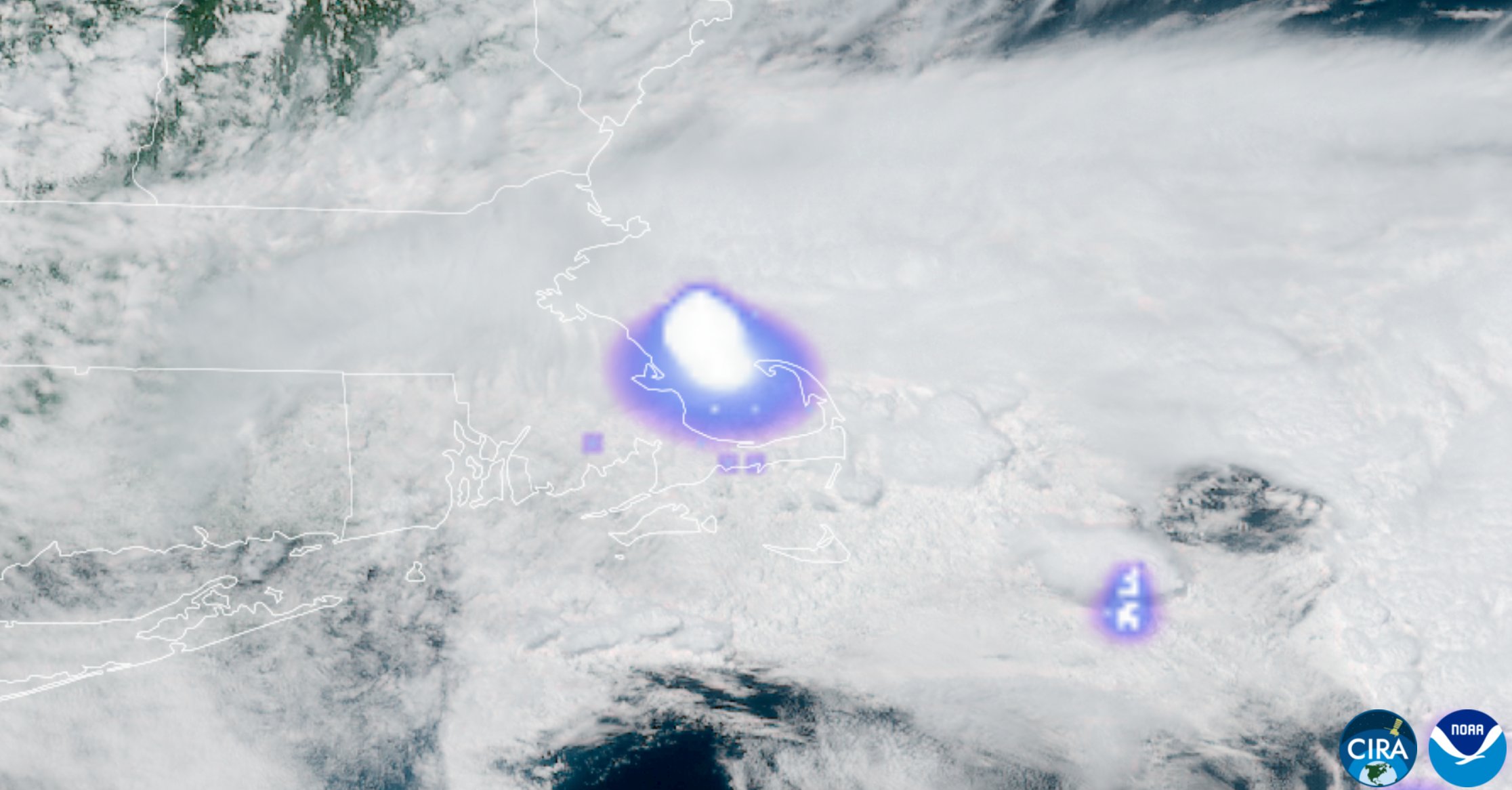
The answer came from space. Nick Stewart, a spaceflight meteorologist who works as an upper-level winds analyst at Cape Canaveral Space Force Station, posted analysis to X within minutes of the event. Stewart identified a large optical flash captured by NOAA's GOES-19 satellite, specifically by its Geostationary Lightning Mapper instrument.
The flash, Stewart noted, did not correlate with any active thunderstorms in the region. Instead, the signature matched what planetary scientists call a bolide: a bright meteor that explodes violently as it decelerates through Earth's atmosphere. Stewart wrote that the flash density product showed an "anomalous 'flash' which is pretty distinctive of a bolide/meteor reentry east of Boston."
The flash density product really shows this anomalous "flash" which is pretty distinctive of a bolide/meteor reentry. east of Boston. This is the likely source of the loud boom/explosion. pic.twitter.com/ka5b9KfiQ7
Advertisement— Nick Stewart (@NStewWX) May 30, 2026
WBZ-TV Chief Meteorologist Eric Fisher confirmed the assessment, stating that satellite data showed the meteor entered the atmosphere over the South Shore near Boston. One resident, Stanley Fung, captured audio of the event on video and described the sound as resembling a "sonic boom."
How GLM Catches What Eyes Can Miss
The Geostationary Lightning Mapper was designed to track terrestrial lightning activity, taking 500 images of Earth every second. But researchers discovered years ago that the instrument is equally adept at detecting meteors. Because bolides flicker as they burn up during atmospheric entry, the rapid brightness changes register the same way lightning does.
NASA's Asteroid Threat Assessment Project has developed machine learning pipelines specifically to extract bolide signatures from GLM data. The system is particularly useful for detecting objects in the 0.1 to 3 meter diameter range, filling gaps that ground-based observation networks often miss. GLM data is publicly available in near real-time, which is how Stewart identified Saturday's event so quickly.
The technology has proven itself repeatedly over the northeastern United States. On New Year's Day 2022, a bolide exploded over Pittsburgh with energy NASA estimated at 30 tons of TNT. That object was roughly a yard in diameter and weighed close to half a ton. It was cloudy that morning, so nobody saw the fireball visually. But GLM caught the flash, and a nearby infrasound station registered the blast wave. Had skies been clear, NASA said, the fireball would have appeared about 100 times brighter than the full moon.
Similar events have been detected over Massachusetts before. In October 2021, residents in parts of Massachusetts and New Hampshire reported a mysterious loud boom that GLM data later attributed to a bolide. In December 2020, a meteor burned up over upstate New York, visible from Ontario to Virginia, triggering sonic booms audible to observers near the event's trajectory.
The Science of Sonic Booms
A sonic boom occurs when an object travels through the atmosphere faster than the speed of sound. Air molecules get pushed aside with tremendous force, creating a shock wave that propagates outward. When a meteor is decelerating from cosmic velocities, often exceeding 40,000 miles per hour, the shock wave can be powerful enough to shake buildings dozens of miles away.
Bolides are distinguished from ordinary fireballs by their explosive terminal flash, often accompanied by visible fragmentation. The American Meteor Society defines a fireball as any meteor brighter than magnitude -4, roughly equivalent to Venus. A bolide is a subcategory that ends with a dramatic detonation rather than a gradual fade.
No damage or injuries have been reported from Saturday's event in Boston. Local authorities have confirmed there is no active threat. Police and fire officials throughout the region have asked residents to refrain from calling emergency services, noting they are aware of the incident and investigating.
What Happens Next
If past events are any guide, NASA's Meteor Watch or the American Meteor Society will likely compile eyewitness reports over the coming days. The AMS maintains a public database of fireball sightings and has tracked events visible across 11 states and into Canada.
For the Boston event, the key variables that remain unknown are the meteor's precise size, mass, and trajectory. If infrasound data becomes available from regional monitoring stations, researchers may be able to estimate the energy released. Without visual sightings of the fireball itself, trajectory reconstruction depends heavily on satellite data and any audio or seismic recordings that surface.
Stewart's credentials lend weight to his preliminary analysis. He is a nine-time Emmy and two-time Murrow award winner who previously worked as a broadcast meteorologist in Iowa before moving to launch operations at Cape Canaveral. His work involves analyzing upper-level winds for rocket launches at Kennedy Space Center, including NASA's Artemis program simulations.
The speed of identification in this case demonstrates how far bolide detection has advanced. What once required days of investigation and speculation can now be resolved within an hour, provided the right instruments are watching. On Saturday, they were.