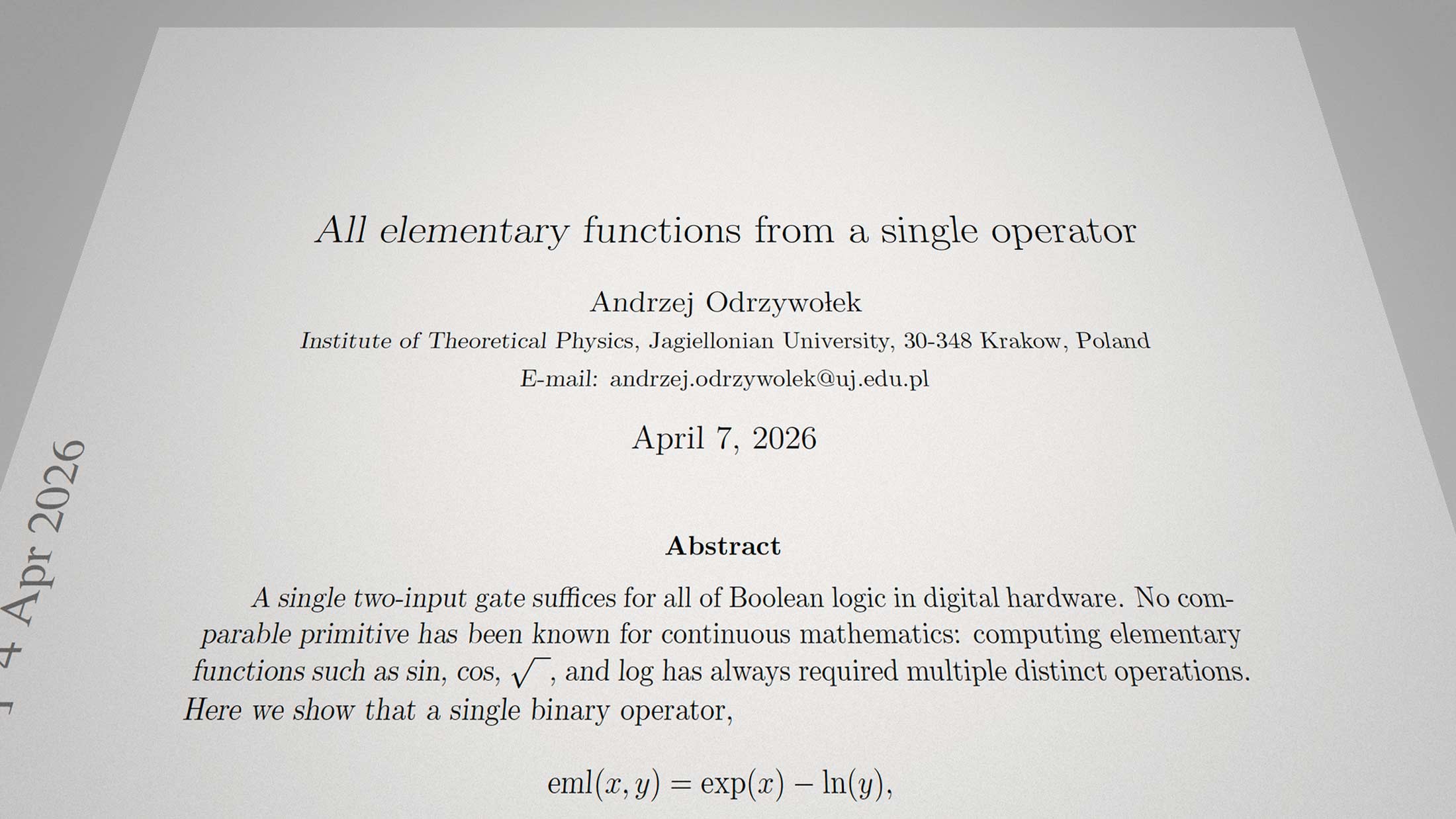
A new paper from Jagiellonian University mathematician Andrzej Odrzywołek is generating attention for a striking claim: a single binary operator, paired with the constant 1, can reconstruct every function on a scientific calculator. Addition, sine, logarithms, pi, even the imaginary unit. All from one formula. It's an elegant result. Whether it changes anything practical is a separate matter.
What the Paper Claims
The operator is called EML, short for Exp-Minus-Log: eml(x,y) = exp(x) − ln(y). Through recursive application, Odrzywołek demonstrates that this single function can reproduce all 36 standard elementary operations. The methodology involved ablation testing, systematically removing functions from a set until only one survivor remained.
The NAND gate comparison has become the go-to analogy. In digital logic, any circuit can be built from NAND gates alone. EML claims the same universality for continuous mathematics. The grammar is tidy: S → 1 | eml(S, S). Every expression becomes a binary tree of identical nodes.
It's a genuinely interesting mathematical observation. But analogies can do a lot of heavy lifting, and this one deserves some scrutiny.
The Gap Between Elegant and Useful
NAND gates are functionally complete, and actual chips are built from them. But that's because NAND operations are trivially cheap in silicon. EML involves exponentiation and logarithms, two of the most computationally expensive operations in numerical computing. Nesting them recursively to produce something as basic as addition would be orders of magnitude slower than just adding two numbers.
The paper acknowledges this indirectly, but much of the surrounding commentary has not. Computing sine via deeply nested EML expressions isn't a viable alternative to optimized polynomial approximations and lookup tables. No numerical library is going to be rewritten around this. No existing hardware will benefit from it.
The verification method also warrants attention. Symbolically proving that nested EML expressions equal known functions is, by the paper's own admission, computationally brutal. Odrzywołek relies on numerical bootstrapping, evaluating candidates at specific transcendental constants and checking for agreement. False matches fail quickly, but this is not the same as formal symbolic proof for every claimed identity. The approach is pragmatic and likely sound, but it leaves room for edge cases.
The AI and Hardware Speculation
The paper and its proponents suggest applications in symbolic regression, where AI systems try to extract mathematical formulas from data. The argument: EML's uniform binary tree structure makes the search space more regular and therefore more amenable to gradient-based optimization.
In theory, this is plausible. In practice, symbolic regression already has effective approaches, and the overhead of working in EML's representation may not justify the structural convenience. Translating a converged EML tree back into a human-readable formula adds another layer of complexity. Whether this actually outperforms existing methods in real benchmarks remains to be demonstrated.
Hardware speculation is even more tenuous. The idea that specialized stack machines or FPGAs could implement EML primitives for efficiency gains runs headfirst into the cost problem. Each EML evaluation requires an exponentiation and a logarithm. Building a chip around that as a primitive instruction would likely be slower for most tasks than conventional floating-point units, not faster.
What's Actually Interesting Here
Strip away the speculative applications and the result still has genuine mathematical value. The fact that continuous mathematics has a functionally complete primitive, analogous to NAND in Boolean logic, is a structural insight worth knowing. It says something about the deep relationships between exponential and logarithmic functions that isn't immediately obvious.
But "interesting structural insight" and "changes everything" are very different claims. Mathematics is full of beautiful universality results that have limited practical consequence. The Church-Turing thesis tells us that a Turing machine can compute anything computable, but nobody runs production workloads on Turing machines.
Odrzywołek's EML may find its niche. It may prove genuinely useful in symbolic regression or in some corner of theoretical computer science. But the gap between a neat mathematical fact and a paradigm shift is wide, and the paper as published doesn't bridge it. The result deserves attention. It doesn't yet deserve revolution.