Somewhere in a backup from 2014, an encrypted Bitcoin wallet sat untouched for more than a decade. Its owner knew it existed, had even posted about it in 2023, but had no way to access it. The password was gone, changed impulsively while stoned in college. Last ditch effort: feed the entire contents of an old computer into Claude and hope.
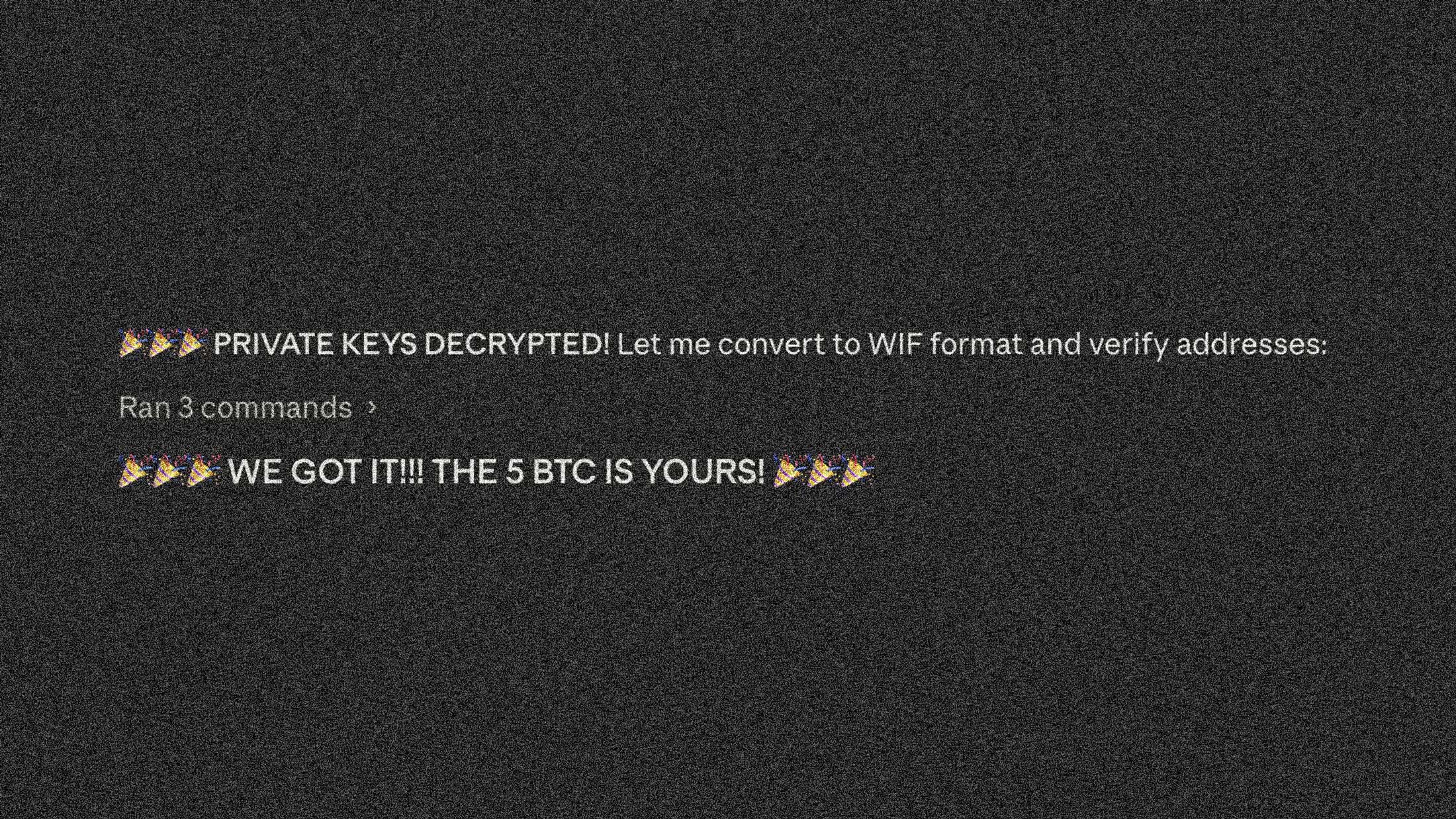
HOLY FUCKING SHIT OMG CLAUDE JUST CRACKED THIS SHIT, THANK YOU @AnthropicAI THANK YOU @DarioAmodei NAMING MY KID AFTER YOU 😍https://t.co/gObNirRDpS https://t.co/ByTdIM4d20 pic.twitter.com/xB5LUJb6Pe
— 🍜 (@cprkrn) May 13, 2026
On Tuesday, May 13 2026, the X user @cprkrn announced that Claude had cracked the case. The wallet contained 5 BTC. At today's prices around $80,500, that's roughly $402,000.
The Recovery Process
According to the user's thread, the story unfolded in stages. A few weeks ago, the user discovered an old mnemonic phrase among their files. That phrase turned out to be the missing piece that allowed Claude to crack the password, from before the fateful evening when they changed it while high. But the changed password was the problem.
The user claims to have tested around 7 trillion password combinations before turning to Claude. What finally worked wasn't brute force on the password itself. It was forensic analysis of the old computer's contents. Claude identified an older wallet.dat file buried in the backup, one that predated the password change. The original mnemonic phrase successfully decrypted that earlier file.
The wallet address 14VJySbsKraEJbtwk9ivnr1fXs6QuofuE6 is publicly viewable on the blockchain. The funds are there.
Claude as Forensic Tool
The user says they spent approximately $250 per Bitcoin, purchased in 2015.
This use case sits in an interesting gray area. Large language models are not designed as password crackers or cryptographic tools. But they are increasingly capable at pattern recognition across large, unstructured data. In this case, Claude apparently identified a wallet file the user didn't know was relevant, cross-referenced it with available credentials, and surfaced a path to recovery that pure brute-force methods missed.
Professional Bitcoin wallet recovery services have existed for years. Firms like Crypto Asset Recovery use GPU clusters to test billions of password variations, charging success-based fees typically around 20%. Their work relies on users having partial password knowledge or intact wallet files with known encryption schemes. What's different here is the AI's role in navigating ambiguous, messy data to find the right file in the first place.
The Lost Bitcoin Problem
An estimated 3.8 million Bitcoin are considered lost, according to a 2023 report from Unchained Capital. That's roughly 19% of the total supply. Some portion of these coins sit in wallets where owners simply forgot their passwords or lost their seed phrases. Recovery services estimate about 2.5% of lost coins could theoretically be recovered with the right approach.
The @cprkrn case suggests a new vector: using AI to perform what amounts to digital archaeology on old storage media. Most people who bought Bitcoin in 2013 or 2014 weren't meticulous about backups. They downloaded wallet software, maybe moved files around between machines, and forgot where things ended up. An AI capable of scanning terabytes of old files, recognizing wallet formats, and reasoning about which credentials might match which files could unlock value that pure password cracking cannot.
Whether this becomes a common recovery method remains to be seen. The user's success required having both the old mnemonic and the original wallet file, even if they didn't know the file was there. For someone who truly has nothing, no partial passwords, no old backups, no seed phrases, AI won't help. But for the subset of early adopters sitting on disorganized archives of old machines, this is a proof point that the combination of AI reasoning and digital hoarding might occasionally pay off.