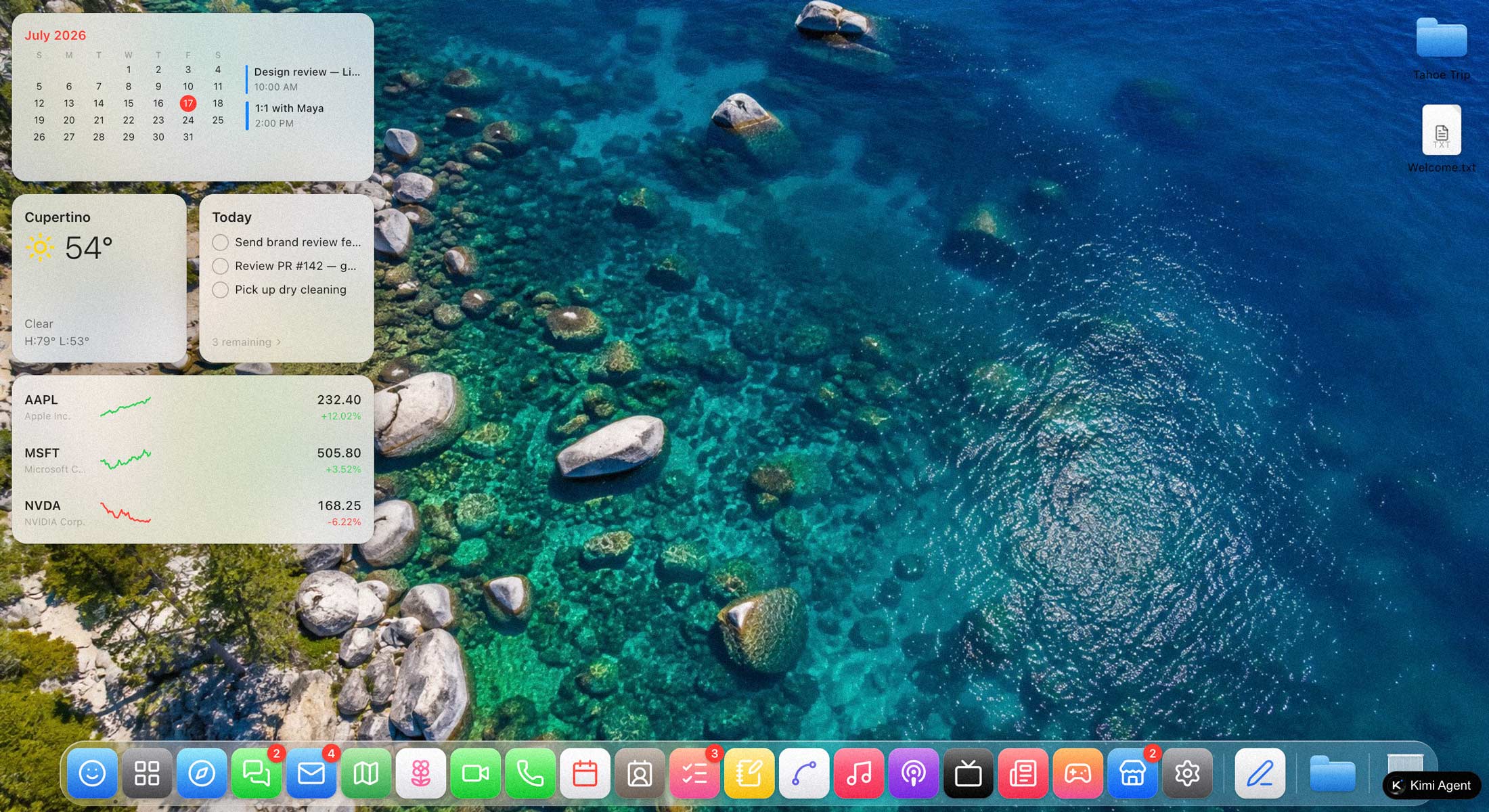
Max Weinbach, a technology analyst at Creative Strategies, set Moonshot AI's new Kimi K3 on a strange task: recreate macOS 27 Golden Gate, Apple's forthcoming operating system, as a fully functional web application. Complete with working Liquid Glass effects and native apps. In a browser.
Three hours and twenty minutes later, the model finished. The result is live at macos27.kimi.page.
It finally finished, here's the final output. Used 60% of my monthly Kimi usage on ithttps://t.co/TnsbOq6L8Z https://t.co/jh21W2j2iC
— Max Weinbach (@mweinbach) July 16, 2026
Weinbach used K3's Agent Swarm mode, a feature that distinguishes Moonshot's flagship from conventional large language models. Rather than processing instructions sequentially, Agent Swarm coordinates dozens of sub-agents working in parallel. One agent might be building the dock while another renders the translucent menu bar. Moonshot's documentation describes the system as capable of scaling to hundreds of sub-agents across thousands of coordinated steps.
The task burned through 60% of Weinbach's monthly Kimi allocation, according to his post. That gives a rough sense of the computational intensity involved. This was not a demo prompt.
What Kimi K3 Actually Is
Kimi K3 arrived on July 16, 2026, as Moonshot AI's largest open-weight model yet. At roughly 2.8 trillion parameters, it is substantially larger than DeepSeek's V4 Pro. The model features a one-million-token context window and ships in two variants: K3 Max for general-purpose tasks and K3 Swarm Max for parallel batch processing.
Early benchmark results suggest K3 performs competitively with Anthropic's Fable 5 and OpenAI's GPT-5.6 Sol, particularly on coding and agentic tasks. In blind testing by AI evaluator Arena, developers preferred Kimi over every leading U.S. model for front-end coding. The release has drawn comparisons to the DeepSeek moment that rattled markets in early 2025.
Why a Fake OS Matters
What Weinbach built is not an operating system. It is a simulation. There are no kernel calls, no memory management, no actual processes. But that misses the point.
The demonstration shows that a sufficiently capable AI model can autonomously construct a complex, visually coherent, interactive application without human intervention beyond the initial prompt. The Liquid Glass effects in the web recreation mirror Apple's actual macOS 27 Golden Gate design, which features translucent UI elements, dynamic lighting, and adjustable transparency. Weinbach's prompt invoked real design constraints, and Kimi K3's agent swarm organized itself to meet them.
This is a preview of what prompt-to-application development looks like when models get fast enough. Today, a three-hour build time is a curiosity. But inference speeds are improving rapidly. Context windows are expanding. Agent orchestration is becoming more sophisticated. Anthropic, OpenAI, and now Moonshot are all converging on the same architecture: models that can break tasks into components, delegate to sub-agents, and synthesize the results without constant human supervision.
The Logical Endpoint
If an AI can build a working macOS clone in a few hours, the natural question is whether people will eventually stop installing software altogether. The logic is straightforward: as inference latency approaches zero and model capabilities continue to climb, the distinction between a local application and a generated-on-demand application becomes academic.
This is not imminent. Weinbach's experiment required 60% of a paid monthly allocation and over three hours of compute. But the trajectory is clear. Software may become something you describe rather than something you download. The executable binary, the installed application, the versioned release: these could all become artifacts of an era when generation was slower than distribution.
For now, macos27.kimi.page is a party trick. A useful one. It demonstrates that the gap between prompt and production is narrower than most people assume, and narrowing fast.