Anduril just announced a partnership that signals how seriously the Pentagon is rethinking naval manufacturing. The defense technology company is teaming with South Korea's HD Hyundai and Louisiana-based Edison Chouest Offshore to design and build a new class of autonomous surface vessels, with a variant positioned for the Navy's Modular Attack Surface Craft (MASC) program. The first hull is already under construction at HD Hyundai's shipyard in Korea, with the vessel expected in the water later this year.
This is not a concept render or a future roadmap. Steel is being cut.
The Hardware
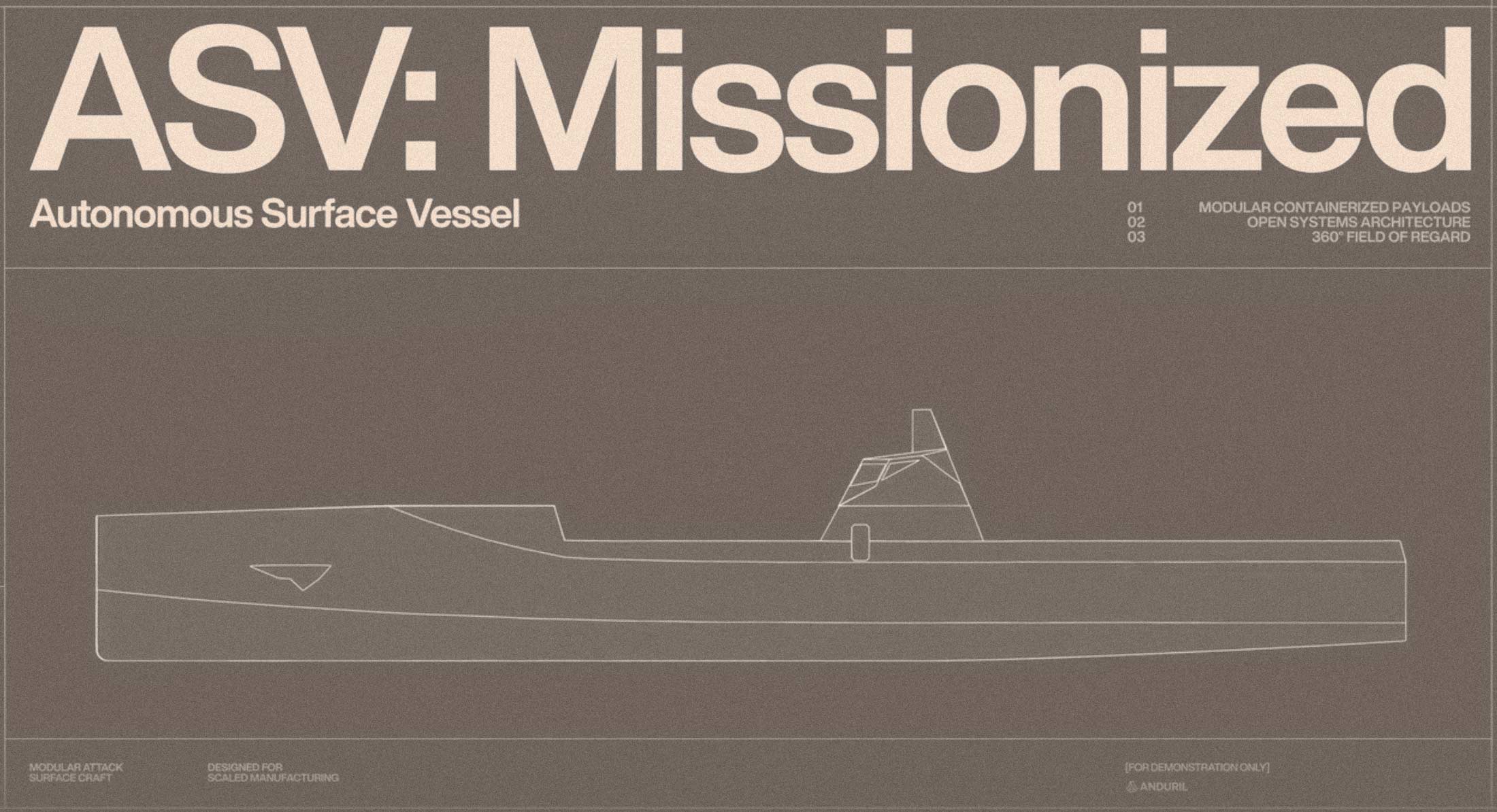
The vessels are built around Anduril's open-architecture design philosophy. Rather than fixing a single payload configuration, the hull is designed to swap mission modules for intelligence, surveillance, strike, and electronic warfare roles. The framing matters because it means the Navy is not locked into a single supplier's ecosystem. Hardware from multiple vendors can integrate into the same platform, and the payload can be updated without redesigning the ship.
A distinctive central superstructure gives the vessel an unobstructed 360-degree field of view, enabling continuous situational awareness and eliminating the blind spots that plague vessels designed primarily for crewed operation. Specific dimensions, tonnage, and range have not been publicly disclosed.
Anduril's Lattice autonomy software will serve as the operating system. Lattice already runs across Anduril's counter-drone systems and surveillance towers, processing sensor data and coordinating responses faster than human operators can. Applying that same software stack to surface vessels means these ships can operate independently or as part of coordinated fleets with minimal human oversight.
Why Korea
The partnership structure reveals the uncomfortable math facing American shipbuilding. HD Hyundai operates one of the largest and most efficient shipyards on the planet. The company builds commercial vessels, offshore platforms, and naval ships at a pace and cost that American yards simply cannot match. South Korea's shipbuilding industry produces roughly 40% of the world's commercial vessels by tonnage.
American shipyards, meanwhile, have consolidated and contracted over decades. The industrial base that built fleets during World War II no longer exists. Huntington Ingalls and General Dynamics dominate military shipbuilding, but capacity constraints mean the Navy consistently faces delays and cost overruns on new construction.
Edison Chouest brings domestic production capability for the next phase. The first prototype is being fabricated in Korea to validate the design, but future vessels, including the MASC variant, will be built in the United States. Production is slated to move to the renovated Foss Shipyard in Seattle alongside Edison Chouest facilities. The company operates one of the largest privately-owned fleets of offshore support vessels in the world and has experience building specialized craft for demanding marine environments.
The Strategic Calculation
The Navy has been studying unmanned surface vessels for years, but the urgency has increased as military planners game out potential conflicts with China. Beijing's naval construction pace dwarfs American output. The People's Liberation Army Navy has grown into the world's largest fleet by hull count, even if American ships remain more capable individually.
Autonomous vessels offer a potential asymmetric response. They cost less than crewed ships, require smaller crews to operate, and can be risked in ways that crewed vessels cannot. A distributed fleet of autonomous surface vessels complicates an adversary's targeting problem and extends the Navy's reach without proportionally extending its personnel requirements.
The modular payload system also addresses the challenge of technological obsolescence. Traditional warships take years to design and build, then serve for decades. The weapons and sensors they carry often become outdated before the hull wears out. Containerized payloads can be upgraded or replaced without dry-docking the entire vessel.
What Comes Next
Anduril has been positioning itself as a defense prime contractor rather than a software vendor, and this partnership reinforces that trajectory. Acquiring shipyard capacity alongside a Korean manufacturing partner is the kind of industrial move more traditionally associated with legacy primes, not a software-first defense startup.
The MASC program remains in its early stages, and the first Korean-built hull will undergo extensive testing before the Navy commits to production quantities. But the industrial model Anduril is pioneering here, combining allied manufacturing capacity with American autonomy software and domestic final production, may prove as significant as the technology itself.