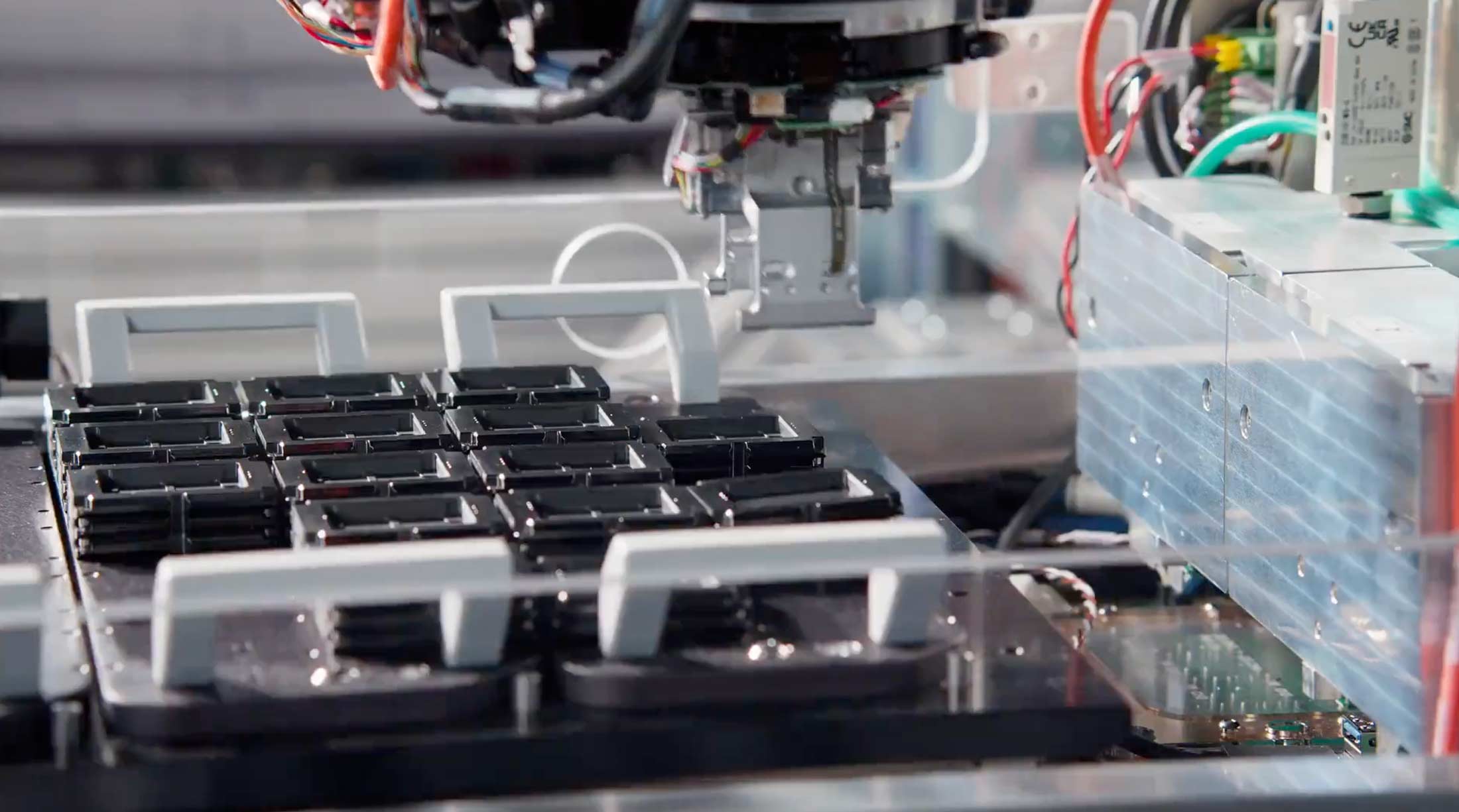
Atomic Machines emerged from stealth on Tuesday with $250 million in funding and a claim that reads like it was pulled from a science fiction novel: a manufacturing system that produces working micro-machines directly from digital instructions, with no molds, masks, or custom process development.
The company calls it the Matter Compiler. The name is borrowed from Neal Stephenson's The Diamond Age, and the ambition is borrowed from nowhere else in the industry. The pitch is that code determines what gets built, the same way code determines what software does. Different file, different machine.
After six years in stealth, Atomic Machines is out. Our mission: on-demand, universal command of matter. First beachhead: the Matter Compiler, an AI-native manufacturing system that builds working micro-machines from code alone. No per-product tooling. No process development. Different code, different machine.
— Jeff Holden (@jeffholden) October 8, 2026
The MEMS Problem
Microelectromechanical systems have been a documented bottleneck for decades. The MEMS industry operates under a maxim it has never been able to escape: one product, one process. Build an accelerometer, and you need a fabrication line tuned to accelerometers. Build a micro-mirror, and you start over. Each new device class has taken years of custom development. As one SEMI analysis put it, "We're still living in a one product-one process world when it comes to MEMS manufacturing."
Atomic Machines argues this was never a physics problem. It was a manufacturing architecture problem. The Matter Compiler is designed as a general-purpose constructor, building three-dimensional machines with moving parts, multiple materials, and features down to single-digit microns. The AI measures and corrects every fabrication step in real time and runs its own experiments on its own hardware to test what simulation proposes.
"3D printing made shapes programmable: any geometry, straight from a file. We're making machines programmable," founder and CEO Jeff Holden said in the company's announcement.
The Founder
Holden joined Amazon as its tenth engineer, built the global supply chain technology, joined the executive S-Team, and delivered Amazon Prime. He later became Uber's first Chief Product Officer, where he founded the Advanced Technology Group (self-driving), led development of Uber Eats, and spearheaded Uber Elevate. He left in 2018 and founded Atomic Machines a year later.
The investor list includes Gigafund, XTX Ventures, Valor Equity Partners, Construct Capital, and the Regents of the University of California. Gigafund's Luke Nosek framed the bet in terms that match the company's rhetoric: "Enabling a world with that kind of creativity and abundance is why Gigafund invested."
First Product
The PrimeSwitch PS-150 is the first device out of the Matter Compiler: a bistable electromechanical relay that opens in 50 microseconds. Conventional contactors take milliseconds. Atomic Machines says the speed difference is roughly a factor of a thousand.
The relay is rated for 150 amps of continuous current and 1,500 volts of galvanic isolation, with on-resistance of 200 micro-ohms. The package measures 9.5 millimeters across and 3 millimeters thick. It holds its state with zero power.
The target is 800-volt DC power distribution in AI data centers. At those voltages, a fault delivers destructive energy in microseconds. Infrastructure for AI compute has outpaced the protection hardware built for slower electrical systems.
PrimeSwitch is shipping to early-access customers for evaluation. The company has not disclosed pricing or the names of those customers. Public demonstration is scheduled for the Open Compute Project Global Summit in San Jose, October 12-15.
Whether the Matter Compiler can produce a second device class with the same ease is the question the company has not yet answered. One relay, however fast, does not prove the thesis. It proves a relay.