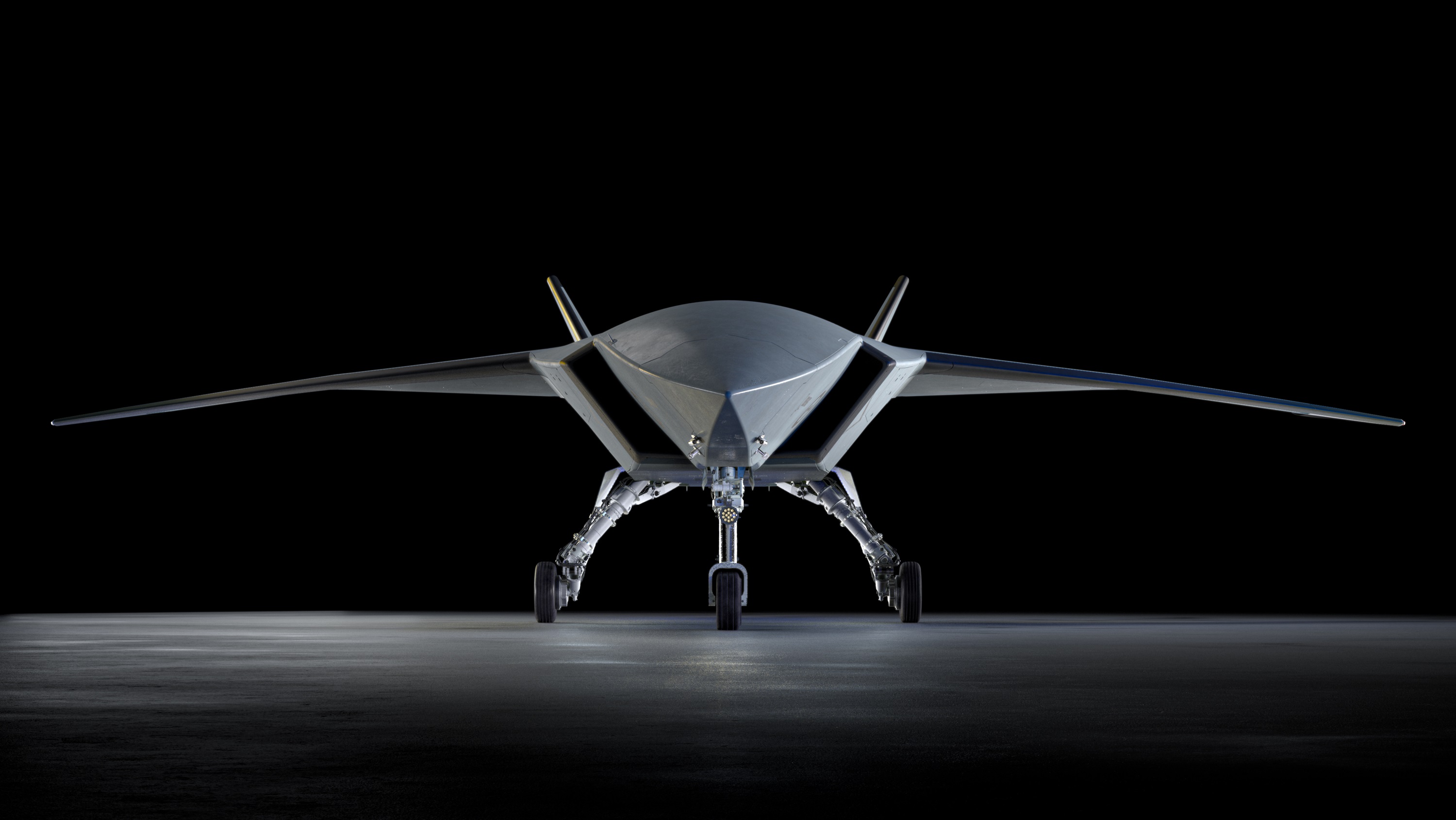
Boeing unveiled a significant capability upgrade for its MQ-28 Ghost Bat at the ILA Berlin Air Show on Tuesday, revealing an enhanced version of the collaborative combat aircraft that can carry an additional 2,000 pounds of fuel, stores, and mission payloads thanks to an increased wingspan. The announcement, timed for a European audience, signals Boeing's intent to turn its Australian-born drone into the CCA of choice for NATO air forces.
The upgraded MQ-28 can now be provisioned to carry two AIM-120 AMRAAM missiles or four small diameter bombs internally. Beyond-line-of-sight communication links will allow operators to control the aircraft from crewed platforms, ground stations, or naval vessels at effectively unlimited standoff distances. According to Glen Ferguson, the MQ-28 global program director, the additional capacity lets operators balance payload and endurance based on mission requirements, whether that means extended range, heavier weapons loads, or some combination of both.
These features were developed in partnership with the Royal Australian Air Force and will roll out through a spiral upgrade program. Boeing says the upgrades build on the MQ-28's validated low-observability characteristics and survivability improvements confirmed in radar cross section testing conducted earlier this month in Brisbane.
✅ >25% larger wing
— Boeing Australia (@BoeingAustralia) June 10, 2026
✅ Increased fuel and payload capacity
✅ Beyond Line of Sight capability
✅ Internal weapons stations for greater mission configurability
MQ-28 Ghost Bat enhancements deliver flexibility, range and capacity advancements.
More: https://t.co/IPZLUy5Qub pic.twitter.com/7EK5fUD11h
The Most Mature CCA in the World?
The MQ-28 began development in 2017 and first flew in 2021. It has since completed more than 150 flights and logged milestones that no other collaborative combat aircraft can claim. In December 2025, a Ghost Bat teamed with a RAAF E-7A Wedgetail and an F/A-18F Super Hornet to autonomously fire an AIM-120 AMRAAM and destroy an airborne target. According to The War Zone, that made the MQ-28 the first unmanned aircraft to fire an AMRAAM. In May, the aircraft conducted three flights from Naval Air Station Point Mugu in California, its first international operations.
This operational maturity is Boeing's core selling point. Glen Ferguson has been direct about it. Speaking at the Singapore Airshow in February, he noted that when Boeing walks potential customers through non-public capabilities, "most of them are blown away at how mature we are."
Australia has invested approximately A$1.4 billion in the program. Following the December live-fire test, Canberra announced contracts for six additional Block 2 aircraft and development of an enhanced Block 3 prototype. The country now has 18 MQ-28s on order, with operational capability targeted for 2028.
Export Ambitions and the German Showdown
Boeing's Berlin announcement was no accident. Germany is preparing to field a collaborative combat aircraft by 2029 as its Tornado fleet nears retirement. In late March, Boeing and Rheinmetall announced a strategic partnership to offer the MQ-28 to the Bundeswehr. Rheinmetall will serve as system integrator, overseeing integration into German command and weapons systems. CEO Armin Papperger sees potential revenue in the hundreds of millions of euros.
The Ghost Bat enters a crowded field. Airbus and Kratos are preparing to fly two XQ-58A Valkyrie aircraft in Germany with European mission systems installed. Helsing and Grob are developing the CA-1 Europa. General Atomics has outlined a CCA offer based on its YFQ-42A Dark Merlin with an industrial footprint near Munich. German Defense Minister Boris Pistorius visited Australia in late March and publicly confirmed the Ghost Bat was under consideration, but stressed no final decision had been made.
Japan has also shown interest, establishing a framework on collaborative combat aircraft activities with Australia in April. The U.S. Navy has deployed a test and evaluation squadron to work on the MQ-28 in Australia, and Boeing is competing for future increments of the U.S. Air Force's CCA program.
The American Competition
The U.S. Air Force's Collaborative Combat Aircraft program is proceeding on a separate track. For the first increment, the service selected Anduril and General Atomics to produce prototype aircraft after an initial competition that also included Boeing, Lockheed Martin, and Northrop Grumman. Both Anduril's YFQ-44A Fury and General Atomics' YFQ-42A Dark Merlin began flight testing in 2025. The Air Force expects to select a winner by the end of 2026.
The American approach differs philosophically. The Air Force CCA program emphasizes affordable mass, with plans to field approximately 1,000 drones to pair with F-35s and future sixth-generation fighters. The MQ-28, by contrast, was designed from the start as a higher-end platform with validated stealth characteristics and modular mission systems.
Boeing is not out of the American competition. The company was selected as one of nine vendors for Increment 2 concept refinement in December, and executives believe the MQ-28's maturity gives them an edge regardless of which increment they ultimately win.
What This Means for the Category
The collaborative combat aircraft category has transitioned from conceptual slides at defense conferences to actual hardware flying actual missions. The MQ-28 has logged more flight hours and demonstrated more operational capabilities than any competitor. But the market is fragmenting along national lines, with each major defense customer weighing operational readiness against industrial base considerations.
Australia's strategic calculus was straightforward: fund a domestic program, build sovereign capability, create high-skill jobs. Germany's will be more complex, balancing the Ghost Bat's maturity against competing offers that promise deeper European industrial participation. The U.S. Air Force, with the largest potential fleet requirement, is pursuing a different architecture entirely.
The MQ-28's Berlin upgrades address specific operational gaps. Internal weapons bays reduce radar signature during strike missions. Extended range matters in the Pacific, where distances dwarf European theaters. Beyond-line-of-sight communications allow the aircraft to operate at ranges where direct datalinks fail. These are the kinds of incremental improvements that distinguish a developmental platform from one that's ready for the fleet.
Boeing is betting that AI-enabled autonomy and robotic systems will reshape air combat in ways that favor first movers with operational experience. The company may be right. But the CCA market is not a winner-take-all proposition. Multiple vendors will supply multiple air forces, each adapting platforms to sovereign requirements. The question is less whether the Ghost Bat will find customers than how many, and whether Boeing can maintain its lead as American competitors catch up.