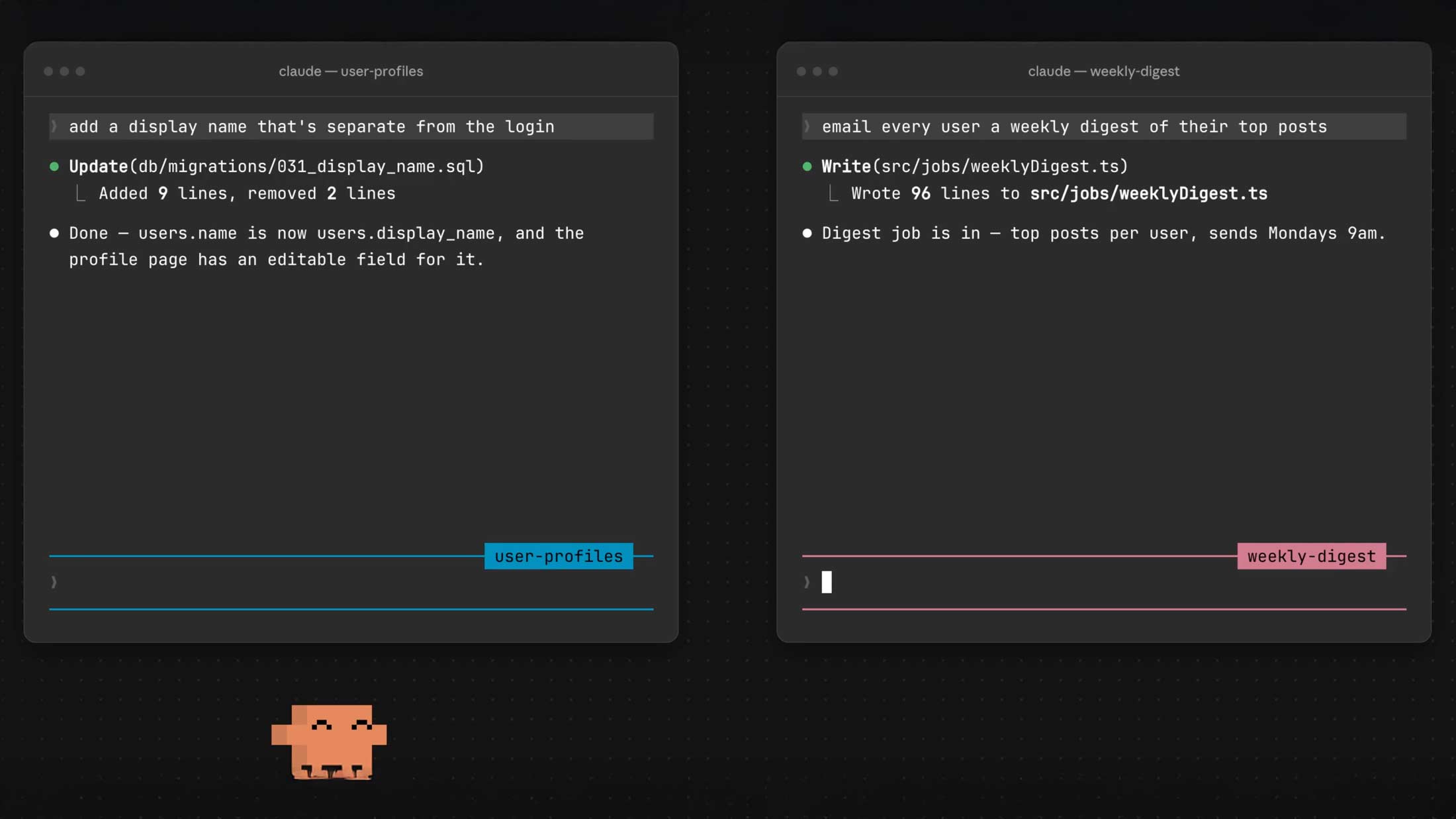
Anthropic released Claude Code v2.1.224 yesterday with a feature that cuts one of the more tedious friction points in agentic coding workflows: sessions can now talk to each other.
The new SendMessage and ListAgents tools allow Claude Code sessions to exchange messages across terminals, projects, and even machines. ListAgents discovers active sessions available for messaging. SendMessage delivers the handoff. The receiving session displays incoming messages as a labeled card with a link back to the sender, so context remains traceable.
What Actually Gets Sent
The messaging system sends summaries, not raw history. No conversation transcripts. No file contents. When you tell Claude to hand off context to another session, it compresses the relevant state into a summary that the receiving session can act on without re-ingesting the full context window. This is the right design choice. Full transcript sharing would create token bloat and raise obvious security concerns around unintended data exposure.
If the receiving session is mid-task, Claude Code holds the message in queue and delivers it once the current work finishes. Claude cannot send messages from or into sessions that nobody is watching, like scheduled task runs. These restrictions exist for safety reasons: cross-session communication creates new vectors for unintended behavior, and Anthropic is clearly aware of that.
Why This Matters
The immediate frustration this solves is familiar to anyone running parallel Claude Code sessions across interdependent projects. A session working on a library discovers a bug that affects a session working on the consuming app. Until now, you were the relay. Copy the issue details from Terminal A, paste into Terminal B, wait for the fix, manually inform Terminal B that the dependency updated. The human becomes a message router between agents that could just coordinate directly.
Agent teams and subagents existed before this, but they operated within a single session's scope. Cross-session messaging is different. It enables what Anthropic's documentation calls "loosely coupled agent teams" that can divide tasks across investigation, implementation, and review while passing results directly without manual transcription.
Mobile Is Where This Clicks
For desktop users, the gains are incremental. But pair this with Remote Control, the synchronization layer that connects your local Claude Code terminal to the Claude mobile app, and the workflow possibilities change shape.
Remote Control connects claude.ai/code or the Claude iOS and Android apps to sessions running on your machine. Code execution stays local. The phone is just a window. With cross-session messaging layered on top, you can now coordinate multiple running sessions from your phone without re-explaining context in each one. Tell one session what you need, have it message the relevant session directly, and review the outcome when you get back to your desk.
This is where exponential productivity claims start sounding less like marketing. Sessions become parallel workers you can dispatch from anywhere. The mental overhead of maintaining context across multiple terminals compresses into a single instruction. Claude handles the handoff summary. The receiving session picks up mid-task. You stay informed without becoming the bottleneck.
Safety Guardrails
Anthropic built safety behaviors into the feature. In auto mode, messages sent to other sessions are evaluated by a permission classifier before dispatch. Sessions running with bypassed permissions hold cross-session messages pending approval via the crossSessionInbound setting. Archived sessions cannot receive messages, and Claude tells you when a delivery fails.
The feature is currently available on macOS and Linux. Support for the broader agent infrastructure ecosystem continues to expand as Claude Code usage grows.
Cross-session messaging shipped alongside other notable additions in v2.1.224, including self-hosted environments via the new claude self-hosted-runner command for Team and Enterprise plans, and expanded sandbox credential-masking options. The changelog lists 31 changes total.