Most flying robots are loud, rigid, and dangerous to touch. Cuddle-Fish, a research project from Keio University in Japan, takes the opposite approach. The soft floating robot uses a helium-filled body and gentle flapping fins to drift through indoor spaces. No propellers, no buzzing, no risk of injury from contact.
The project, led by PhD student Mingyang Xu at Keio's Graduate School of Media Design, has been generating attention in HCI research circles. A follow-up paper titled "Floating Companion: Exploring Design Space for Soft Floating Robots in Indoor Environments" won the Best Paper Award at ACM DIS 2026, the flagship conference for interaction design.
Researchers built a soft floating robot for indoor interaction.
— clankr (@clankrmedia) July 13, 2026
It uses helium and flapping fins instead of propellers.
The result is quiet, lightweight, and safe to touch.
It can follow people, give reminders, and act as a study buddy.
Published at ACM DIS 2026. pic.twitter.com/M2WzvFCoLO
How It Works
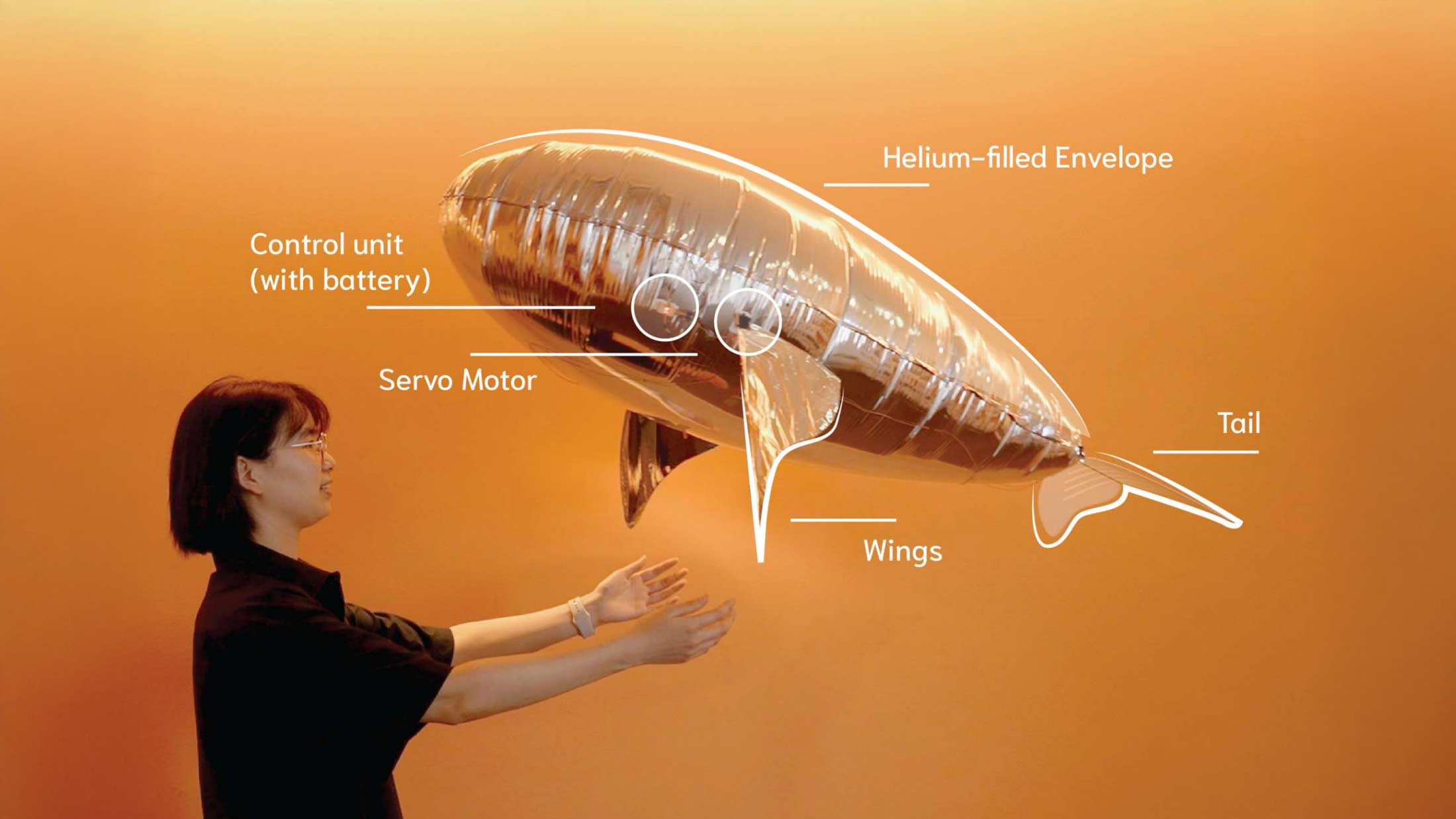
Cuddle-Fish combines three elements: a helium-filled envelope made from aluminum-coated nylon film, two servo-actuated flapping wings for propulsion and maneuverability, and a tail for stability. An internal movable mass shifts the center of gravity to control pitch and altitude. The entire system runs on a 3.7V lithium-polymer battery and an onboard microcontroller.
The robot's wingspan adjusts between 45 and 78 centimeters, small enough to pass through standard doorframes (typically 70-90cm wide). That size constraint matters. Previous lighter-than-air robots from Festo's Bionic Learning Network, like the Air_ray and AirPenguin, stretched over 3.7 meters in length. Impressive demonstrations, but impractical for anyone living in an apartment.
Helium's lifting capacity is limited to about one gram per liter, which forced the team to obsess over weight. The result is something genuinely novel: an aerial robot designed from the ground up for human cohabitation rather than industrial inspection or outdoor surveillance.
People Want to Touch It
In a user study with 24 participants, researchers demonstrated six interaction scenarios where the robot moved near participants. The findings were striking. People not only felt safe around Cuddle-Fish but spontaneously engaged in affective behaviors without prompting. They patted it. They stroked it. Some hugged it. A few touched it to their cheeks.
This runs counter to how people typically respond to flying robots. Quadcopter drones trigger anxiety about crashes and blade injuries. The combination of soft materials, slow wing movements, and bioinspired form seems to bypass those concerns entirely. One researcher involved in the project observed that the design "eliminates the danger of spinning blades while maintaining the ability to move through indoor spaces."
Applications Beyond the Home
The research team has proposed two near-term application scenarios: the robot as a building guide and as a playmate. The building guide concept is particularly interesting for corporate environments.
Imagine walking into a large corporate campus, museum, or hospital. Instead of consulting a kiosk or waiting for a human greeter, a small floating companion drifts toward you. It can lead you to your destination, answer questions, and provide real-time navigation through complex spaces. Unlike a tablet on wheels, it operates at eye level and can navigate stairs, atriums, and multi-story lobbies without infrastructure changes.
The therapeutic potential also warrants attention. Researchers noted that soft floating robots could provide emotional support and companionship, particularly for people who spend significant time alone. Participants in the DIS 2026 study compared the robots to pets, describing them as having a sense of presence, "a sense of a living being in the room."
What Comes Next
Cuddle-Fish remains a research prototype. Battery life, autonomous navigation, and speech integration would all need significant development before commercial deployment. But the core insight has been validated: flying robots can share space with humans if they are designed for touch rather than avoidance.
The home robotics market has been dominated by ground-based platforms. Vacuums, security bots, and the occasional AI companion that rolls around on wheels. Cuddle-Fish suggests a different trajectory. Social robotics research has largely ignored the aerial domain because safety seemed impossible to solve. This team solved it by abandoning propellers entirely.
Whether floating companions become a real product category depends on whether engineers can scale the concept without losing its essential quality: something safe enough to hug.