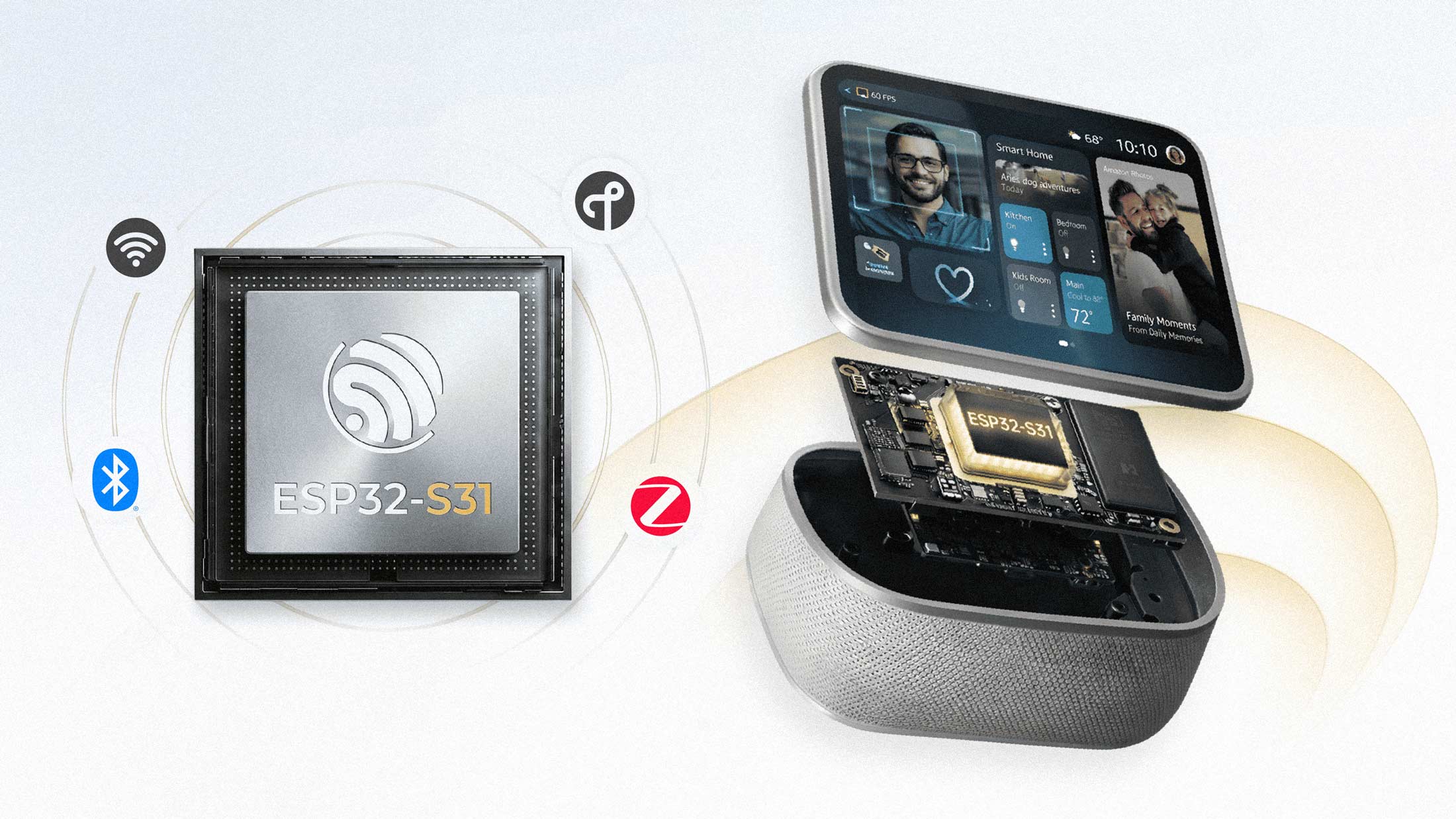
Espressif Systems announced the ESP32-S31 this week, and for the millions of makers, home-automation tinkerers, and IoT product teams who have built on ESP32 silicon over the past decade, this is the most consequential update to the wireless microcontroller line in years. The headline changes are new silicon architecture, the first Wi-Fi 6 support in the family, a return of integrated Ethernet at gigabit speeds, and a rare-for-Espressif pairing of modern Bluetooth Low Energy with Bluetooth Classic.
What Changed Under the Hood
The S31 ships with dual 32-bit RISC-V cores running at 320 MHz, replacing the Xtensa LX7 architecture Espressif has used on the S-series to date. One of the two cores includes a 128-bit SIMD data path, and Espressif cites processing of 6.86 CoreMark per MHz. GPIO count climbs to 60, up from 45 on the ESP32-S3, giving PCB designers notably more headroom for peripherals without needing external expanders.
On-chip memory stays at 512 KB of SRAM, in line with the S3, but the PSRAM interface is considerably faster, supporting 8-bit DDR PSRAM at 250 MHz with concurrent flash access. That combination is aimed at heavier workloads, including on-device inference and audio processing, without starving the main program on memory bandwidth.
Wireless, and a Quiet Return of Ethernet
The wireless stack is the most obvious sales pitch. The S31 supports Wi-Fi 6 in the 2.4 GHz band, up from the Wi-Fi 4 ceiling on the S3. For devices that sleep and wake constantly, the Target Wake Time features in Wi-Fi 6 translate directly into better battery life in crowded networks, which is where most smart-home devices actually live.
Bluetooth jumps to 5.4, with support for both Bluetooth Low Energy and Bluetooth Classic (BR/EDR) in the same chip. That is a meaningful point for audio projects in particular, because it makes the S31 the only part in the current ESP32 lineup that can speak to legacy Bluetooth audio devices while also carrying LE Audio support. IEEE 802.15.4 is also on board, giving native Thread and Zigbee connectivity, with Matter support advertised across both Wi-Fi and Thread radios.
The most underappreciated change is the integrated 1000 Mbps Ethernet MAC. The original ESP32 from 2016 had a 10/100 Ethernet MAC, but Espressif dropped integrated Ethernet entirely when it moved to the S2 and S3 generations. Developers who wanted wired networking on those chips had to bolt on an SPI-connected controller. The S31 brings Ethernet back and goes straight to gigabit, which for anyone building PoE sensors, industrial gateways, or in-wall controllers is more interesting than any of the wireless upgrades.
ESP32-S31 vs. ESP32-S3
| Specification | ESP32-S31 | ESP32-S3 |
|---|---|---|
| CPU Architecture | Dual-core RISC-V | Dual-core Xtensa LX7 |
| Max Clock Speed | 320 MHz | 240 MHz |
| SRAM | 512 KB | 512 KB |
| GPIOs | 60 | 45 |
| Wi-Fi | Wi-Fi 6 (802.11ax) | Wi-Fi 4 (802.11 b/g/n) |
| Bluetooth | 5.4 (LE Audio + Classic) | 5.0 (LE only) |
| IEEE 802.15.4 | Yes (Thread/Zigbee) | No |
| Ethernet MAC | 1000 Mbps (Gigabit) | None (external SPI required) |
| PSRAM Speed | 250 MHz DDR | 80 MHz |
| Matter Support | Yes (Wi-Fi + Thread) | Wi-Fi only |
Security and Peripherals
Espressif has moved its security story forward alongside the connectivity upgrades. The S31 includes RAM-based Physically Unclonable Functions for key generation, secure boot, flash and PSRAM encryption, and a Trusted Execution Environment with Access Permission Management. For makers those features are nice-to-haves. For anyone shipping commercial smart-home products, they are close to table stakes now that Matter certification pulls security requirements to the chip level.
Peripheral support is generous. A high-speed USB OTG controller, a DVP camera interface for 8-to-16-bit sensors, parallel LCD support up to 24-bit, dual I2S for audio, 14 capacitive touch channels, and the usual set of I2C, SPI, UART, ADC, PWM, SDIO, timers, DMA, and TWAI for CAN 2.0 buses. The feature list reads more like a mid-range applications processor than a connectivity MCU, which has been Espressif's trajectory for the last two generations.
Availability and Caveats
Here is where expectations need tempering. Espressif has not published a launch price or retail date. Samples are listed as available through customer support, which in this industry typically means large OEM accounts get parts first and hobbyists wait several quarters for development boards. ESPHome, Arduino, and the broader maker software stack will need time to catch up. Support is promised through Espressif's open-source ESP-IDF, ESP-Matter, and ESP-GMF frameworks.
The S31 also does not replace the ESP32-P4, Espressif's recent high-end applications processor. The P4 ships with MIPI DSI and MIPI CSI interfaces and a hardware H.264 video encoder that the S31 lacks. For projects that need heavier multimedia capability, the P4 remains the answer, even though it has no integrated wireless. For nearly everything else, the S31 is now the most capable wireless SoC Espressif has shipped.
For makers who have been waiting for a single-chip upgrade path that modernizes the wireless stack, restores wired Ethernet, and keeps the familiar ESP-IDF development experience, this is the announcement that justifies the wait. Development boards and clean library support will decide whether it translates into the same level of community adoption the ESP32-S3 has enjoyed.