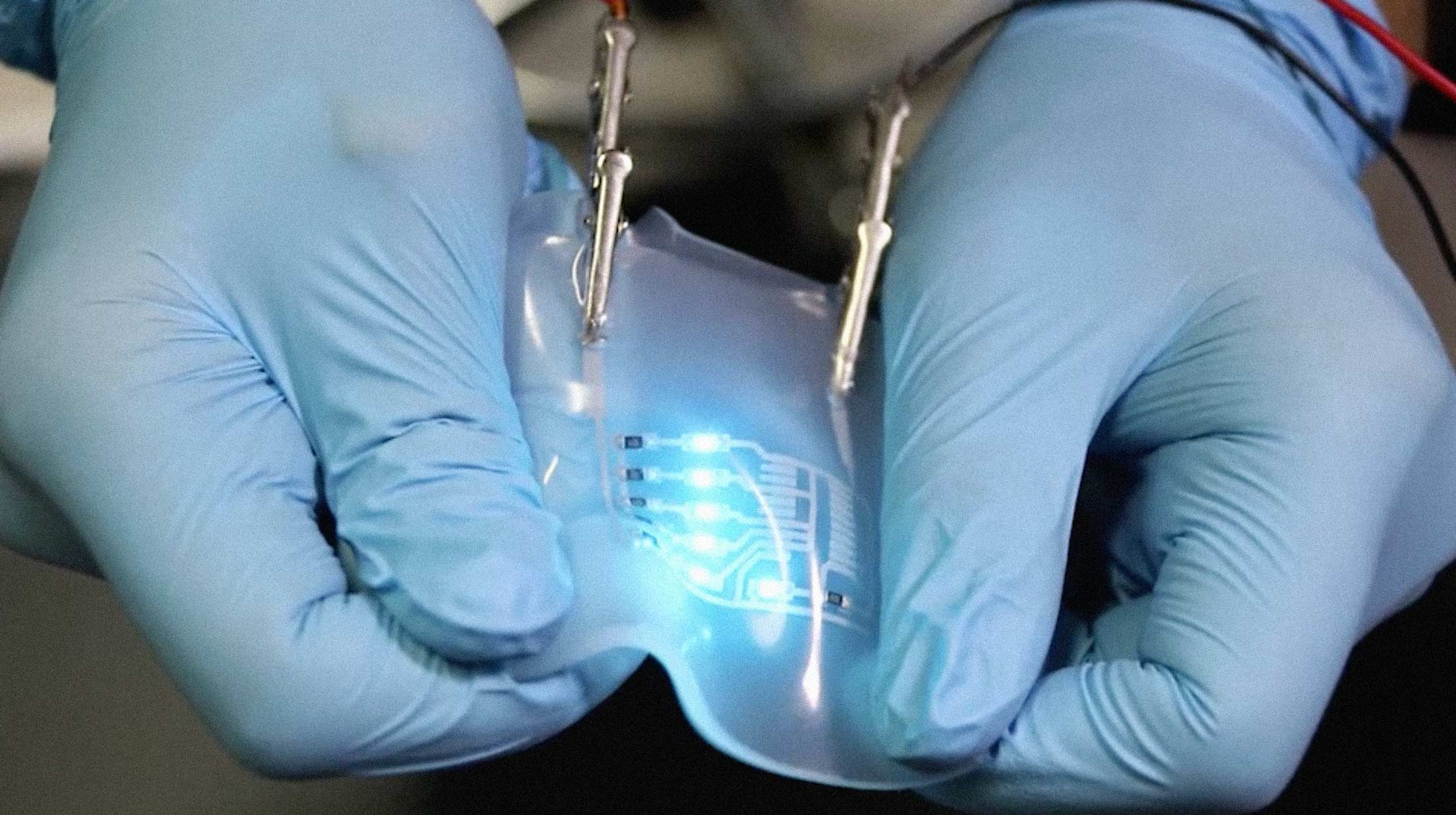
Rigid circuit boards have defined computing for half a century. They work fine when electronics sit flat inside laptops and servers. But humanoid robots bend at the elbow. Wearable devices flex with the wrist. Electronic skin needs to stretch across curved surfaces. The gap between biological motion and silicon stiffness is the bottleneck that flexible polymer circuits are designed to close.
The underlying materials science has matured significantly. Conventional flexible substrates rely on polyimide, polyethylene naphthalate (PEN), and polyethylene terephthalate (PET). These polymers allow thin-film transistors, sensors, and conductors to flex without fracturing. Research from npj Flexible Electronics published in 2025 found that mechanical reliability remains a core challenge: polymer substrates can crack under repeated bending, especially when paired with stiff transparent-conducting oxide electrodes. Interlayer engineering solutions are being developed to mitigate this failure mode.
Stretchable Arduinos and Soft Robots
Yale researchers published a landmark paper in Science Robotics in September 2024 demonstrating stretchable Arduino Pro Minis embedded directly into soft robot bodies. The circuits survived strains exceeding 300%, controlled locomotion in crawling robots, and sensed human arm movements in wearable sleeves. The team used biphasic liquid metal conductors patterned onto tacky silicone substrates. The fabrication process and circuit designs are open-source.
The implications for robotics are direct. Soft robots currently rely on rigid circuit boards placed in low-strain regions or tethered to external computers. Embedding stretchable computation into high-strain locations removes design constraints. The Yale team placed their circuits at the elbow of a wearable sleeve, demonstrating performance under conditions that would destroy conventional boards.
A Material Fix for E-Waste
Flexible electronics face a sustainability problem. Kapton, the workhorse polyimide substrate found in phones, laptops, and aerospace systems, does not melt or dissolve easily. That makes recycling expensive and component recovery nearly impossible. Researchers at MIT, the University of Utah, and Meta published a solution in RSC Applied Polymers in 2024: a photopolymerizable polyimide that hardens in seconds under UV light at room temperature. The material incorporates ester groups in the polymer backbone, allowing dissolution with an alcohol and catalyst solution. Precious metals and microchips can be recovered intact.
The new substrate addresses two problems at once: it enables multilayer circuit architectures without adhesive bonding, and it makes component recycling economically viable. A University of Utah spinoff is commercializing the technology.
AI and Embodied Intelligence
Flexible electronics matter more as AI moves from data centers to physical form factors. Research published in The Innovation in 2025 surveyed flexible electronics in humanoid robot heads, arguing that natural facial expressions require multimodal sensing, flexible actuators, and AI-driven emotional computing. Separate work in Nature Communications found that flexible electronics can reduce artifacts caused by skin movement between wearable robots and human bodies, improving control accuracy for prosthetics and exoskeletons.
The market reflects this convergence. Allied Market Research valued the global flexible electronics market at $26.2 billion in 2022 and projects it will reach $57.3 billion by 2032. Consumer electronics remains the largest segment, but healthcare, automotive, and robotics applications are growing fastest. Flexible sensors, in particular, are forecast to see the highest compound annual growth rate.
Structural Challenges Persist
Manufacturing precision for flexible devices still lags rigid alternatives. Integration density remains limited. Material costs are higher. And durability claims often remain theoretical or confined to proof-of-concept demonstrations. Researchers from Frontiers in Electronics noted in 2024 that ideal flexible substrates need Young's modulus between 1 kPa and 100 MPa to match biological tissue. PDMS (polydimethylsiloxane) offers stretchability up to 1,000%, but its low modulus limits some applications.
Thermal stress presents another constraint. Flexible circuits undergo delamination when exposed to temperature cycles, a consequence of mismatched coefficients of thermal expansion between substrate and conductor layers. Roll-to-roll manufacturing is helping reduce costs, but yield rates are not yet competitive with rigid PCB production.
Polymer-based circuits will not replace silicon inside CPUs anytime soon. But for robots that need to feel their environment, wearables that need to move with their users, and AI systems that need to inhabit physical form factors, flexible electronics are the infrastructure layer that makes embodiment possible. The materials science is catching up to the demand.