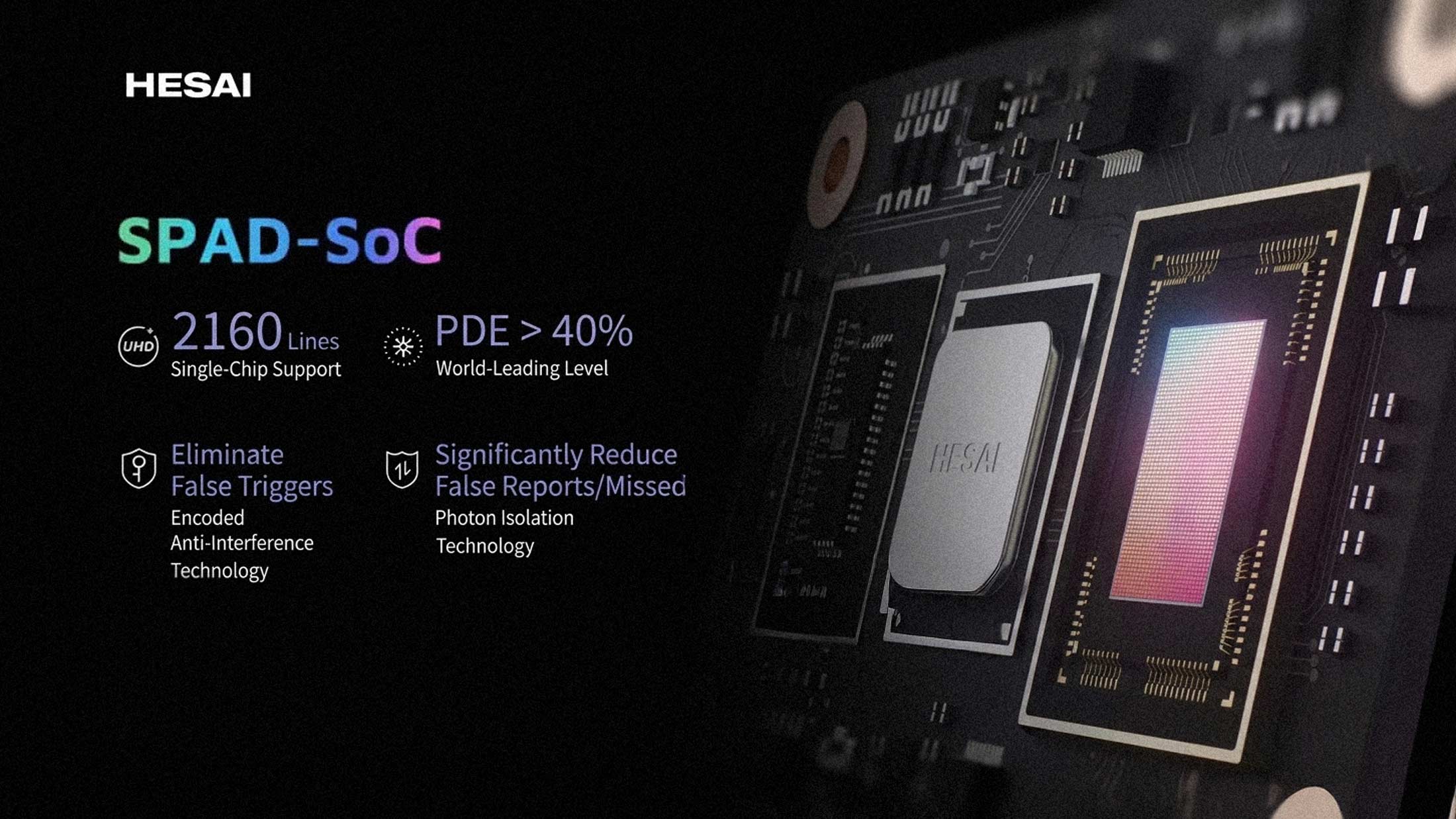
Hesai Technology just announced what might be the most significant advancement in LiDAR since the technology moved beyond laboratory curiosity. The Picasso SPAD-SoC is the world's first chip capable of capturing full-color imagery natively within a LiDAR system, merging spatial positioning with RGB color data in a single sensor array.
What 6D Perception Actually Means
Traditional LiDAR systems excel at measuring distance and mapping environments in three dimensions. They fire laser pulses, measure return times, and construct detailed point clouds of the surrounding world. But they've always been color-blind. To understand what objects actually look like, autonomous systems have needed separate camera systems running in parallel, with complex software stitching together the two data streams after the fact.
The Picasso chip eliminates that entire workflow. Each of its 4,320 channels captures XYZ coordinates and RGB color values simultaneously, producing what Hesai calls native 6D perception. At 4K resolution, the system delivers imaging quality that approaches camera-grade clarity while maintaining the precise distance measurements that make LiDAR essential for navigation.
This is not incremental. It represents a fundamental architectural shift in how machines perceive their environment.
The Sensor Fusion Problem Disappears
Anyone who has followed the autonomous vehicle industry knows that sensor fusion remains one of the hardest problems in the field. Cameras capture rich visual detail but struggle in low light and cannot directly measure distance. LiDAR provides centimeter-accurate spatial data but sees the world in monochrome point clouds. Radar penetrates weather but offers low resolution.
The standard approach layers all three sensor types together, then tasks software with aligning their outputs into a coherent model. This creates latency, introduces potential misalignment errors, and adds significant cost and complexity to every autonomous platform.
Picasso's integrated approach sidesteps these challenges entirely. When color and spatial data arrive from the same sensor at the same moment, there is nothing to align. The computational overhead drops. The potential failure modes shrink. The bill of materials gets shorter.
For robotics companies already working with advanced perception systems, this simplification could accelerate development timelines considerably.
Consumer Applications Start Looking Realistic
LiDAR has lived primarily in industrial and automotive contexts because the sensor packages have been expensive, bulky, and power-hungry. The Picasso chip's system-on-chip architecture suggests Hesai is targeting a different scale of deployment.
Consider home robotics. Vacuum cleaners and lawn mowers already use basic LiDAR for navigation, but they navigate a world without color context. A robot that can distinguish between a red toy fire truck and an actual obstruction makes better decisions. One that can identify a sleeping pet by its visual characteristics rather than just its heat signature operates more safely around families.
Smart home security systems could benefit substantially. Current motion detection cameras struggle with false positives from shadows and lighting changes. A color-aware LiDAR sensor would detect actual intrusions with far greater reliability, measuring the physical presence of a person rather than inferring it from pixel changes.
The close-range vision capabilities that robotics platforms have been chasing become more achievable when the primary sensor can handle both navigation and object recognition duties.
What This Unlocks for Logistics
Hesai showcased the technology at MODEX 2026, the major logistics and supply chain expo. The context matters. Warehouse automation has been constrained by the need for controlled lighting and expensive multi-sensor setups on automated guided vehicles.
A forklift that can read package labels, identify color-coded bin locations, and navigate safely around workers using a single sensor system represents genuine operational simplification. The cost per vehicle drops. The maintenance burden shrinks. The deployment timeline accelerates.
Hesai's safety certifications for AI autonomy applications suggest the company sees industrial logistics as the immediate commercial opportunity, with broader applications following as production scales.
The Picasso chip does not solve every perception challenge in autonomy. But it removes a significant architectural constraint that has shaped system design for a decade. When sensors see in full color by default, the software stack simplifies, the hardware footprint shrinks, and applications that seemed impractical start looking inevitable.