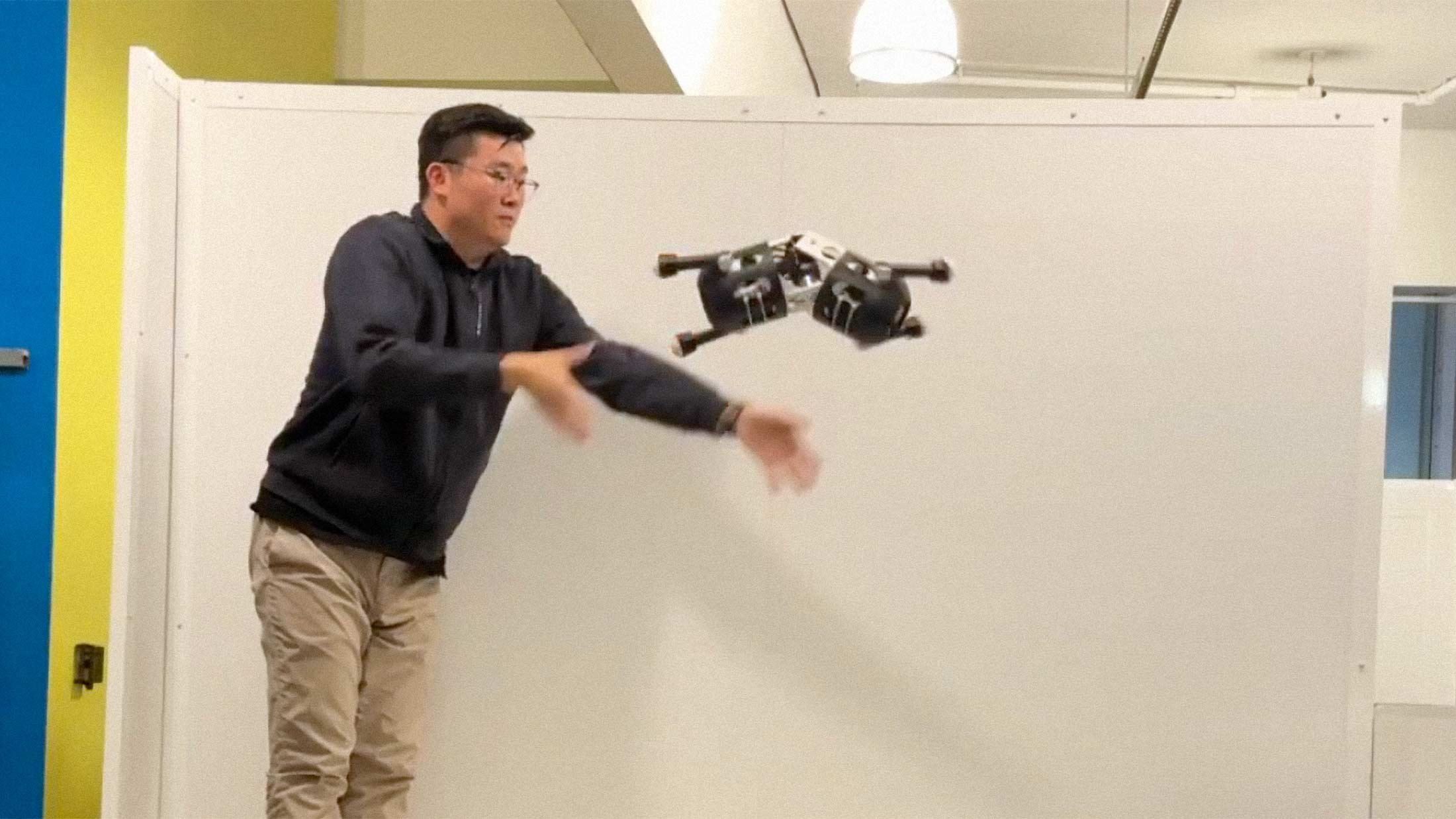
A cat dropped upside-down bends its spine, sweeps the bend around its body, and lands paws-down. The maneuver generates no angular momentum and has puzzled physicists since at least the 1890s. Researchers at MIT's Computer Science and Artificial Intelligence Laboratory have now reproduced the trick in hardware.
The robot, called Felis, divides its body into two segments linked by a motor-driven two-axis universal joint at the waist. Each leg gets a single motor. The total count is six, roughly half the actuator budget of a typical quadruped.
How the Spine Takes Over
Most legged robots keep their trunk rigid and pack all the actuation into their limbs. Felis inverts that logic. By moving the joint complexity into the body, the design offloads work that would otherwise fall to the legs.
When dropped upside-down, the robot twists its waist to reorient in midair. Because the front and rear halves counter-rotate against each other, the system conserves angular momentum while still managing a 180-degree flip. In simulation, the team reports successful landings on all 17 drops tested during sim-to-real transfer.
Zhiyang Dou, a PhD student at MIT CSAIL who leads the project, works in the Computational Design and Fabrication Group under Wojciech Matusik. The research also involves Cynthia Sung, an associate professor in mechanical engineering at the University of Pennsylvania, along with Edward Adelson, Lingjie Liu, and several other collaborators.
Now meet the robot "cat" 😸 MIT CSAIL researchers' feline-inspired robot has an actuated spine, helping it make midair adjustments to land on its feet: https://t.co/NDDNiaiijj https://t.co/r3oxYsnzsR
— MIT CSAIL (@MIT_CSAIL) November 29, 2026
Ground Capabilities
The spine is not purely an aerial trick. On flat surfaces Felis walks forward and backward, turns in place, and jumps. In one demonstration, it even moves in time with music. The team has not disclosed whether these behaviors emerged from the same learned policy used for midair righting or from a separate controller.
The broader claim is straightforward: shifting actuation from the limbs into the body could make legged robots lighter and mechanically simpler. Whether that tradeoff holds up in rough terrain or under heavy payloads remains to be shown.
A technical report is expected soon. The team has already published the control code on GitHub, though the hardware design has not yet appeared. Dou received an Outstanding Systems Paper Award at RSS 2026 earlier this year for related work on neural actuation modeling, and was named a Hasso Plattner Fellow for 2026-2027 by the MIT and HPI AI and Creativity Hub.
The 17-for-17 figure applies only to the simulation environment. Physical drop tests, their heights, and the robot's weight are not documented in the public materials reviewed for this article.