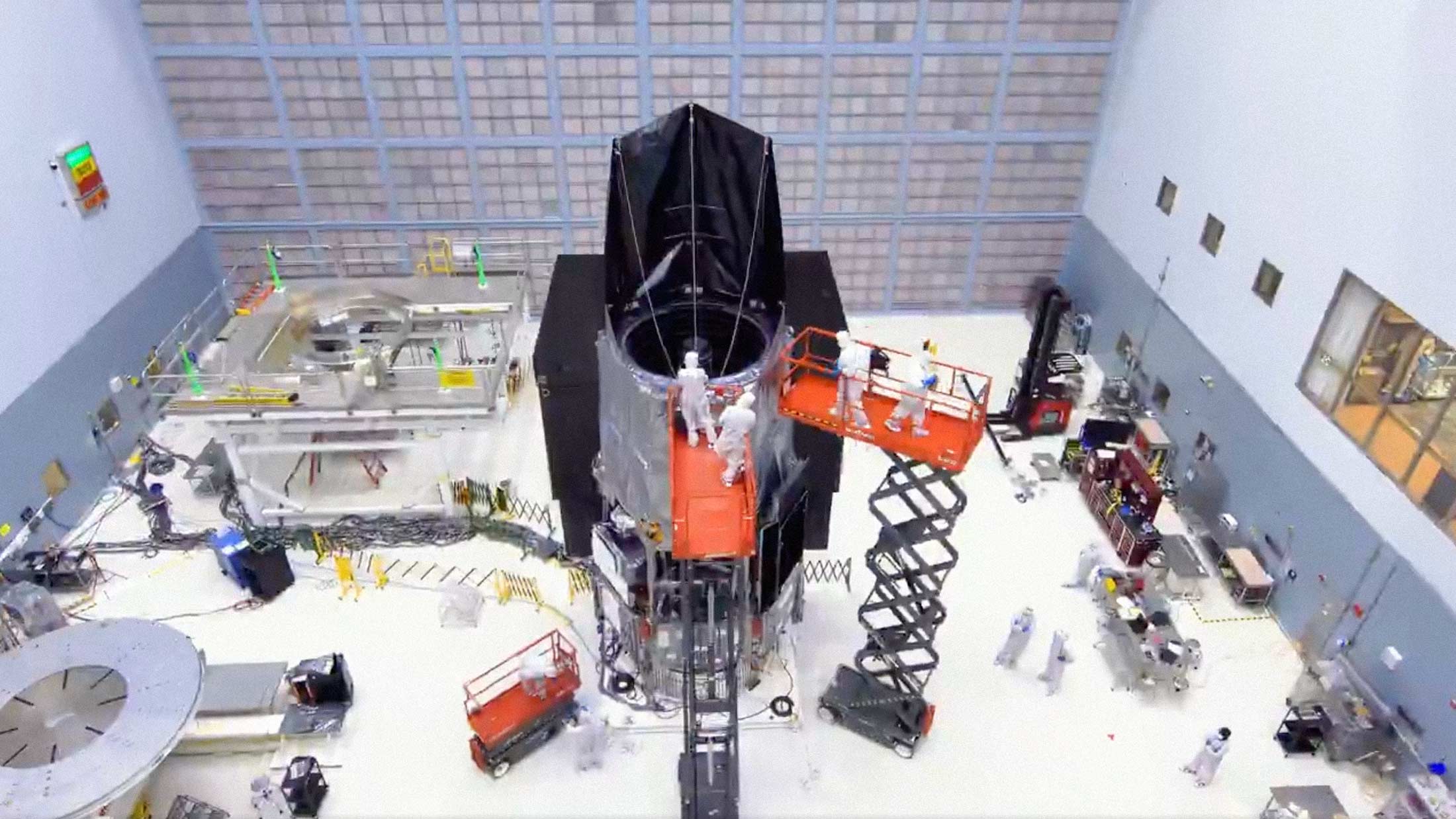
NASA is five days from launching the most ambitious infrared observatory ever built. The Nancy Grace Roman Space Telescope is scheduled to lift off at 7:26 a.m. ET on Sunday, August 30, aboard a SpaceX Falcon Heavy from Launch Complex 39A at Kennedy Space Center. Live coverage begins at 6:20 a.m. ET.
The telescope represents a fundamental shift in how astronomers study the cosmos. Where the Hubble Space Telescope and James Webb Space Telescope provide exquisite detail of individual targets, Roman is built for breadth. Its 300-megapixel Wide Field Instrument captures a patch of sky at least 100 times larger than Hubble's infrared camera in a single exposure, enabling surveys up to 1,000 times faster while maintaining Hubble-class resolution.
Roman shares Hubble's 2.4-meter primary mirror, but the comparison stops there. The telescope will travel to the second Sun-Earth Lagrange point, about one million miles from Earth, where it will join Webb in a stable orbit that keeps the Sun, Earth, and Moon consistently behind it. From that vantage point, Roman will operate for at least five years, with enough fuel for a potential decade of observations.
In under a week, @NASARoman is scheduled to launch 1 million miles away to help us see the big picture of the cosmos.
— NASA (@NASA) August 24, 2026
We’ll be broadcasting Roman’s launch live starting at 6:20am ET (1020 UTC) on Aug. 30. Save the date and set your alarm to join us here! pic.twitter.com/5E8fYmzY4d
What Roman Will Actually Do
The mission targets three categories of cosmic mystery that remain stubbornly unresolved.
Dark energy tops the list. The universe's expansion is accelerating, driven by a force that constitutes roughly 68 percent of its total energy content. Roman will measure shapes and distances of hundreds of millions of galaxies to map how dark energy has influenced cosmic structure over billions of years. These measurements will help determine whether dark energy behaves like a cosmological constant or has evolved over time.
Dark matter comes next. By tracing how mass bends light through gravitational lensing, Roman will reveal how dark matter clusters and influences galaxy formation across enormous regions of sky. The Wide Field Instrument will measure light from over a billion galaxies throughout the mission.
The telescope will also conduct one of the most comprehensive exoplanet searches ever attempted. Using microlensing observations of the Milky Way's central bulge, Roman is expected to discover thousands of new worlds orbiting other stars. According to NASA, the mission will perform a microlensing survey expected to find approximately 2,600 exoplanets.
The Coronagraph: A Technology Demonstration With Stakes
Roman carries a second instrument that could shape the next generation of space observatories. The Coronagraph Instrument is a technology demonstration designed to directly image exoplanets by blocking starlight with unprecedented precision. If successful, it will achieve contrast ratios 100 to 1,000 times better than any coronagraph previously flown in space.
The Coronagraph will not image Earth-like planets. That capability remains beyond current technology. But it will prove the techniques necessary for future missions like NASA's proposed Habitable Worlds Observatory, which would directly search for biosignatures on rocky planets in habitable zones. Roman's coronagraph is the stepping stone.
How Roman Fits With Hubble and Webb
NASA describes Roman as complementary to its existing flagship telescopes rather than a replacement for either. The three observatories occupy different niches. Hubble continues to provide high-resolution views across ultraviolet, visible, and near-infrared wavelengths. Webb peers deeper into the infrared with a much larger 6.5-meter mirror and narrower field of view. Roman maps cosmic landscapes at panoramic scale, identifying targets for the others to examine in detail.
ESA's Euclid, which also orbits at L2, pursues similar dark energy science using complementary methods. Euclid surveys roughly one-third of the sky in optical and infrared light, while Roman's largest survey will probe a smaller area of about 5,100 square degrees with greater depth and precision. The two missions will both contribute 3D maps of the universe to answer fundamental questions about cosmic history.
The Namesake
The telescope honors Dr. Nancy Grace Roman, NASA's first chief astronomer and the first woman to hold an executive position at the agency. Roman joined NASA in 1959 and oversaw programs including the Cosmic Background Explorer and, most consequentially, the Hubble Space Telescope. She convinced Congress to fund Hubble in 1977. Astronomers know her as the "Mother of Hubble." She died in 2018.
Roman once told an audience that she "was told by many people that a woman could not be an astronomer." The telescope that bears her name will generate data freely available to the global scientific community after processing.
The mission arrives eight months ahead of its original schedule. All science data will be public.